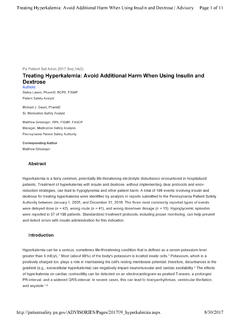
Treating Hyperkalemia: Avoid Additional Harm When Using ...
of hyperkalemia on cardiac contractility can be detected on an electrocardiogram as peaked T-waves, a prolonged PR-interval, and a widened QRS-interval. In severe cases, this can lead to bradyarrhythmias, ventricular fibrillation, and asystole. 1 2 1,2 Treating Hyperkalemia: Avoid Additional Harm When Using Insulin and Dextrose | Advisory Page ...
Download Treating Hyperkalemia: Avoid Additional Harm When Using ...

Information
Domain:
Source:
Link to this page:
Documents from same domain
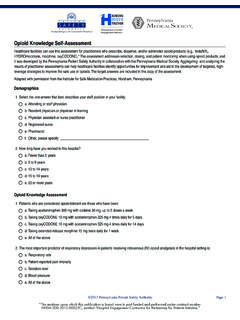
Opioid Knowledge Self-Assessment
patientsafety.pa.govOpioid Knowledge Self-Assessment Healthcare facilities can use this assessment for practitioners who prescribe, dispense, and/or administer opioid products ...
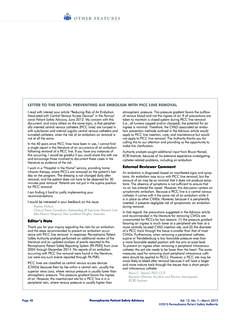
Letter to the Editor: Preventing Air Embolism with PICC ...
patientsafety.pa.govletter to the editor: preventing air embolism with picc line removal I read with interest your article “Reducing Risk of Air Embolism Associated with Central Venous Access Devices” in the Pennsyl-
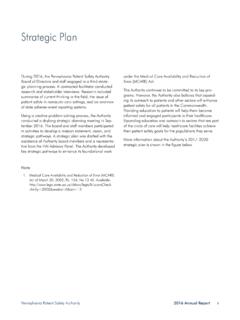
Strategic Plan 2017-2020 - Patient Safety Authority
patientsafety.pa.govStrategic Plan During 2016, the Pennsylvania Patient Safety Authority Board of Directors and staff engaged in a third strate- ... Strategic Plan 2017–2020 VISION Safe healthcare for all patients MISSION Improve the quality of healthcare in Pennsylvania by collecting and

PATIENT SAFETY: COLOR BANDING Standardization and ...
patientsafety.pa.govColor-banding policy will need to be reviewed and approved. Hospitals need to review their respective forms for need of modifications (pt. ed, assessments, etc.) ... • Color Code – Intent of Specific Colors • Authority for Application of band • Process for Band Confirmation • Inter-Dept./Agency Communication
Confirming Feeding Tube Placement: Old Habits Die Hard
patientsafety.pa.govMore Reliable Methods to Verify Feeding Tube Placement Radiographic Confirmation of Nasogastric Tube Placement The gold standard for nasogastric feeding tube placement is radiographic confirmation with a chest x-ray. pretations by nonradiologists: The gold standard for nasoenteric feeding tube placement is radiographic confir-
The Beers Criteria: Screening for Potentially ...
patientsafety.pa.govhepatic clearance of many drugs, such as diazepam, amitriptyline, and chlordiazepoxide, carried out by the cytochrome P-450 system often diminishes with age. Overall, the clearance of drugs metabolized by the liver is typically decreased 30 to 40% in the elderly. Renal size and renal blood flow also decrease signifi-cantly with age.
Safety in Using Promethazine (Phenergan)
patientsafety.pa.gov©2007 Pennsylvania Patient Safety Authority Page 1 Produced by ECRI Institute & ISMP under contract to the Patient Safety Authority Patient Safety Advisory F irst approved by the U.S. Food and Drug Ad-ministration (FDA) in 1951, promethazine (Phenergan) is a medication in common use today. However, despite its familiarity, its use is not with-
PATIENT SAFETY AUTHORITY AND DEPARTMENT OF HEALTH
patientsafety.pa.gov12. A mid-procedure change in the plan of care in response to new information discovered during the procedure does not constitute an injury. 13. Additional healthcare services: a. Healthcare services provided to prevent an injury from occurring are excluded from this term for the purpose of Serious Event determinations. b.
Brochure Medical Records - Pennsylvania Patient Safety ...
patientsafety.pa.govrecord. In the future, when medi-cal records are requested by other providers, your provider must include his denial of your request to amend the medical record as well a copy of your statement of disagreement. It should not take more than 90 days to amend your medical records. If the request is accepted,
Retained Surgical Items: Events and Guidelines Revisited
patientsafety.pa.govand the Association of periOperative Registered Nurses published guidance for preventing RSIs, including minimizing distractions and participating in team-work training. The Joint Commission speaks to the role of weak or absent organizational leadership as reasons for the continuance of RSIs. (Pa Patient Saf Advis 2017 Mar;14[1]:27-35.)
Related documents
Lab Values: Interpreting Chemistry and Hematology for ...
lms.rn.comMar 30, 2012 · Hyperkalemia: Clinical Picture Clinical signs and symptoms of hyperkalemia include: • ECG changes: tachycardia, widened QRS, peaked T waves, lengthening of PR interval, P wave difficult to identify, ventricular fibrillation • Decreased urine output • Lethargy • Decreased muscle tone, muscle cramps Treatment is of the underlying c ause(s).

Rapid Sequence Intubation: Medications, dosages, and ...
med.umkc.eduRapid Sequence Intubation: Medications, dosages, and recommendations !! ! Timeline’of’Rapid’Sequence’Intubation! S!!!!! 1. Preparation!–!Assemble!all ...

Aldactone - Food and Drug Administration
www.accessdata.fda.govSevere heart failure: The Randomized Aldactone Evaluation Study (RALES) ... Dosing could be withheld for serious hyperkalemia or if the serum creatinine increased to ... For the management of edema and sodium retention when the patient is only partially responsive to, or is …

GET WITH THE GUIDELINES - American Heart Association
www.heart.orgminimize risk of hyperkalemia and renal insufficiency (Level of Evidence: A) ... tartrate on morbidity and mortality in patients with mild to severe chronic heat failure and reduced LV ejection fraction” ... management of heart failure. Circulation, 62, e240-e327.

DRUG NAME: Pazopanib - BC Cancer
www.bccancer.bc.cahyperkalemia (27%, severe 4%) nervous system dysgeusia (8%) headache (10%, severe 0%) ... AGENT EFFECT MECHANISM MANAGEMENT . esomeprazole. 7. pazopanib bioavailability reduced by ~40% (AUC, Cmax); reduced systemic exposure of pazopanib metabolites pH-dependent solubility
Critical Care Descriptors-1 - MedData
www.meddata.comCHF severe BiPAP (elevated pCo2 > than 60) (Respiratory Acidosis) ... Hyperkalemia Key indicators are treated with (calcium, bicarb and/or insulin and D50W) ... Signs of Aggressive Management • IV anti-arrhythmics: Adenosine, Atropine, Cardizem
Potassium Disorders: Hypokalemia and Hyperkalemia
www.aafp.orgSep 15, 2015 · kidney disease, hyperglycemia, and medication use are common causes of hyperkalemia. When severe, potassium ... and management of …
The management of cardiac arrest - ALSG
www.alsg.orgTHE MANAGEMENT OF CARDIAC ARREST 49 Asystole This is the most common arrest rhythm in children, because the response of the young heart to prolonged severe hypoxia and acidosis is progressive bradycardia leading to asystole. The ECG will distinguish asystole from ventricular fibrillation, ventricular tachycardia and pulseless electrical activity.

Tumor Lysis Syndrome (TLS) in Adult Patients Page 1 of 7
www.mdanderson.orgAug 17, 2021 · Severe Dialysis may be needed in severe cases Hypocalcemia (calcium ≤ 7 mg/dL or ionized calcium ≤ 0.8 mmol/L) ... Abnormality Management Recommendations Hyperkalemia Moderate (potassium 6 mEq/L – 7 mEq/L) and asymptomatic
UPHS Post Cardiac Arrest Targeted Temperature …
www.med.upenn.eduManagement Trial) suggested no difference in survival and neurological outcomes when TTM at 33°C was compared with TTM of 36ºC. Authors of this study listed several limitations that could ... hyperkalemia or severe hepatic insufficiency exists. 4 a. Patients with clinical conditions such as ARDS, significant pulmonary edema, or