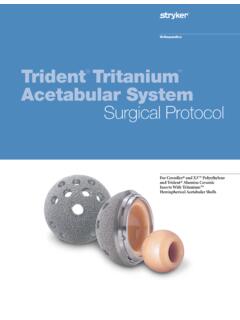
Trident Tritanium Acetabular System Surgical Protocol
Surgical Protocol Indications • Painful, disabling joint disease of the hip resulting from: degenerative arthritis, rheumatoid arthritis, post-traumatic arthritis or late stage avascular necrosis. • Revision of previous unsuccessful femoral head replacement, cup arthroplasty or other procedure. • Clinical management problems where
Download Trident Tritanium Acetabular System Surgical Protocol

Information
Domain:
Source:
Link to this page:
Documents from same domain

System 8 - Stryker MedEd
www.strykermeded.comMeet Stryker’s System 8 power tools An award-winning design, made even better Deliberate, substantive changes give System 8 handpieces improved ergonomics, and give you a better wrist position and
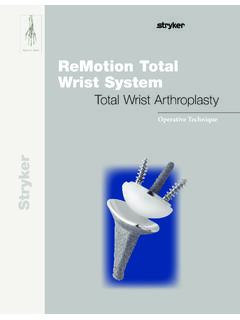
ReMotion Total Wrist System - Stryker MedEd
www.strykermeded.com4 Introduction The ReMotion Total Wrist System implant is a prosthesis anatomically designed for minimal resection of the distal radius and carpal bones of the
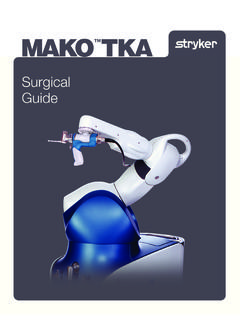
210469 TKA Robotic Surgical Technique - Stryker …
www.strykermeded.comMako TKA Surgical Guide 2 Governing Law Any legal action or proceeding relate d to this manual or the information contained in it shall be brought exclusively in a court in Bergen County, New Jersey, and shall be governed by the laws of the State of
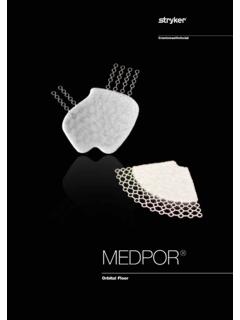
MEDPOR - Stryker MedEd
www.strykermeded.comIllustrations are not actual size. Please consult dimensional descriptions. Available in a variety of shapes, sizes, and configurations, MEDPOR and MEDPOR TITAN
Surgical Technique - Stryker MedEd
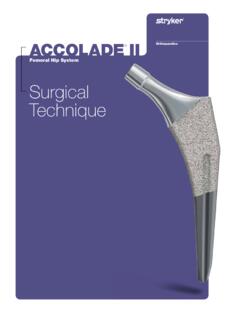
www.strykermeded.com4 ACCOLADE II SurgICAL tECHnIquE 5 The ACCOLADE II Hip System is a broach only system. While use of an axial starter reamer is needed, use of cylindrical reamers is not necessary to prepare the femoral canal. The Axial Starter Reamer is used with the T-Handle to open the femoral canal and to aid in determining the orientation of the femoral axis.
T2 Supracondylar Nailing System - Stryker MedEd
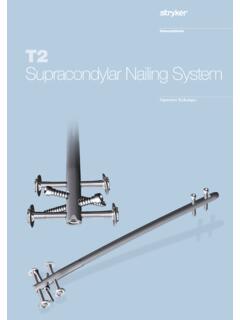
www.strykermeded.comimplants for internal fixation of the femur. According to the fracture type, the system offers the option of a static locking mode with 3 plane fixation. The design of the T2 SCN System is universal for left and right indications. Two implant versions are available: • Short version: Proximal Targeting via Target Device • Long version:
Hip Fractures
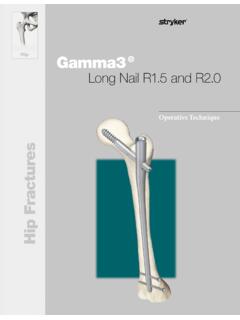
www.strykermeded.com• Antecurvature radius R1.5m and R2.0m of the shaft • Distal locking holes (round and oblong) for 5mm screws; up to 5mm dynamization is possible Long Nail Distal Locking Options • Locking in the distal part of the oblong hole creates a dynamic locking mechanism − requires only one screw (see Fig. 2).

Accolade System SurgicalTechnique - Stryker MedEd
www.strykermeded.com6020-0030* 0 86mm 30mm 33mm 6020-0130 1 110mm 30mm 34mm 6020-0230 2 115mm 30mm 35mm 6020-2530 2.5 118mm 30mm 36mm 6020-0335 3 120mm 35mm 39mm 6020-3535 3.5 124mm 35mm 39mm 6020-0435 4 125mm 35mm 40mm 6020-4535 4.5 129mm 35mm 41mm 6020-0537 5 130mm 37mm 44mm 6020-5537 5.5 133mm 37mm 45mm 6020-0637 6 135mm …

Surgical Technique - Stryker MedEd
www.strykermeded.comacetabular preparation. Depending on acetabular bone quality, the surgeon may choose to ream line-to-line. trident Hemispherical: Full surgical technique details can be found in LSP69. Under-reaming by 1 to 2 mm of the actual Trident Hemispherical shell size is recommended to achieve interference fit. trident psl: Full surgical technique details

Hoffmann 3 - Stryker MedEd
www.strykermeded.comPins. It is intended to provide stabilization of open and/or unstable fractures and where soft tissue precludes the use of other fracture treatments such as IM nailing or casting or other means of internal fixation. The indications for use of external fixation devices include: • Bone Fracture Fixation • Osteotomy • Arthrodesis
Related documents
Non-Operative Rotator Cuff Tear Protocol
www.sosmed.orgprotocol. J Shoulder Elbow Surg. 2009 Jan-Feb;18(1):138-60. doi: 10.1016/j.jse.2008.06.004. Epub 2008 Oct 2. Kukkonen J, Joukainen A, Aärimaa V, et al. Treatment of non-traumatic rotator cuff tears: A randomised controlled trial with one-year clinical results.
Corey A. Wulf, MD NON-SURGICAL ROTATOR CUFF TEAR ...
tcomn.commay require surgical intervention this protocol provides you with general guidelines for the non-surgical rehabilitation of the patient with a full-thickness rotator cuff tear. specific changes in the program will be made by the physician as appropriate for the individual patient.
ANTERIOR CRUCIATE LIGAMENT (ACL) POST-‐OP …
universityorthopedics.comPROTOCOL The following is a protocol for postoperative patients following ACL reconstruction. The primary goal of this protocol is to protect the reconstruction while steadily progressing towards and ultimately achieving pre-‐injury level of activity. Please note this protocol
ADULT ELECTROLYTE REPLACEMENT PROTOCOLS
www.surgicalcriticalcare.netprotocol or policy, nor are intended to replace clinical judgment or dictate care of individual patients. 1 Approved 05/29/01 Revised 01/14/08 ADULT ELECTROLYTE REPLACEMENT PROTOCOLS SUMMARY Standing electrolyte replacement protocols are available for use in adult patients admitted to Orlando Regional Healthcare hospitals.

Clavicle Fracture Rehabilitation Protocol
www.justingriffinmd.comCLAVICLE FRACTURE REHABILITATION PROTOCOL RANGE OF MOTION IMMOBILIZER EXERCISES PHASE I 0-6 weeks 0-4 weeks: None 4-6 weeks: begin PROM Limit flexion to 90°, external rotation to 45°, extension to 20° 0-4 weeks: Immobilized at all times day and night Off for hygiene and gentle exercise only 0-4 weeks: elbow/wrist ROM, grip
Outpatient Procedure Component Surgical Site Infection ...
www.cdc.govThese ASCs will use this protocol for surveillance of surgical patients receiving an eligible NHSN outpatient procedure (Table 1). Reporting Plan . A facility may choose to perform surgical site surveillance “in-plan” or “off-plan” for any of the NHSN
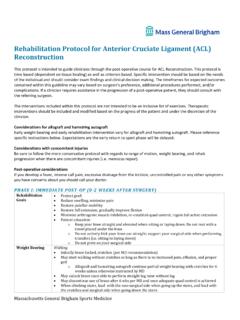
Rehabilitation Protocol for Anterior Cruciate Ligament ...
www.massgeneral.orgRehabilitation Protocol for Anterior Cruciate Ligament (ACL) Reconstruction This protocol is intended to guide clinicians through the post-operative course for ACL Reconstruction. This protocol is time based (dependent on tissue healing) as well as criterion based. Specific intervention should be based on the needs

ACHILLES TENDON REPAIR
www.beaconortho.comPOST-SURGICAL REHABILITATION PROTOCOL . POST-OP DAYS 1 – 10 •Brace/Splint – Watch for skin breakdown •Crutches – non weight bearing (NWB) •Active motion (AROM) hip and knee •Wiggle toes •Straight leg raise (SLR) x 4 •Lower extremity (LE) stretches – Hamstring, quads, ITB, hip flexors •Ice and Elevation. GOALS •Pain ...
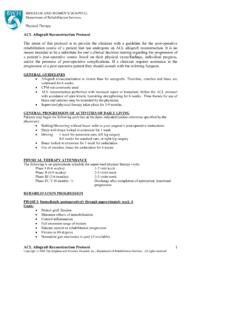
Knee - ACL Allograft Protocol
www.brighamandwomens.orgThe intent of this protocol is to provide the clinician with a guideline for the post-operative rehabilitation course of a patient that has undergone an ACL allograft reconstruction. It is no means intended to be a substitute for one’s clinical decision making regarding the progression of
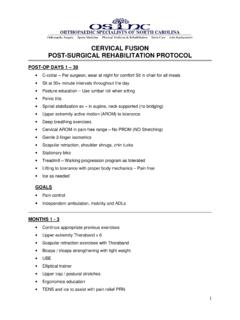
CERVICAL FUSION POST-SURGICAL REHABILITATION …
orthonc.comPOST-SURGICAL REHABILITATION PROTOCOL POST-OP DAYS 1 – 30 • C-collar – Per surgeon, wear at night for comfort Sit in chair for all meals • Sit at 30+ minute intervals throughout the day • Posture education – Use lumbar roll when sitting • Pelvic tilts • Spinal stabilization ex – in supine, neck supported (no bridging)