
UDL Guidelines Checklist
Allow learners to participate in the design of classroom activities and academic tasks Involve learners, where and whenever possible, in setting their own personal academic and behavioral goals Checkpoint 7.2 - Optimize relevance, value, and authenticity Vary activities and sources of information so that they can be:
Download UDL Guidelines Checklist

Information
Domain:
Source:
Link to this page:
Documents from same domain
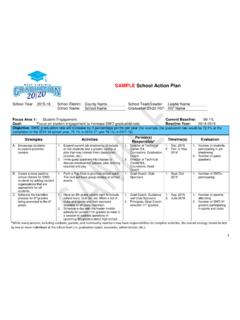
SAMPLE School Action Plan - West Virginia …
wvde.state.wv.usSAMPLE School Action Plan 4 D. Improve school climate to keep at-risk SWD engaged. 1. Participate in School Climate Survey, with SWD participation.
Section 5 Identifying Strengths and Weaknesses
wvde.state.wv.usSection 5 Identifying Strengths and Weaknesses ... SCREENING FOR BARRIERS AND SPECIAL LEARNING NEEDS ... IDENTIFYING RESOURCES AND ADDRESSING BARRIERS 7
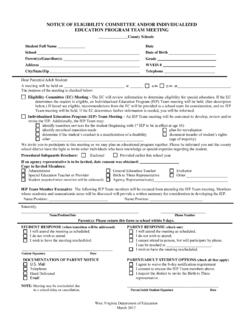
NOTICE OF ELIGIBILITY COMMITTEE AND/OR …
wvde.state.wv.usWest Virginia Department of Education March 2017 NOTICE OF ELIGIBILITY COMMITTEE AND/OR INDIVIDUALIZED EDUCATION PROGRAM TEAM MEETING _____County Schools
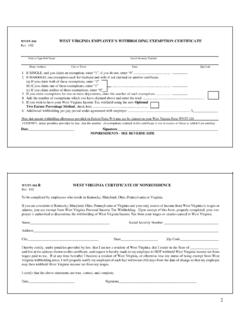
WEST VIRGINIA EMPLOYEE’S WITHHOLDING …
wvde.state.wv.us2 Date_____ Signature_____ NONRESIDENTS - SEE REVERSE SIDE
West Virginia Side by Side Summary of Key Requirements of ...
wvde.state.wv.usThe side-by-side format is provided, so that users can see where local programs have common ground on which to build collaborations. • The legal requirements of these three (3) agencies are seen as compatible and conducive to
The Creative Curriculum Developmental Continuum
wvde.state.wv.usThe Expanded Forerunners of The Creative Curriculum® Developmental Cont nuum for Ages 3–5 Thanks to Whit Hayslip and Karen Krische for their leading role in the development of the Expanded Forerunners of The Creative Curriculum ® Developmental Continuum for Ages 3–5.
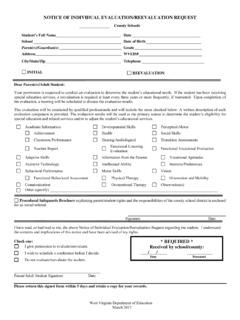
Individual Evaluation/Reevaluation Request
wvde.state.wv.usFunctional Listening Evaluation – assess how a student’s listening abilities are affected by noise, distance and visual input in the student’s natural listening environment Information from the Parents – acquisition of information from the parents to assist in evaluation and program planning.
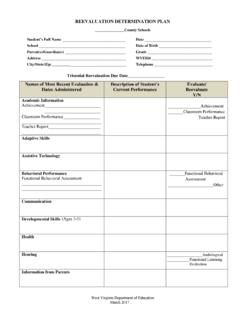
REEVALUATION DETERMINATION PLAN
wvde.state.wv.usREEVALUATION DETERMINATION PLAN ... Functional Behavioral Assessment ... Information from Parents _____Audiological _____ Functional Listening Evaluation (Ages 3-5) CONTINUE Names of Most Recent Evaluation & Dates Administered Description of Student’s Current Performance ...
Educator Evaluation Pilot - wvde.state.wv.us
wvde.state.wv.usEducator Evaluation Pilot - Guide 1 ... guide student learning. Educator Evaluation Pilot - Guide 9 Standard 2 – The Learner and the Learning Environment 2.1 The teacher understands and responds to the unique characteristics of learners.
West Virginia’s Consolidated State P lan
wvde.state.wv.usWest Virginia Department of Education B-318, 1900 Kanawha Blvd. E Charleston, WV 25305 By signing this document, I assure that: Telephone: (304) 558-0200 Email Address mlblatt@kl2.wv.us To the best of my knowledge and belief, all information and data included in this plan are true and correct.
Related documents
Common Core State StandardS
www.corestandards.orgCommon Core State StandardS for matHematICS I ntrod UC t I on | 3 Introduction Toward greater focus and coherence Mathematics experiences in early childhood settings should concentrate on (1) number (which includes whole number, operations, and relations) and (2) geometry, spatial relations, and measurement, with more mathematics learning
Grade K-5 Mathematics Standards
www.georgiastandards.orgMathematics is the economy of information. The central idea of all mathematics is to discover how knowing some things well, via reasoning, permit students to know much else—without having to commit the information to memory as a separate fact. It is the connections, the reasoned, logical connections that make mathematics manageable.
Michigan Math Standards
www.michigan.govMathematics Learning in Early Childhood, National Research Council, 2009 . The composite standards [of Hong Kong, Korea and Singapore] have a number of features that can inform an international benchmarking process for the development of K–6 mathematics standards in the U.S. First, the composite

Curriculum for Upper Primary Classes (VI – VIII
www.cisce.orgSequential arrangement of learning experiences ( Spiralling) An attempt has been made in this curriculum to design a sequential arrangement of learning experiences, that will provide a spiral of cumulative learning. As they progress through classes, children will revisit certain topics or themes several times, but the depth and

An overview of dyscalculia - ed
files.eric.ed.gov• Photocopy mathematics books, which are generally difficult to read because of the interspersement of diagrams, tables, and charts, with the relevant sections placed in a more sequential order. • Separate multi-step problems into small, manageable steps. • Use a line reader, if available, to highlight a line of work and fade the
Teaching place-value - ed
files.eric.ed.govTeaching place-value: Concept development, big ideas and activities Introduction Working as a mathematics education consultant in schools, both as a system-based advisor and private consultant, I am regularly asked to support teachers to work with students who do not understand place value. As reported by other researchers including Rogers (2013),

Draft Primary Curriculum Framework - NCCA
ncca.iestrong foundatoi n for teaching and learning . Among the curriculum’s many successes have been children’s enjoyment of learning and teachers’ increased use of active learning methodologies, as well as improved attainment levels in reading, mathematics and science as evidenced in national and international assessments .