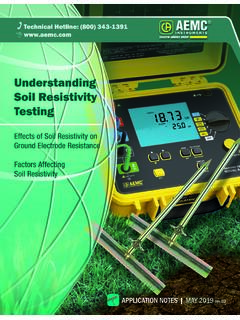
Understanding Soil Resistivity Testing - AEMC
Soil Resistivity Testing Soil resistivity measurements have a threefold purpose. First, data is used to make sub-surface geophysical surveys as an aid in identifying ore locations, depth to bedrock and other geological phenomena. Second, resistivity has a direct impact on the degree of corrosion in underground pipelines. A decrease in
Download Understanding Soil Resistivity Testing - AEMC

Information
Domain:
Source:
Link to this page:
Documents from same domain
Understanding Insulation Resistance Testing - AEMC
www.aemc.comthe differences in readings (see curves, Figure 2). Tests by this method are sometimes referred to as absorption tests. Good insulation shows a continual increase in resistance (see curve D) over a period of time (in the order of 5 to 10 minutes). This is caused by the absorption; good insulation shows this charge effect over a time period much
Three-Phase Dual-Voltage Motor Insulation Resistance …
www.aemc.comLow Voltage 1,7 2,8 3,9 4&5&6 High Voltage 1 2 3 4&7, 5&8, 6&9 In this case, high-voltage connections are the same as for delta motors. The wiring diagram for a wye connected 9-lead motor is as follows: Wye connected 9-lead wiring diagram Note that the wye-connected 9-lead motor’s internal connections vary from the delta motor.

Fall-of-Potential Testing with the Ground Resistance ...
www.aemc.comResistance Tester Model 3640, the simplest and easiest to use member of our Ground Resistance Tester product family. This direct reading instrument measures ground resistances from 10 milliohms up to approximately 2000 ohms at the push of a button – no
Related documents
2. Electrical resistivity methods
personales.upv.es2. Electrical resistivity methods The resistivity method is used in the study of horizontal and vertical discontinuities in the electrical properties of the ground. It utilizes direct currents or low frequency alternating currents to investigate the electrical properties (resistivity) of the subsurface.
Standard Test Methods for DC Resistance or Conductance of ...
www-eng.lbl.gov3.1.11.1 Discussion—Volume resistivity is usually ex-pressed in ohm-centimetres (preferred) or in ohm-metres. Volume resistivity is the reciprocal of volume conductivity. 4. Summary of Test Methods 4.1 The resistance or conductance of a material specimen or of a capacitor is …

17. RESISTIVITY THEORY 17.1 Introduction 17.2 Basic ...
homepages.see.leeds.ac.ukcentigrade. Clearly, if the BHT is 200oC, the increase in the resistivity of the formation fluids can be as much as 800%. This will cause the resistivities measured with downhole tools to increase steadily down the borehole. To avoid this added complication all downhole resistivity measurements are

TECHNIQUES FOR MEASURING RESISTIVITY FOR MATERIALS ...
download.tek.comTo simplify measurements, the 4200A-SCS Parameter Analyzer comes with a project that contains tests for making resistivity measurements using a four-point collinear probe. The 4200A-SCS can be used for a wide range of material resistances including very high resistance semiconductor materials because of its high input impedance (>1016 ohms).
Surface Resistivity and Surface Resistance Measurements
www.advancedenergy.comSurface Resistivity and Surface Resistance Measurements Using a Concentric Ring Probe Technique electrodes. Meter provides a constant voltage U and measures the current I flowing between elec-trodes. Resistance Rs is then easily calculated and the value of resistivity is equal to the value of resistance multiplied by the geometry coefficient.

Electrical Resistivity of Concrete - Giatec Scientific Inc.
www.giatecscientific.comresistivity measurements using two different signal frequencies (40 Hz and 1 kHz) in the uniaxial method. The use of a low- frequency signal (40 Hz) increased the measured resistivity by 9% compared to 1 kHz signal. So, in the uniaxial technique, the resistivity measurement at low frequencies (below 500 Hz)
RESISTIVITY OF SEMICONDUCTORS BY FOUR PROBE …
www.iiserkol.ac.inall the measurements and not the resistivity measurements only. FOUR PROBE METHOD Many conventional methods for measuring resistivity are unsatisfactory for semiconductors because metal-semiconductor contacts are usually rectifying in nature. Also there is generally minority carrier injection by one of the current carrying contacts.
Chapter 4 RADIATION MONITORING INSTRUMENTS - IAEA
www-naweb.iaea.orgCHAPTER 4 104 Survey meters come in different shapes and sizes, depending upon the specific application (see Fig. 4.2). The gas is usually a non-electronegative gas in order to avoid negative ion formation by electron attachment, which would increase the collection time in the detector, thus limiting the dose rate that can be monitored.
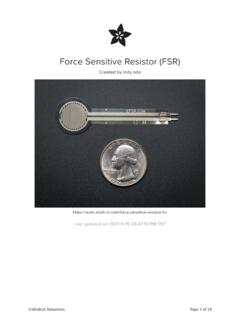
Force Sensitive Resistor (FSR) - Adafruit Industries
cdn-learn.adafruit.comNov 15, 2021 · resistance of the sensor at different force measurements. (Note that force is not measured in grams and what they really mean is Newtons * 100!) It is important to notice that the graph isn't really linear (its a log/log graph) and that at especially low force measurements it quickly goes from infinite to 100KΩ. Testing an FSR

Bioelectrical Impedance Analysis in Body Composition ...
consensus.nih.govof resistivity ( ). It is then observed that the end-to-end resistance (R) is the resistivity times the length (L), divided by the cross-sectional area (A) (i.e., R = L/A). Multiplying the right side of the equation by L/L gives R = L. 2 /Vol, where . Vol. is the volume. Rearranging gives . Vol = L. 2 /R, an equation that allows one to ...