Unsupervised Deep Embedding for Clustering Analysis
non-linear embedding that is necessary for more complex data. Spectral clustering and its variants have gained popular-ity recently (Von Luxburg,2007). They allow more flex-ible distance metrics and generally perform better than k-means. Combining spectral clustering and embedding has been explored inYang et al.(2010);Nie et al.(2011).Tian
Download Unsupervised Deep Embedding for Clustering Analysis

Information
Domain:
Source:
Link to this page:
Documents from same domain

TPOT: A Tree-based Pipeline Optimization Tool for ...
proceedings.mlr.pressJMLR: Workshop and Conference Proceedings 64:66{74, 2016 ICML 2016 AutoML Workshop TPOT: A Tree-based Pipeline Optimization Tool for Automating Machine …
Ensembles for Time Series Forecasting
proceedings.mlr.pressEnsembles for Time Series Forecasting set of real world time series. Our results clearly indicate that this is a promising research direction. In Section2we provide a brief description of the tasks being tackled in this paper.
Show, Attend and Tell: Neural Image CaptionGeneration …
proceedings.mlr.pressShow, Attend and Tell: Neural Image Caption Generation with Visual Attention Kelvin Xu? KELVIN.XU@UMONTREAL.CA Jimmy Lei Bay JIMMY@PSI.UTORONTO.CA Ryan Kirosy RKIROS@CS.TORONTO.EDU Kyunghyun Cho?
Wasserstein Generative Adversarial Networks
proceedings.mlr.pressWasserstein Generative Adversarial Networks Figure 1: These plots show ˆ(P ;P 0) as a function of when ˆis the EM distance (left plot) or the JS divergence (right plot).The EM plot is continuous and provides a usable gradient everywhere.
Self-Attention Generative Adversarial Networks
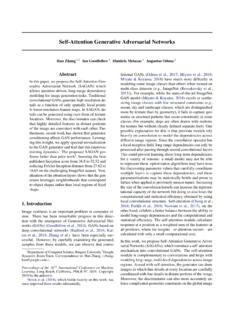
proceedings.mlr.pressSelf-Attention Generative Adversarial Networks Figure 1. The proposed SAGAN generates images by leveraging complementary features in distant portions of the image rather than local regions of fixed shape to generate consistent objects/scenarios. In each row, the first image shows five representative query locations with color coded dots.
Generative Adversarial Text to Image Synthesis
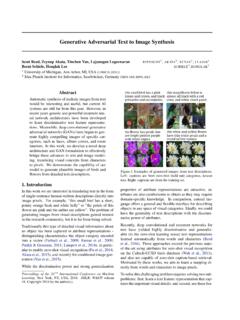
proceedings.mlr.pressdeep convolutional decoder networks to generate realistic images.Dosovitskiy et al.(2015) trained a deconvolutional network (several layers of convolution and upsampling) to generate 3D chair renderings conditioned on a set of graph-ics codes indicating shape, position and lighting.Yang et al. (2015) added an encoder network as well as actions ...

On the di culty of training recurrent neural networks
proceedings.mlr.pressOn the di culty of training recurrent neural networks @Et+1 @xt+1 Et Et+1 Et 1 xt 1 xt +1 ut +11 u tu @Et @xt @Et1 @xt1 @ xt +2 @xt +1 @x +1 x @xt1 @xt1 @xt2 Figure 2. Unrolling recurrent neural networks in time by creating a copy of the model for each time step.

Deep Gaussian Processes
proceedings.mlr.pressrepresentational power of a Gaussian process in the same role is significantly greater than that of an RBM. For the GP the corresponding likelihood is over a continuous vari-able, but it is a nonlinear function of the inputs, p(yjx) = N yjf(x);˙2; where N j ;˙2 is a Gaussian density with mean and variance ˙2. In this case the likelihood is ...
Noise-contrastive estimation: A new estimation principle ...
proceedings.mlr.pressated noise y. The estimation principle thus relies on noise with which the data is contrasted, so that we will refer to the new method as “noise-contrastive estima-tion”. In Section 2, we formally define noise-contrastive es-timation, establish fundamental statistical properties, and make the connection to supervised learning ex-plicit.
Gender Shades: Intersectional Accuracy Disparities in ...
proceedings.mlr.press117 million Americans are included in law en-forcement face recognition networks. A year-long research investigation across 100 police de-partments revealed that African-American indi-viduals are more likely to be stopped by law enforcement and be subjected to face recogni-tion searches than individuals of other ethnici-ties (Garvie et al.,2016).
Related documents

An Introduction to Locally Linear Embedding
cs.nyu.eduas linear methods. Recently, we introduced an eigenvector method—called locally linear embedding (LLE)—for the problem of nonlinear dimensionality reduction[4]. This problem is illustrated by the nonlinear manifold in Figure 1. In this example, the dimen-sionality reduction by LLE succeeds in identifying the underlying structure of the
Knowledge Graph Embedding: A Survey of Approaches and ...
persagen.comKnowledge Graph Embedding: A Survey of Approaches and Applications Quan Wang, Zhendong Mao, Bin Wang, and Li Guo Abstract—Knowledge graph (KG) embedding is to embed components of a KG including entities and relations into continuous vector spaces, so as to simplify the manipulation while preserving the inherent structure of the KG.
Structural Deep Network Embedding - SIGKDD
www.kdd.orgStructural Deep Network Embedding method, namely SDNE. More specifically, we first propose a semi-supervised deep model, which has multiple layers of non-linear functions, thereby being able to capture the highly non-linear network structure. Then we propose to exploit the first-order and second-order proximity jointly to p-
FaceNet: A Unified Embedding for Face Recognition and ...
www.cv-foundation.orgsionality using PCA, but this is a linear transformation that can be easily learnt in one layer of the network. In contrast to these approaches, FaceNet directly trains its output to be a compact 128-D embedding using a triplet-based loss function based on LMNN [19]. Our triplets con-sist of two matching face thumbnails and a non-matching

Visualizing Data using t-SNE
jmlr.csail.mit.edutechniques, including Sammon mapping, Isomap, and Locally Linear Embedding. The visualiza-tions produced by t-SNE are significantly better than those produced by the other techniques on almost all of the data sets. Keywords: visualization, dimensionality reduction, manifold learning, embedding algorithms, multidimensional scaling 1. Introduction
Knowledge Graph Embedding via Dynamic Mapping Matrix
aclanthology.orgof several embedding models. N e and N r represent the number of entities and relations, respectively. N t represents the number of triplets in a knowledge graph. m is the dimension of entity embedding space and n is the dimension of relation embedding space. d denotes the average number of clusters of a

Sobolev spaces and embedding theorems - ICMC
sites.icmc.usp.brIf, for example, the embedding Wm;p(Rn) ‰ Lq(Rn) is known to hold, similar property will be true for the spaces over Ω. We will quote below a theorem justifying existence of such extension operator: Theorem 1. Let Ω be either a half-space in Rn …