Unsupervised Deep Embedding for Clustering Analysis
Several variants of k-means have been proposed to address issues with higher-dimensional input spaces.De la Torre & Kanade(2006);Ye et al.(2008) perform joint dimension-ality reduction and clustering by first clustering the data with k-means and then projecting the data into a lower di-mensions where the inter-cluster variance is maximized.
Download Unsupervised Deep Embedding for Clustering Analysis

Information
Domain:
Source:
Link to this page:
Documents from same domain

TPOT: A Tree-based Pipeline Optimization Tool for ...
proceedings.mlr.pressJMLR: Workshop and Conference Proceedings 64:66{74, 2016 ICML 2016 AutoML Workshop TPOT: A Tree-based Pipeline Optimization Tool for Automating Machine …
Ensembles for Time Series Forecasting
proceedings.mlr.pressEnsembles for Time Series Forecasting set of real world time series. Our results clearly indicate that this is a promising research direction. In Section2we provide a brief description of the tasks being tackled in this paper.
Show, Attend and Tell: Neural Image CaptionGeneration …
proceedings.mlr.pressShow, Attend and Tell: Neural Image Caption Generation with Visual Attention Kelvin Xu? KELVIN.XU@UMONTREAL.CA Jimmy Lei Bay JIMMY@PSI.UTORONTO.CA Ryan Kirosy RKIROS@CS.TORONTO.EDU Kyunghyun Cho?
Wasserstein Generative Adversarial Networks
proceedings.mlr.pressWasserstein Generative Adversarial Networks Figure 1: These plots show ˆ(P ;P 0) as a function of when ˆis the EM distance (left plot) or the JS divergence (right plot).The EM plot is continuous and provides a usable gradient everywhere.
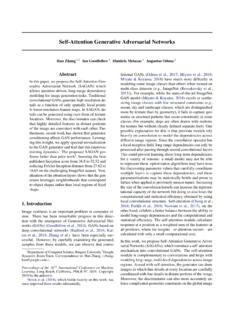
Self-Attention Generative Adversarial Networks
proceedings.mlr.pressSelf-Attention Generative Adversarial Networks Figure 1. The proposed SAGAN generates images by leveraging complementary features in distant portions of the image rather than local regions of fixed shape to generate consistent objects/scenarios. In each row, the first image shows five representative query locations with color coded dots.
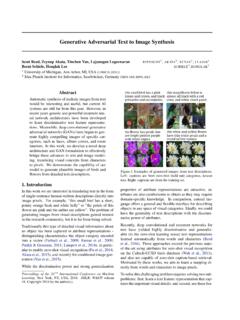
Generative Adversarial Text to Image Synthesis
proceedings.mlr.pressdeep convolutional decoder networks to generate realistic images.Dosovitskiy et al.(2015) trained a deconvolutional network (several layers of convolution and upsampling) to generate 3D chair renderings conditioned on a set of graph-ics codes indicating shape, position and lighting.Yang et al. (2015) added an encoder network as well as actions ...

On the di culty of training recurrent neural networks
proceedings.mlr.pressOn the di culty of training recurrent neural networks @Et+1 @xt+1 Et Et+1 Et 1 xt 1 xt +1 ut +11 u tu @Et @xt @Et1 @xt1 @ xt +2 @xt +1 @x +1 x @xt1 @xt1 @xt2 Figure 2. Unrolling recurrent neural networks in time by creating a copy of the model for each time step.

Deep Gaussian Processes
proceedings.mlr.pressrepresentational power of a Gaussian process in the same role is significantly greater than that of an RBM. For the GP the corresponding likelihood is over a continuous vari-able, but it is a nonlinear function of the inputs, p(yjx) = N yjf(x);˙2; where N j ;˙2 is a Gaussian density with mean and variance ˙2. In this case the likelihood is ...
Noise-contrastive estimation: A new estimation principle ...
proceedings.mlr.pressated noise y. The estimation principle thus relies on noise with which the data is contrasted, so that we will refer to the new method as “noise-contrastive estima-tion”. In Section 2, we formally define noise-contrastive es-timation, establish fundamental statistical properties, and make the connection to supervised learning ex-plicit.
Gender Shades: Intersectional Accuracy Disparities in ...
proceedings.mlr.press117 million Americans are included in law en-forcement face recognition networks. A year-long research investigation across 100 police de-partments revealed that African-American indi-viduals are more likely to be stopped by law enforcement and be subjected to face recogni-tion searches than individuals of other ethnici-ties (Garvie et al.,2016).
Related documents

An Introduction to the WEKA Data Mining System - CCSU
cs.ccsu.edu• K-nearest neighbor (KNN, IBk) Take the class of the nearest neighbor or the majority class among K neighbors K=1 -> no K=3 -> no K=5 -> yes K=14 -> yes (Majority predictor, ZeroR) • Distance is calculated as the number of different attribute values • Euclidean distance for numeric attributes • Weighted K-nearest neighbor K=5 -> undecided

POST GRADUATE PROGRAM IN ARTIFICIAL INTELLIGENCE
d9jmtjs5r4cgq.cloudfront.netSupervised learning • Linear Regression • Multiple Variable Linear Regression • Logistic Regression • Naive Bayes Classifiers • k-NN Classification • Support Vector Machines MODULE 2 Ensemble Techniques • Decision Trees • Bagging • Random Forests • Boosting MODULE 3 Unsupervised learning • K-means Clustering
Machine Learning Basic Concepts - edX
courses.edx.orgK-nearest neighbors Training algorithm: Add each training example (x;y) to the dataset D. x2Rd, y2f+1; 1g. Classi cation algorithm: Given an example xqto be classi ed. Suppose Nk(xq) is the set of the K-nearest neighbors of xq. ^yq= sign(X xi2Nk(xq) yi)

Lecture 13: Generative Models
cs231n.stanford.eduSupervised vs Unsupervised Learning K-means clustering This image is CC0 public domain. Fei-Fei Li & Justin Johnson & Serena Yeung Lecture 13 - 11 May 18, 2017 Unsupervised Learning ... Examples: Clustering, dimensionality reduction, feature learning, density estimation, etc. 14 Supervised vs Unsupervised Learning Supervised Learning

MACHINE LEARNING LABORATORY MANUAL - JNIT
www.jnit.orgfor clustering using k-Means algorithm. Compare the results of these two algorithms and comment on the quality of clustering. You can add Java/Python ML library classes/API in the program. 9. Write a program to implement k-Nearest Neighbour algorithm to classify the iris data set. Print both correct and wrong predictions.
Survey of Clustering Data Mining Techniques
faculty.cc.gatech.edu3.1. Probabilistic Clustering 3.2. K-Medoids Methods 3.3. K-Means Methods 4. Density-Based Partitioning 4.1. Density-Based Connectivity 4.5. Density Functions 5. Grid-Based Methods 6. Co-Occurrence of Categorical Data 7. Other Clustering Techniques 7.1. Constraint-Based Clustering 7.2. Relation to Supervised Learning 7.3.

DetCo: Unsupervised Contrastive Learning for Object Detection
arxiv.orglearning and online clustering, e.g. MoCo v1/v2 [19,5], BYOL [18], and SwAV [3], have achieved great progress to bridge the performance gap between unsupervised and fully-supervised methods for image classification. How-ever, their transferring ability on object detection is not sat-isfactory. Concurrent to our work, recently DenseCL [39],