
Upper Body: Thera Band Exercise Program - Basic
This program is to be used to improve upper body strength and range of motion. Many of the exercises focus on muscles of the shoulders, chest and upper back. Please consult with your therapist for specific instructions before doing any of these exercises. If at any time you experience unusual pain or discomfort, stop
Download Upper Body: Thera Band Exercise Program - Basic

Information
Domain:
Source:
Link to this page:
Documents from same domain

Upper Body: Range of Motion Exercises for the Arms ...
www.sralab.orgScapular Exercises . Up/Down (elevation/depression) – seated or sidelying Hand/Start positions #1: Place one hand on the back, so that fingers line up with the

Upper Body: Arm Strengthening Exercises with Tabletop …
www.sralab.orgUpper Body: Arm Strengthening Exercises with Tabletop Support Author: Sarah Housman, MS, OTR/L These exercises for the joints of the arm can help: Strengthen weak arm muscles; Improve range of motion; Minimize stiffness and pain. Instructions Use the muscles of your weak arm as much as possible.
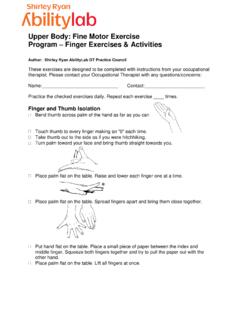
Upper Body: Fine Motor Exercise Program Finger Exercises ...
www.sralab.orgUpper Body: Fine Motor Exercise Program – Finger Exercises & Activities . Author: Shirley Ryan AbilityLab. OT Practice Council . These exercises are designed to be completed with instructions from your occupational
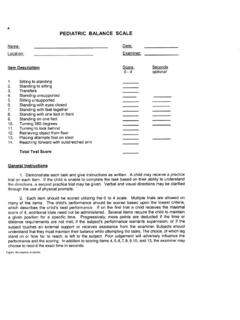
AbilityLab Home | Shirley Ryan AbilityLab
www.sralab.orgstationary foot. A taped line and/or footprints may be placed on the floor to help the child maintain a stationary foot position. In addition to a visual demonstration, a single physical prompt (assistance with placement) may be given. The child may be engaged in non-stressful conversation to maintain his/her attention span for 30 seconds.
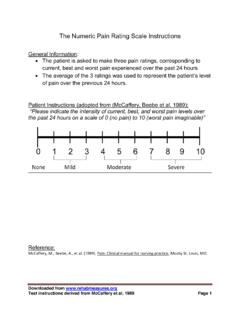
The Numeric Pain Rating Scale Instructions
www.sralab.orgThe Numeric Pain Rating Scale Instructions General Information: The patient is asked to make three pain ratings, corresponding to current, best and worst pain experienced over the past 24 hours. The average of the 3 ratings was used to represent the patient’s level of pain over the previous 24 hours.
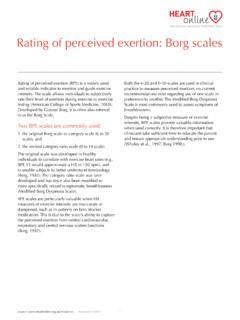
Rating of perceived exertion: Borg scales
www.sralab.orgRating of perceived exertion: Borg scales Rating of perceived exertion (RPE) is a widely used and reliable indicator to monitor and guide exercise intensity. The scale allows individuals to subjectively rate their level of exertion during exercise or exercise testing (American College of Sports Medicine, 2010).

CHEDOKE-McMASTER STROKE ASSESSMENT
www.sralab.orga clinical or research setting. ... If a client becomes excessively fatigued or apprehensive it is advisable to end the assessment. Client Comprehension of Instructions A therapist’s instruction, whether words or gestures, should be clear and concise. ... external rotation less than 60 ...
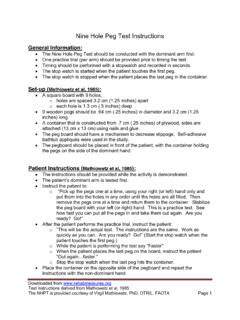
Nine Hole Peg Test Instructions - Shirley Ryan AbilityLab
www.sralab.orgNine Hole Peg Test Instructions General Information: The Nine Hole Peg Test should be conducted with the dominant arm first. One practice trial (per arm) should be provided prior to timing the test. Timing should be performed with a stopwatch and recorded in seconds. The stop watch is started when the patient touches the first peg.
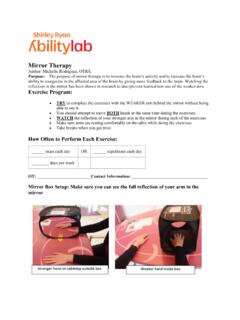
Mirror Therapy - Shirley Ryan AbilityLab
www.sralab.orgYun G., Chun M., Park J., Kim B. (2011) The synergic effect of mirror therapy and neuromuscular electrical stimulation for hand function in stroke patients. Annals of …

JFK Coma Recovery Scale-Revised - AbilityLab Home
www.sralab.orgNov 01, 2005 · COMA RECOVERY SCALE-REVISED ©2004 Administration and Scoring Guidelines Joseph T. Giacino, Ph.D. and Kathleen Kalmar, Ph.D. Center for Head Injuries Edison, New Jersey Johnson Rehabilitation Institution Affiliated with JFK Medical Center Updated 11-1-05
Related documents
Upper Body: Range of Motion Exercises for the Arms ...
www.sralab.orgThese exercises can help to improve the range of movement and decrease stiffness/pain at the joints of the arm. The shoulder blade/scapula must be stretched first before any shoulder movement All exercises may be done sitting or lying down. The helper should perform each motion as instructed until resistance is felt or as directed.

Cervical Range of Motion and Isometrics Home Exercise …
ahc.aurorahealthcare.orgCervical Range of Motion and Isometrics. Home Exercise Program. 1. Chin Tucks. Sit up straight with your shoulders back and down, keeping your . eyes and chin level. Pull your head back and up tall as if you were being pulled by a string from the top of your head. Hold . Perform . seconds. Repeat times per day. times. 2. Chin Tucks – Supine ...

Cane Exercises - Aurora Health Care
ahc.aurorahealthcare.orgShoulder – 4. Range of Motion Exercises (Wand activities): External/ Internal Rotation. Move wand upward toward head, then down toward waistline. Hold seconds. Repeat times. Do sessions per day. Continued. X17468 (12/2019) ©AAHC The information presented is intended for general information and educational
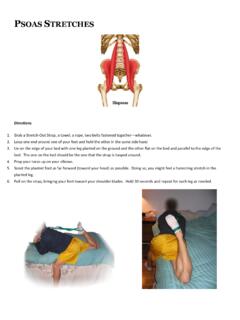
SOAS STRETCHES - MassageTherapy.com
staceypotts.massagetherapy.comslightly larger & softer than a tennis ball. This massage technique releases your Psoas through an active range of motion. Lay on the ball, about 1-2 inches outside your belly button. You’ll feel your Psoas respond as you lower yourself. It will hurt a little. Arch your back; come up onto your elbows. This will result in a more forceful ...

JOB LOCATION: PRINERGY 3 - Versus Arthritis
www.versusarthritis.orgSimple exercises Pendulumciseerxe Stand with your good hand resting on a chair. Let your other arm hang down and try to swing it gently backwards and forwards and in a circular motion. Repeat about 5 times. Try this 2–3 times a day. Shoulder stretch Stand and raise your shoulders. Hold for 5 seconds. Squeeze your shoulder blades back and