
Whymonitor water quality?
in contaminated water samples collected by USGS and analysed at the NWQL. All detections of MCHM from the Elk River, from other a ected downstream rivers, and in tap water samples were below levels of concern established by health agencies. The USGS traced the chemicals over 630 kilometers downstream from the spill site.
Download Whymonitor water quality?

Information
Domain:
Source:
Link to this page:
Documents from same domain

Simulation models for conservative and nonconservative ...
water.usgs.govThe OTIS solute transport model provides a tool for analysis of conservative solutes and nonconservative solutes that are subject to simple first-order transformation. Man y cases

Using OTIS to Model Solute Transport in Streams and Rivers
water.usgs.govApplication of OTIS to the Uvas Creek chloride injection requires estimates of stream cross-sectional area (A), transient storage (A s , α), and dispersion (D).

Kentucky Water Resources Research Institute Annual ...
water.usgs.govIntroduction The FY 2013 Annual Technical Report for Kentucky consolidates reporting requirements of the Section 104(b) base grant award into a single document that includes: 1) …

Installation instructions, File Structure, and Hardware ...
water.usgs.govinstallation instructions below are for Microsoft Windows 7 and 8.x. It is assumed that users have some familiarity with Microsoft Windows and geographic information system (GIS)

WATER RESOURCES DIVISION
water.usgs.govUSGS Water Mission Area Hydrologic Instrumentation Facility Page 2 of 4 Tuesday . 08:00 . The DAA Model H-522+ DCP • Overview • Inputs and Outputs
Estimating Sediment Discharge - Water Resources
water.usgs.govEstimating Sediment Discharge John R. Gray and Francisco J. M. Simões D.1 INTRODUCTION Sediment-discharge measurements usually are available on a discrete or periodic basis. However, estimates of sedi-ment transport often are needed for unmeasured periods, such as when daily or annual sediment-discharge values are

USA Aquifer Map - Water Resources
water.usgs.govCreated Date: 7/31/2006 10:43:56 AM
Related documents

Pointers on Shipping: Clinical Samples, Biological ...
www.fedex.comThe illustrations depict samples packaging that is acceptable for shipping clinical samples such as human or animal materials, including excreta, secreta, blood (including FDA-approved pharmaceuticals that are blood products), tissue and tissue fluids, as well as environmental test samples of soil and water.

Standard Operating Procedure: Sample Preparation and ...
archive.epa.govWater samples should be collected in the field or prepared in the lab by placing the water in a glass bottle. Typically, a 60-mL serum bottle is used. Add the water down the side of the bottle so as not to agitate the sample. Fill to the top and cap using a butyl rubber Teflon faced septum and the appropriate size aluminum crimp cap.

Quality control for water and sediment sampling
environment.des.qld.gov.authe number of samples being collected and the level of contamination expected. For example, blank samples may be more important when assessing low levels of environmental contamination (e.g. ultra-trace metals in water) than when assessing industrial waste. Field quality control samples can be used to assess and estimate:
Chemistry of Iron in Natural Water - USGS
pubs.usgs.gova rate governed by the diffusion of oxygen through the water. An aliquot of the natural water, acidified to pH 1.6, lost no ferrous iron after 3 months. If equilibrium is assumed in ground water in its natural environment, deter minations of pH in …
Water and wastewater sampling - EPA
www.epa.sa.gov.au• collecting and/or analysing samples for comparison with the Environment Protection (Water Quality) Policy 2003 (Water Quality Policy) criteria. However, given suitable justification, alternative methods may be approved for unique circumstances upon written application to the Environment Protection Authority (EPA).
NJDEP Drinking Water Quality Standards
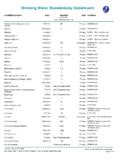
www.nj.govThe number of samples collected by a public water system is determined by the size of the population served. A system collecting at least 40 samples/month can have colif orm no more than 5% of the samples. A system collecting fewer than 40 samples/m onth can have no more than one coliform positive. Any number

Per- and Polyfluoroalkyl Substances (PFAS) Sampling ...
www.waterboards.ca.govwater, leachate, or other aqueous samples. Glass containers may be used for dry or solid samples, provided that adsorbed PFAS can be extracted by laboratory as part of the sample preparation procedure. Sample containers made from low-density polyethylene (LDPE) should not be used as PFAS are used in the manufacturing process of these containers.

Trihalomethanes in Drinking-water
www.who.intwater, with solubilities less than 1 mg/ml at 25 °C. Their log octanol–water partition coefficients range from 1.97 (chloroform) to 2.38 (bromoform). 1.3 Major uses and sources in drinking-water THMs are formed in drinking-water primarily as a result of chlorination of organic matter present in raw water supplies.