
Whymonitor water quality?
Why monitor water quality? Monitoring provides the objective evidence necessary to make sound decisions on managing water quality today and in the future. Water-quality monitoring is used to alert us to current, ongoing, and emerging problems; to determine com-pliance with drinking water standards, and to protect other bene cial uses of water.
Download Whymonitor water quality?

Information
Domain:
Source:
Link to this page:
Documents from same domain

Simulation models for conservative and nonconservative ...
water.usgs.govThe OTIS solute transport model provides a tool for analysis of conservative solutes and nonconservative solutes that are subject to simple first-order transformation. Man y cases

Using OTIS to Model Solute Transport in Streams and Rivers
water.usgs.govApplication of OTIS to the Uvas Creek chloride injection requires estimates of stream cross-sectional area (A), transient storage (A s , α), and dispersion (D).

Kentucky Water Resources Research Institute Annual ...
water.usgs.govIntroduction The FY 2013 Annual Technical Report for Kentucky consolidates reporting requirements of the Section 104(b) base grant award into a single document that includes: 1) …

Installation instructions, File Structure, and Hardware ...
water.usgs.govinstallation instructions below are for Microsoft Windows 7 and 8.x. It is assumed that users have some familiarity with Microsoft Windows and geographic information system (GIS)

WATER RESOURCES DIVISION
water.usgs.govUSGS Water Mission Area Hydrologic Instrumentation Facility Page 2 of 4 Tuesday . 08:00 . The DAA Model H-522+ DCP • Overview • Inputs and Outputs
Estimating Sediment Discharge - Water Resources
water.usgs.govEstimating Sediment Discharge John R. Gray and Francisco J. M. Simões D.1 INTRODUCTION Sediment-discharge measurements usually are available on a discrete or periodic basis. However, estimates of sedi-ment transport often are needed for unmeasured periods, such as when daily or annual sediment-discharge values are

USA Aquifer Map - Water Resources
water.usgs.govCreated Date: 7/31/2006 10:43:56 AM
Related documents
ASSESSMENT OF DRINKING WATER QUALITY AND …
soilandwater.bee.cornell.educovering water consumption behavior, perception of water source quality, and factors determining use. Water quality was determined at 11 selected water points representing both improved and unimproved sources. In the urban areas people were generally satisfied with the water services provided by the municipality because the water quality was ...
Safe Drinking Water Act (SDWA): A Summary of the Act and ...
fas.orgSafe Drinking Water Act (SDWA): A Summary of the Act and Its Major Requirements Congressional Research Service 1 Introduction The Safe Drinking Water Act (SDWA), Title XIV of the Public Health Service Act, is the key federal law for protecting public water supplies from harmful contaminants. First enacted in 1974
Interpreting Drinking Water Test Results
adams.extension.wisc.edudrinking the water. A Note on Drinking Water Standards Public water supplies must meet numerical water quality standards set by the United States Environmental Protection Agency and enforced by the Wisconsin DNR. Routine testing is not required for private wells. However, users of private well water should at least be
Chlorine in Drinking-water - World Health Organization
www.who.intThe first WHO document dealing specifically with public drinking-water quality was published in 1958 as International Standards for Drinking-Water. It was subsequently revised in 1963 and in 1971 under the same title. In 1984–1985, the first edition of the WHO Guidelines for drinking-water quality (GDWQ) was published in …

INTRODUCTION TO DRINKING WATER QUALITY TESTING
sswm.infoDrinking Water Quality Testing Section 1 Introduction 1 1 Introduction to Drinking Water Quality Testing Having safe drinking water and basic sanitation is a human need and right for every man, woman and child. People need clean water and sanitation to maintain their health and

DRINKING WATER QUALITY
www.cdc.govDRINKING 2 WATER QUALITY PICTURE OF AMERICA 3 PUBLIC WATER SUPPLIES The U.S. Environmental Protection Agency (EPA) is authorized under the Safe Drinking Water Act (SDWA) to protect public health by regulating the nation’s drinking water supplies in about 155,000 public water systems.8 Eighty-five to ninety percent
Where Does California’s Water Come From?
www.nature.orgwatersheds could protect and in some cases improve drinking water quality, reducing the need for costly and energy intensive filtration and treatment facilities. Introduction A watershed is an area of land that contributes water to a given location, such as a reservoir, a confluence of two streams, or the ocean.
NJDEP Drinking Water Quality Standards
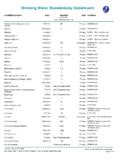
www.nj.govDrinking Water Explanation of Terms **Coliform bacteria standards are based on the presence or absence of coliforms in a sample. The number of samples collected by a public

Secondary Drinking Water Standards
www.waterboards.ca.govSecondary Drinking Water Standards California Code of Regulations, Title 22 Division 4. Environmental Health Chapter 15. Domestic Water Quality and Monitoring Regulations Article 16. Secondary Drinking Water Standards Constituents Maximum Contaminant Levels Consumer Acceptance Contaminant Levels Aluminum 0.2 mg/L Color 15 Units Copper 1.0 mg/L

Drinking water regulations
www.waterboards.ca.govApr 10, 2017 · Board’s drinking water-related activities are in the Health & Safety Code, the Water Code, and other codes. Last updated April 10, 2017—from Titles 17 and 22 California Code of Regulations California Regulations Related to Drinking Water . 3 §63850.