
Whymonitor water quality?
the following 2 examples, monitoring water quality provides empirical evidence to support decision making on health and environmental issues. In the United States, an emphasis is placed on monitoring for compliance with the Clean Water Act and Safe Drinking Water Act, which are administered by the U.S. Environ-mental Protection Agency (EPA).
Download Whymonitor water quality?

Information
Domain:
Source:
Link to this page:
Documents from same domain

Simulation models for conservative and nonconservative ...
water.usgs.govThe OTIS solute transport model provides a tool for analysis of conservative solutes and nonconservative solutes that are subject to simple first-order transformation. Man y cases

Using OTIS to Model Solute Transport in Streams and Rivers
water.usgs.govApplication of OTIS to the Uvas Creek chloride injection requires estimates of stream cross-sectional area (A), transient storage (A s , α), and dispersion (D).

Kentucky Water Resources Research Institute Annual ...
water.usgs.govIntroduction The FY 2013 Annual Technical Report for Kentucky consolidates reporting requirements of the Section 104(b) base grant award into a single document that includes: 1) …

Installation instructions, File Structure, and Hardware ...
water.usgs.govinstallation instructions below are for Microsoft Windows 7 and 8.x. It is assumed that users have some familiarity with Microsoft Windows and geographic information system (GIS)

WATER RESOURCES DIVISION
water.usgs.govUSGS Water Mission Area Hydrologic Instrumentation Facility Page 2 of 4 Tuesday . 08:00 . The DAA Model H-522+ DCP • Overview • Inputs and Outputs
Estimating Sediment Discharge - Water Resources
water.usgs.govEstimating Sediment Discharge John R. Gray and Francisco J. M. Simões D.1 INTRODUCTION Sediment-discharge measurements usually are available on a discrete or periodic basis. However, estimates of sedi-ment transport often are needed for unmeasured periods, such as when daily or annual sediment-discharge values are

USA Aquifer Map - Water Resources
water.usgs.govCreated Date: 7/31/2006 10:43:56 AM
Related documents
Interpreting Drinking Water Test Results
adams.extension.wisc.edudiscernible by the senses. Drinking water can contain nitrate, bacteria, and pesticides at levels which cannot be tasted or smelled, but which can be hazardous to health. If your drinking water comes from a private well, you should test your water once a year even if you do not observe any smells, stains or changes in water quality.
ARSENIC BIOSAND FILTER: “STUDY ON THE EFFECT OF AIR …
web.mit.eduTable 1: Proposed drinking water quality in Nepal Table 2: Properties of arsenic Table 3: Major arsenic minerals occurring in nature Table 4: The national standard of few countries for arsenic in drin king water Table 5: Arsenic level at different district in Nepal as November, 2003 Table 6: Identification of four filter

DRINKING WATER QUALITY
www.cdc.govof drinking water, such as groundwater wells and surface water, not subject to EPA standards under the Safe Drinking Water Act.2,3 In some parts of the United States, arsenic occurs in groundwater at high levels and can present a potential health hazard to people whose primary drinking water source is private well water.4 In addition, some agricul-
Culligan Drinking Water Systems Owners Guide
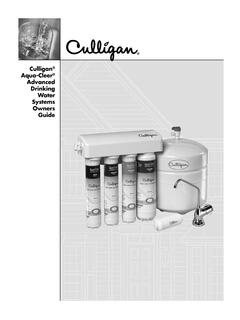
www.culligan.comArsenic (As) is found naturally in some well water. Arsenic in water has no color, taste or odor. It must be measured by a lab test. Public water utilities must have their water tested for arsenic. You can get the result from your water utility. If you have your own well, you can have the water tested by an accredited lab.

Arsenic - Understanding Your Arsenic Test Results
www.health.ny.govArsenic is a chemical present in the environment as a naturally occurring substance and as a result of human activity. It is found in water, air, food and soil. There are two general types of arsenic: organic and inorganic. The inorganic forms of arsenic are the harmful forms, while most of the organic forms of arsenic are essentially harmless.

Allan H. Smith, Elena O. Lingas, & Mahfuzar Rahman
www.who.intbetween arsenic concentrations in drinking-water and the prevalence of skin cancer (24). In this study, the average concentration of arsenic in water was about 500 mg/l, and by age 60 more than 1 in 10 had developed skin cancer. The lifetime risk of develop-ing skin cancer from the intake of 1 mg. kg body weight-1. day-1 (roughlyequivalent ...

EXPOSURE TO ARSENIC: A MAJOR PUBLIC HEALTH CONCERN
www.who.intarsenic-contaminated drinking-water are at increased risk for spontaneous abortion, stillbirth and preterm birth. In utero and early-life exposures to arsenic have been linked to the development of lung cancer and bronchiectasia later in life.
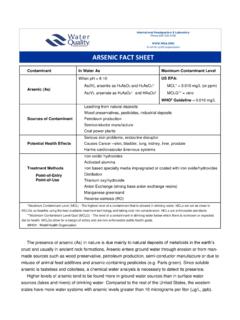
ARSENIC FACT SHEET - Water Quality Association
www.wqa.orgdrinking water. Both community water systems (CWS) and non-transient, non-community water systems (NTNCWS) are required under this rule to reduce the arsenic concentration in their drinking water to10 µg/L or lower. For details of toxicological and epidemiological effects of arsenic in drinking water, please refer to