Transcription of Power Amplifiers - Learn About Electronics
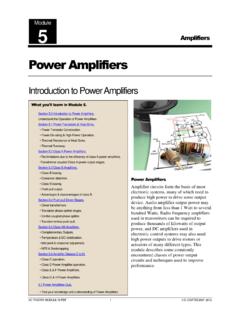
1 Module 5 Amplifiers Power Amplifiers Introduction to Power Amplifiers What you'll Learn in Module 5. Section Introduction to Power Amplifiers . Understand the Operation of Power Amplifiers . Section Power Transistors & Heat Sinks. Power Transistor Construction. Power De-rating & High Power Operation. Thermal Resistance of Heat Sinks. Thermal Runaway. Section Class A Power Amplifiers . The limitations due to the efficiency of class A Power Amplifiers . Transformer coupled Class A Power output stages. Section Class B Amplifiers . Class B biasing.
2 Crossover distortion. Power Amplifiers Class B biasing. Push-pull output. amplifier circuits form the basis of most Advantages & disadvantages of class B. electronic systems, many of which need to Section Push-pull Driver Stages. produce high Power to drive some output device. Audio amplifier output Power may Driver transformers. be anything from less than 1 Watt to several Transistor phase splitter stages. hundred Watts. Radio frequency Amplifiers Emitter coupled phase splitter. used in transmitters can be required to transformerless push-pull.
3 Produce thousands of kilowatts of output Section Class AB Amplifiers . Power , and DC Amplifiers used in Complementary Outputs. electronic control systems may also need Temperature & DC stabilisation. high Power outputs to drive motors or Mid-point & crossover adjustment. actuators of many different types. This NFB & Bootstrapping. module describes some commonly Section amplifier Classes C to H. encountered classes of Power output Class C operation. circuits and techniques used to improve Class D Power amplifier operation. performance.
4 Class E & F Power Amplifiers . Class G & H Power Amplifiers . Power Amplifiers Quiz. Test your knowledge and understanding of Power Amplifiers . AC THEORY MODULE 1 E. COATES 2007 -2010. Power Amplifiers The voltage Amplifiers described in Amplifiers Modules 1 to 4 can increase the amplitude of a signal many times but may not, on their own, be able to drive an output device such as a loudspeaker or motor. For example a voltage amplifier may have a gain of 100 and be able to amplify a 150mV signal to an amplitude of 15V and it is quite possible that the amplifier can feed that 15V signal into a load of say 10K , but if the load is changed to a value of 10 , the voltage amplifier would not be able to provide the extra current needed to maintain an output voltage of 15V across 10.
5 Likewise, a current amplifier may have a gain of 100 and be able to amplify a 10 A signal to 1mA. at a very low output voltage, but be unable to supply a 1mA signal at say 10V. In either case the voltage or current amplifier does not have sufficient Power (volts V x current I). Voltage and current Amplifiers can make use of small transistors and do not draw large amounts of Power from the Power supply in order to amplify signals by often, very large amounts. However the small transistors they use have very tiny junction areas and so cannot handle the Power needed to drive some output devices without overheating.
6 Amplifiers MODULE 2 E. COATES 2007 - 2021. Power Amplifiers Module Power Transistors & Heat Sinks What you'll Learn in Module After studying this section, you should be able to: Recognise Power transistor construction. Understand the need to connect the collector and metal case. Understand the relationship between Power and temperature in Power trainsistors. Power De-rating. Power Transistors Understand the need for heat sinks. There is not a clear cut difference between ordinary'. Methods for choosing heat sinks. transistors used in voltage Amplifiers and Power Methods for fitting heat sinks.
7 Transistors, but generally Power transistors can be categorised as those than can handle more than 1. Calculate Thermal Resistance requirements Ampere of collector (or Drain in the case of FETs). for heat sinks. current. Because Power transistors, such as those shown in Fig. handle larger currents and higher voltages, they have a different construction to small signal devices. They must have low output resistances so that they can deliver large currents to the load, and good junction insulation to withstand high voltages. They must also be able to dissipate heat very quickly so they do not overheat.
8 As most heat is generated at the collector/base junction, the area of this junction is made as large as possible. Power and Temperature The maximum Power rating of a transistor is largely governed by the temperature of the collector/base junction as can be seen from the Power de-rating graph in Fig. If too much Power is dissipated, this junction gets too hot and the transistor will be destroyed, a typical maximum temperature is between 100 C and 150 C, although some devices can withstand higher maximum junction temperatures.
9 The maximum Power output available from a Power transistor is closely linked to temperature, and above 25 C falls in a linear manner to zero Power output as the maximum permissible temperature is reached. Amplifiers MODULE 3 E. COATES 2007 - 2021. Power Amplifiers Power De-rating For example, a transistor such as the TIP31. having a quoted maximum Power output PTOT. of 40W can only handle 40W of Power IF the case temperature (slightly less than the junction temperature) is kept below 25 C. The performance of a Power transistor is closely dependant on its ability to dissipate the heat generated at the collector base junction.
10 Minimising the problem of heat is approached in two main ways: 1. By operating the transistor in the most efficient way possible, that is by choosing a class of biasing that gives high efficiency and is least wasteful of Power . 2. By ensuring that the heat produced by the transistor can be removed and effectively Fig Power de-rating Graph for the TIP31. transferred to the surrounding air as quickly as possible. Method 2 above, highlights the importance of the relationship between a Power transistor and its heat sink, a device attached to the transistor for the purpose of removing heat.