Transcription of Life Cycle Assessment (LCA) - TUC
1 All activities or processes, during the lifetime of a product s result in environ-mental impacts due to consumption of resources, emissions of substances into the natural environment, and other environmental exchanges. Environmental impacts commonly assessed include climate change, strato-spheric ozone depletion, tropospheric ozone (smog) creation, eutrophication, acidification and many others. The tool of LCA, is a quite young tool, firstly developed in 1960s and used for pollution prevention in 1970s. Consequently, there are no specific procedure, and guidelines to be followed for the completion of an LCA, but a number of different approaches, which depend on the issue that needs to be solved through the LCA. The basic principle behind this tool is the identification and description of all the stages that are involved in the life Cycle of products, from the extraction and pre-treatment of the raw materials, the production, transfer, distribution and use of the final product until the possible reuse, recycle or disposal of the waste deriving from this product.
2 life Cycle Assessment (LCA) IS A METHODOLOGICAL FRAMEWORK FOR ESTIMATING AND ASSESSING THE ENVIRONMENTAL IMPACTS ATTRIBUTABLE TO THE life Cycle OF A PRODUCT. As environmental awareness increases, the environmental performance of products and processes has become a key issue, since every prod-uct has a life . The life of a product starts at the design or development of the prod-uct and finishes at end-of- life activities (collection or sort-ing, reuse, recycling, dis-posal) through the following stages Raw Material Acquisition All activities necessary to extract raw material and energy inputs from the envi-ronment, including the trans-portation prior to processing. Processing and Manufac-turing Activities needed to convert the raw material and energy inputs into the desired prod-uct. In practice this stage is often composed of a series of sub-stages with intermedi-ate products being formed along the processing chain. Distribution and Transpor-tation Shipment of the final product to the end user.
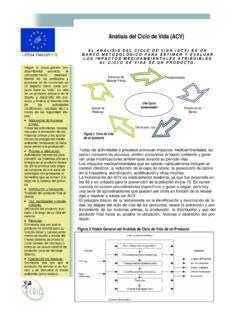
3 Use, Reuse, and Mainte-nance. Utilization of the finished product over its service life . Recycle Begins after the product has served its initial intended function and is subsequently recycled within the same product system (closed-loop recycle) or enters a new product system (open-loop recycle). Waste Management Begins after the product has served its intended function and is returned to the envi-ronment as waste. life Cycle Assessment (LCA) LIFE04 ENV/GR/110 Figure Overview of a life Cycle Assessment of a product Pretreatment Waste management Extraction of raw materials Production of good Distribution, Use life Cycle Assessment Figure 1. life Cycle of a product LCA is used to provide a systematic framework that helps to identify, quan-tify, interpret and evaluate the environmental impacts of a product, function or service in an orderly way. It is a diagnostic tool which can be used to compare existing products or services with each other or with a standard, which may indicate promising areas for improvement in existing products and which may aid in the design of new products.
4 The main procedure steps for a life Cycle Assessment are four: 1. Definition of goal and scope of the study. 2. Model preparation of the product life Cycle including environmental in-flows and outflows. This stage, during which data is collected, is usually referred to as life Cycle Inventory (LCI). 3. The stage at which environmental relevance of all inflows and outflows are understood, is known as life Cycle impact Assessment (LCIA). 4. Finally, study interpretation. Typically, the system is a static simulation model: t consists of unit proc-esses, each representing one or several activities ( production, trans-portation). For each unit processes, there is: Input - resources, emissions, and environmental exchanges Intermediate product flows - linking the unit processes. Theses are the reference flows, that are the amounts of specific product flows for each of the compared systems required to produce one unit of the function. The reference flow then becomes the starting point for building the necessary models of the product systems.
5 Stages of an LCA Page 2 life Cycle Assessment (LCA) MODELLING The basic principle behind an LCA is modelling; the performer tries to describe as realistic as possible a system. Figure 3. life Cycle of Product LIFE04 ENV/GR/110 FUNCTIONAL UNIT The functional unit is a key element of LCA which has to be clearly defined. The functional unit is a meas-ure of the function of the studied system and it provides a reference to which the inputs and outputs can be related. This enables comparison of two essential different systems. Definition of a functional unit could be difficult. The definition should be precise and comparable enough so that the unit can be used throughout the study as reference. For example, the functional unit for a paint system may be defined as the unit surface protected for 10 years. A comparison of the environmental impact of two different paint systems with the same functional unit is therefore possible. The functional unit used for a project should be determined though the elaboration of the collected data and study.
6 Also, potential restrictions with respect to the depth of the study, the sources and quality of data are determined during the process of the study. SYSTEM BOUNDARIES The system boundaries determine which unit processes to be included in the LCA study. Defining system boundaries is partly based on a subjective choice, made during the scope phase when the boundaries are initially set. The following boundaries can be considered: Boundaries between the technological system and nature. A life Cycle usually begins at the extraction point of raw materials and energy carriers from nature. Final stages normally include waste generation and/or heat production. Geographical area. Geography plays a crucial role in most LCA studies, infrastructures, such as electricity production, waste management and transport systems, vary from one region to another. More-over, ecosystems sensitivity to environmental impacts differs regionally too. Time horizon. Boundaries must be set not only in space, but also in time.
7 Basically LCAs are carried out to evaluate present impacts and predict future scenarios. Limitations to time boundaries are given by tech-nologies involved, pollutants lifespan, etc. Boundaries between the current life Cycle and related life cycles of other technical systems. Most activities are interrelated, and therefore must be isolated from each other for further study. For example production of capital goods, economic feasibility of new and more environmentally friendly processes can be evaluated in comparison with currently used technology. Interrelation of product systems has the ten-dency to be interrelated in a very complex manner. Ideally, life cycles of products used to produce the ma-terials and product under investigation are also required. That however would lead to an endless and com-plex list of inflows and outflows. Consequently, limits, boundaries have to be set for the exclusion of certain parts, which can however alter the final output of the study.
8 A diagram of the system is very helpful for the identification of the boundaries, and so are some choices such as production and disposal of capital goods, and nature boundaries. DATA QUALITY REQUIREMENTS Reliability of the results from LCA studies strongly depends on the extent to which data quality require-ments are met. The following parameters should be taken into account: Time-related coverage, Geographical coverage, Technology coverage, Precision, completeness represen-tiveness of the data. Consistency and reproducibility of the methods used throughout the data collection. Uncertainty of the information and data gaps. Threshold points can also be placed in addition to the boundaries, below or above which data collection for inflow or outflow can not be considered, increasing the quality and usefulness of the data. Page 3 life Cycle Assessment (LCA) Determination of the scope and depth of the study Inventory of data and informa-tion Assessment of environmental impacts Interpretation of data and infor-mation Figure 4.
9 Schematic Illustration of the LCA stages DATA COLLECTION: life Cycle INVENTORY LCI comprises of all stages dealing with data retrieval and management. Data for each process considered is required for the completion of the model. This data set is a compilation of inputs and outputs related to the function or product generated by the process. The forms to be used for data collection must be properly designed for optimal collection. Subsequently data is validated and related to the functional unit in order to allow the aggregation of results. A very sensi-tive step in this calculation process is the allocation of flows releases to air, water and land. Most of the existing technical systems yield more than one product. Therefore, materials and energy flows regard-ing the process as a whole, as well as environmental releases must often be allocated to the different products. The data collection is the most resource consuming part of the LCA. Reuse of data from other studies can simplify the work but this must be made with great care so that the data is representative.
10 Nevertheless, product systems usually contain process types common to nearly all studies, namely, energy supply, transport, waste treatment services, and the production of commodity chemicals and materials. The quality aspect is therefore also crucial. Problems that may be faced by people performing the LCI during data col-lection include: Large number of unit processes resulting to mutual learning of many process owners may be neces-sary; Work often requiring communication across several organizational borders, outside the regular business information flow; Throughout the LCA, for all unit processes, the quantity of each product, pollutant, resource, etc. has to be measured in the same way. Additionally, the nomenclature used for the denotation of flows and other environmental exchanges also needs to be consistent throughout the product system. DATA TYPES Even though much data is available through databases, there are always some processes that are not listed or the available data is not representative of the process required.