Transcription of The Heart of Change - University of Colorado
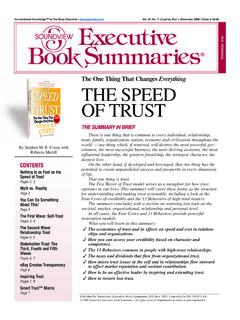
1 Published by soundview Executive Book Summaries, Box 1053, Concordville, Pennsylvania 19331 USA 2002 soundview Executive Book Summaries All rights reserved. Reproduction in whole or part is Stories of How People ChangeTheir OrganizationsTHE HEARTOF CHANGETHE SUMMARY IN BRIEFIf you ve ever tried to Change anything, you know how hard it is. Howdo you go about getting your message across to truly Change people sbehavior?While most companies believe Change happens by making people thinkdifferently, that isn t the case. Instead, according to John Kotter and DanCohen, Change happens when you make people have to appeal more to the Heart than the this summary, you will learn about a new dynamic the see-feel- Change dynamic that fuels action by showing people potent reasons forchange that spark their emotions. Built around the eight steps of changefirst introduced in Kotter s bestseller,Leading Change , The Heart ofChangegives straight advice on successful Change and true stories ofcompanies making Change Knowledge for the Busy ExecutiveVol.
2 24, No. 11 (3 parts) Part 1, November 2002 Order # 24-26 CONTENTSThe Heart of ChangePage 2 Increase UrgencyPages 2, 3 Build the Guiding TeamPages 3, 4 Get theVision RightPages 4, 5 CommunicateFor Buy-InPage 5 Empower ActionPages 6, 7 Create Short Term WinsPages 7, 8 Don t Let UpPage 8 Make Change StickPage 8By John Kotter andDan CohenFILE: HANDS-ON MANAGEMENT What You ll Learn In This SummaryIn the following pages, you will learn about: The Heart of Change :Why people succeed and why they fail at largescale- Change and how you can use an eight-step path to success. The Need for Urgency:You will see why you must raise feelings ofurgency so that people start telling each other we must do something. Building the Guiding Team That Gets the Vision Right: You need theright group of people with the right vision to start the Change process. Communicating for Buy-in: You will send clear messages about changeand remove barriers to those changes. Creating Early Wins and Not Letting Up: You will see why creating anearly win is important and why you have to keep momentum up.
3 Making Change Stick: You will learn how to Change your organization sculture so that Change will Heart of ChangePeople Change what they do because they are shown atruth that influences their feelings. This is especially soin large-scale organizational Change , where you aredealing with new technologies, cultural transformation,globalization and e-business. In an age of turbulence,when you handle this reality well, you understand why some organizations are leapinginto the future more successfully than others, you needfirst to see the flow of effective large-scale changeefforts. Change is an eight step process that few handlewell. These steps are:1. Create a sense of urgencyso that people starttelling each other Let s go, we need to changethings! 2. Pull together a guiding teampowerful enough toguide a big Create clear, simple, uplifting visionsand sets Communicate the vision through simple, Heart -felt messagessent through multiple channels sothat people begin to buy into the Empower peopleby removing obstacles to Create short-term winsthat provide Maintain momentumso that wave after wave ofchange is Make Change stick by nurturing a new culture.
4 Increase UrgencyIn successful Change efforts, the first step is makingsure sufficient people act with sufficient urgency with on-your-toes behavior that looks for opportunitiesand problems and energizes colleagues, that beams asense of let s go. Without urgency, large-scale changewon t sets of behaviors often stop Change . The first iscomplacency, driven by false pride or arrogance. Thesecond is immobilization and self-protection, driven byfear or panic. The next is you-can t-make-me-move deviance, driven by anger. And the last is a pessimisticattitude, leading to constant hesitation. These behaviorsprevent people from taking action. Instead, they holdback or complain as others initiate new action. Theresult is that a needed Change effort is first step is not to create a vision. This is espe-cially true if your organization is in crisis, if alligatorsare nipping at your feet. If they stand on a burning plat-form, they have no choice but to take immediate action,to jump away from their comfortable a team to discuss the organization s newvision won t be very successful, because team memberswill be worried more about self-preservation than thenew Heart OF CHANGEby John Kotter and Dan Cohen THECOMPLETESUMMARYS oundview Executive Book Summaries Published by soundview Executive Book Summaries(ISSN 0747-2196), Box 1053, Concordville, PA 19331 USA, a division of ConcentratedKnowledge Corporation.
5 Publisher, George Y. Clement. V. P. Publications, Maureen L. Solon. Editor-in-Chief, Christopher G. : $195 per year in , Canada & Mexico, and $275 to all other countries. Periodicals postage paid at Concordville, PA and additional :Send address changes to soundview , Box 1053, Concordville, PA 19331. Copyright 2002 by soundview Executive Book formats:Summaries are available in print, audio and electronic formats. To subscribe, call us at 1-800-521-1227 (1-610-558-9495 outside &Canada). Multiple-subscription discounts and Corporate Site Licenses are also author:John P. Kotter is a world-renownedexpert on leadership at the Harvard Business School andthe author of many books, including Leading S. Cohen is a Principal with Deloitte 2002 by John P. Kotter and DeloitteConsulting LLC. Summarized by permission of the pub-lisher, Harvard Business School Press, 60 Harvard Way,Boston, MA 02163. 190 pages. $ , Feel, ChangeChanging one person is hard enough, but changing100 or 1000 is an almost Herculean task.
6 Yet organi-zations are doing just that. Most that do so success-fully focus on showing what needs to be people respond emotionally to the lesson, theiremotional reactions propel them into action. They see,then feel, then Change . To help them make the leap,you must: Help people see the need for Change with com-pelling, eye-catching dramatic situations to visu-alize problems and solutions. Let people feel as they are hit with the reality oftheir situation and feel the need to act. Let people take their emotionally charged ideasinto action.(continued on page 3)One company brought the need for Change to execu-tive attention with a compelling demonstration. Thecompany bought and ordered gloves for its factoriesthrough a decentralized process. As a result, the compa-ny bought 424 different types of make matters worse, each factory negotiated itsown glove purchases. Some factories paid $5 per pairwhile another paid $17 per pair for exactly the sameglove!
7 To spur action, a manager collected one pair of all424 types of gloves, attached the price, and placed themon the board room conference table. The vice-presidentswere shocked by what they saw and immediately tookaction to Change the company s procurement s what works to motivate action: Show others the need to Change with a compellingobject that they can actually see, touch and feel. Show people valid and dramatic evidence from out-side the organization that demonstrates that changeis required. Look for cheap and easy ways to reduce compla-cency and don t underestimate complacency, fearand anger. Build the Guiding TeamThe team you put together to guide Change needs asense of urgency. When there is urgency, more peoplewant to lead, even if there is personal risk and fewshort-term rewards. But urgency isn t enough. Large-scale Change does not happen without a powerful guid-ing force. A fragmented management team cannot dothe job, and a hero CEO doesn t work either.
8 Therearen t enough hours in the day for even the strongestexecutive to accomplish Change single-handedly. Yourchallenge is to put together an effective guiding powerful guiding group has two characteristics. Itis made up of the right people, and it demonstratesteamwork. The right people are those individuals withappropriate skills, leadership capacity, organizationalcredibility, and the connections to handle organizationalchange. The right people aren t necessarily part of theexisting senior do you build a team of the right people? A single individual who feels great urgency usuallypulls in the first people. The people selected create ateam with: Relevant knowledge about what s happening out-side the enterprise (essential for creating vision). Credibility, connections and stature within theorganization (essential for communicating vision). Valid information about the internal workings of theenterprise (essential for removing barriers that disem-power people from acting on the vision).
9 Formal authority and the managerial skills associat-ed with planning, organizing and control (needed to cre-3 The Heart of Change SUMMARYS oundview Executive Book Summaries Increase Urgency(continued from page 2)Angry Customer VideotapeSpurs ActionHow do you Change years of ingrained habits andattitudes? You can try facts and figures, but nothingworks better than a shock. That s how one companymanaged to inspire Change in a group of craftsmenwho had refused to listen to a key customer s needsand continued to do things their customer had ordered custom-designed equip-ment, but found he still had to make significant alter-ations to the equipment. He told management that hehad talked to the craftsmen designing the equipmentmany times, but that they didn t seem to listen. Sure,they would nod their heads, he explained, but theywouldn t take action. The manager asked permissionto videotape the customer s complaints. He thenshowed the craftsmen the tape.)
10 Many were genuinelysurprised to see the angry customer complain theyhadn t listened. Some thought they were right and thecustomer wrong. But the overwhelming reaction wasthat something had to be done. The videotape createda sense of urgency that propelled the craftsmen intoaction.(continued on page 4)The New and More Diverse TeamWhat happens when an organization moves fromacquisition mode to one focused on organic growth?Here s how one company created a new and morediverse team to make the transition. The companyhad just ended an acquisition phase and found therewere no remaining competitors small enough to deal-maker team had been small and was dominated by people with years of combinedbanking experience, but few of the skills needed tomanage organic team the CEO put together was incrediblydiverse. It consisted of representatives from everymajor function: finance, human resources, corporateaffairs, IT, regional leaders, and asset , the team members represented the entirecompany.