Transcription of METHOD 100.2 DETERMINATION OF ASBESTOS …
1 METHOD OF ASBESTOS STRUCTURES over 10 m IN LENGTH IN DRINKING WATERKim A. Brackett, (IT Corp.)Patrick J. Clark (Risk Reduction Engineering Laboratory, USEPA)James R. Millette, (MVA, Inc.)June 1994 OFFICE OF RESEARCH AND ENVIRONMENTAL PROTECTION AGENCYCINCINNATI, OHIO 452681 METHOD DETERMINATION OF ASBESTOS STRUCTURES over 10 m IN LENGTH IN DRINKING SCOPE AND This test METHOD is recommended for the DETERMINATION ofthe presence and quantitation of ASBESTOS structures indrinking water samples. The METHOD allows for thequantitation of structures greater than 10 m in length. This test METHOD describes the equipment and procedures necessary for the sampling and analysis of drinkingwater by transmission electron microscopy (TEM).
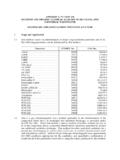
2 The identification of ASBESTOS by TEM is based on (a) morphology, (b) selected area electron diffraction(SAED) and (c) energy dispersive x-ray analysis (EDXA). Applicable analytes and Chemical Abstract Service (CAS) Numbers:AsbestosCAS Number Chrysotile12001-29-5 Crocidolite12001-28-4 Amosite (Grunerite)12001-73-5 Anthophyllite77536-67-5 Tremolite77536-68-6 Data Quality Objectives MethodAccuracya Precisiona Completeness TEM 95% 95% 100% a. Confidence coefficient of a confidence interval for a Poisson variable within which count ranges are expected to Analytical Sensitivity. A sensitivity of 200,000 fibersper liter ( MFL) is required unless filter loading satisfies the stopping rules in Section See TABLE Only ASBESTOS structures meeting the definitions set forth in the Chatfield protocol are counted (1).
3 TABLE 1. Limitation of Analytical Sensitivity by Volumeof Water Sample Filtered (1) Volume of SampleFiltered (mL) Analytical25 mm Diam. Filterb47 mm Diam. Filterc Sensitivity (f/L) x x x x x x x x x x 104a Concentration corresponding to 1 structure detected in 10 grid openings of approximately Assuming active filter area of Assuming active filter area of SUMMARY OF METHODW ater is collected in a polyethylene or glass container andshipped to the laboratory. Known aliquots of the sample arefiltered through a to m pore mixed cellulose ester(MCE). A carbon extraction replica is prepared from a portion ofthe filter and is examined in the TEM at a magnification of10,000 to 20,000X.
4 ASBESTOS structures are identified bymorphology, selected area electron diffraction (SAED) and energydispersive x-ray analysis (EDXA). Structures are classifiedaccording to the counting rules specified in the Chatfieldpolycarbonate filter protocol (1). Only ASBESTOS structuresgreater than 10 m in length are counted. Some states mayrequire identification and measurement of all ASBESTOS fibers,3regardless of size. In this case the use of a m pore-sizepolycarbonate or MCE filter membrane is necessary to prevent lossof small fibers during DEFINITION OF Analytical Sensitivity -- The waterborne concentrationrepresented by the finding of one ASBESTOS structure in the totalarea of filter examined.
5 This value will depend on the fraction of the sample filtered and the dilution factor (if applicable). Asbestiform -- A specific type of fibrous habit whichhas greater flexibility and higher tensile strength than otherhabits of the same mineral. ASBESTOS -- generic term for a group of hydrated Aspect Ratio -- The ratio of the length of a fibrousparticulate to its apparent width (equivalent diameter). Bundle -- A structure composed of three or more fibersin a parallel arrangement with each fiber lying less than onediameter Cluster -- A structure with fibers in a randomarrangement such that all fibers are intermixed and no singlefiber is isolated from the EDXA -- Energy dispersive X-ray Fiber -- For the purposes of this METHOD , a structurehaving a minimum length of 10 m and an aspect ratio (length towidth) of 3.
6 1 or greater with substantially parallel Fibril -- The smallest crystalline fiber that can beseparated from a fiber bundle which cannot be subdivided withoutlosing its fibrous Grid -- a 3 mm diameter 200-mesh copper lattice used tohold the carbon extraction replica for observation in the Intersection -- Nonparallel touching or crossing offibers, with the projection having an aspect ratio $3 Matrix -- Fiber or fibers with one free end and theother end embedded in or hidden by a MFL -- million fibers per SAED or ED -- Selected area electron structure -- A microscopic bundle, cluster, fiber ormatrix which may contain TEM -- transmission electron INTERFERENCESThe minerals listed below can exhibit morphological, chemical orcrystal structure similarities to the ASBESTOS minerals.
7 Thelaboratory QA/QC manual should describe routine techniques todifferentiate them from ASBESTOS . In general, these techniquesshould be the same as those required for accreditation by theNational Institute of Standards and Technology/National VoluntaryLaboratory Accreditation Program (NIST/NVLAP) for Attapulgite (Palygorskite) Vermiculite SAFETYThis test METHOD may involve hazardous materials, operations andequipment, and does not purport to address all of the safetyproblems, if any, associated with its use. It is theresponsibility of the user of this METHOD to establishappropriate safety and health practices and determine theapplicability of regulatory limitations prior to use.
8 Samplefiltration take place in a clean HEPA filtered positive pressurehood to avoid possible contamination of the preparation. Collapsing of the filter should be performed in an exhaust EQUIPMENT AND Transmission Electron Microscope capable of performingelectron diffraction, with a fluorescent screen inscribed with acalibrated measuring scale. The TEM must have EDXA and be ableto produce a spot size, at crossover, less than 250 nm Energy dispersive X-ray High vacuum carbon evaporator with rotating Positive pressure HEPA filtered Fume Table-top low power ultrasonic Ozone generator capable of generating at least 400g of ozone per day at a concentration of 1% by weight when supplied with dry Quartz Submersible UV lamp (254 m wavelength) Waterproof Forceps (tweezers) Graduated pipettes (1, 5, 10 ml sizes), disposable 25 or 47 mm diameter filter funnel assembly (either glass or disposable plastic)
9 1000 mL side arm vacuum filtration 25 or 47 mm diameter mixed cellulose ester (MCE) membrane filters (# m and 5 m pore size) Disposable petri dishes (or suitable equivalent) for storage of filtration Glass microscope Curved scalpel Low temperature oven or cabinet-type Low temperature plasma Jaffe 200 mesh copper TEM finder Carbon 1000 mL glass or polyethylene sample bottles with screw-on REAGENTS AND Reagent grade chemicals shall be used in all tests. Unless otherwise indicated, it is intended that all reagentsshall conform to the specifications of the Committee onAnalytical Reagents of the American Chemical Society (2).
10 Deionized particle-free Dimethylformamide (DMF) Glacial acetic 1-methyl-2-pyrrolidone also called 1-methyl-2-pyrolidinone or n-methyl-2-pyrrolidone (CAS 872-50-4) NIST traceable ASBESTOS Laboratory standards for the interference mineralslisted in Section SAMPLE COLLECTION, PRESERVATION AND The sample container will be an unused, pre-cleaned,screw-capped bottle of glass or low density (conventional)polyethylene of at least 1 liter capacity. It is recommendedthat the use of polypropylene bottles be avoided since problemsof particulate being released into water samples have beenobserved. Before use, the bottles should be rinsed twice byfilling approximately one-third full with fiber-free water andshaking vigorously for thirty seconds.