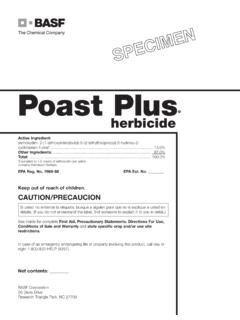
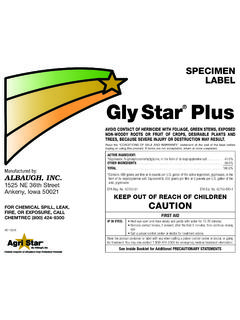
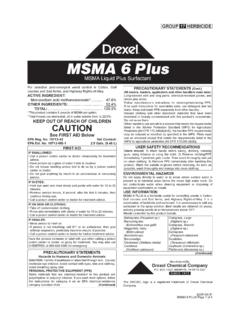
Transcription of SPECIMEN LABEL SHOREKLEAR-PLUS
1 AQUATIC HERBICIDESHOREKLEAR- plus an Arch Chemicals, Inc. companyW175N11163 Stonewood Dr. Ste. 234, Germantown WI 530221-800-558-5106 USE ON EMERGED AQUATIC WEEDS AND BRUSH IN AQUATIC AND OTHER NONCROP Reg. No. Est. No. 42291-GA-1 ACTIVE INGREDIENTS:Glyphosate, N-(phosphonomethyl) glycine, in the form of its isopropylamine INGREDIENTS:.. RGENERAL INFORMATIONThis product is a nonselective herbicide that is diluted and applied to the foliage of actively growing weeds as a spot or broadcast application. It is absorbed by the leaves and moves throughout the stem and roots to control the entire plant. Visible symptoms may require a week or more to appear, with burndown usually occurring in 2 to 4 weeks.
2 Symptoms are a gradual wilting and yellowing of the sprayed plant followed by deterioration of both shoots and roots. This product has no herbicidal activity in the soil and will not wash or leach to affect nearby AND NONCROP SITES:Aquatic sites and wetlands: This product may be applied to emerged weeds, woody brush and trees in all bodies of fresh and brackish water which may be fl owing, non-fl owing, or transient. This includes lakes, rivers, streams, ponds, estuaries, rice levees, seeps, irrigation and drainage ditches, canals, reservoirs, wastewater treatment facilities, wildlife habitat restoration and management areas, and similar sites including the following: Aquatic food crop: Agricultural drainage systems, irrigation systems, lakes/ponds/reservoirs (with human or wildlife use) stream/rivers/channeled water, drainage ditches, canals, irrigation ditches, estuaries.
3 Aquatic non-food industrial: aquatic areas/water, drain-age systems, waste water systems. Aquatic non-food outdoor: aquatic areas/water, ditches, ditch banks. This product may be used in and around water and wetlands found near power, telephone and pipeline rights-of-way sites, including where these sites are adjacent to or surrounding domestic water supply reservoirs, supply streams, lakes and ponds. If aquatic sites are present in the non-crop area and are part of the intended treatment, read and observe the following directions: This product does not control plants, which are completely sub-merged or have a majority of foliage under water. There is no restriction on the use of treated water for irrigation, recreation, or domestic purposes.
4 Consult local State fi sh and game agency and local public water control authorities before applying this product in and around public waters. Permits may be required to treat in such areas. NOTE: Do not apply this product within mile upstream of an active potable water intake in fl owing water (i e. river, stream, etc.) or within mile of an active potable water intake in a standing body of water such as lake, pond, or reservoir. To make aquatic applications around and within mile of active potable water intakes the water intake must be turned off for a minimum period of 48 hours after the application. The water intake may be turned on prior to 48 hours if the glyphosate level in the intake water is below parts per million as determined by laboratory analysis.
5 These aquatic applications may be made ONLY in those cases where there are alternative water sources or holding ponds which would permit the turning off of an active potable water intake for a minimum period of 48 hours after the applications. This restriction does not apply to intermittent inadvertent overspray of water in terrestrial use sites. For treatments after drawdown of water or in dry ditches, allow 7 or more days after treatment before reintroduction of water to achieve maximum weed control. Apply this product within 1 day after draw-down to ensure application to actively growing weeds. Floating mats of vegetation may require retreat-ment. Avoid wash-off of sprayed foliage by spray boat or recreational boat backwash or by rainfall within 6 hours of application.
6 Do not retreat within 24 hours following the initial treatment. Applications made to moving bodies of water must be made while traveling upstream to prevent concentration of this herbicide in water. When making any bankside applications, do not overlap more than 1 foot into open water. Do not spray in bodies of water where weeds do not exist. The maximum application rate of gallons of product per acre must not be exceeded in any single broadcast application that is being made over water. When emerged infestations require treatment of the total surface area of impounded water, treating the area in strips may avoid oxygen depletion due to decaying vegetation. Oxygen depletion may result in fi sh SITES AND AQUATIC SITES WITHIN NONCROPLAND SITES: This product may also be used to control the listed weeds, woody brush, and trees in terrestrial non-crop sites and/or in aquatic sites associated with these areas: Terrestrial Non-Food Crop.
7 Ornamental and/or shade trees, ornamental woody shrubs and vines, orna-mental plants, agricultural rights-of-way/fencerows/hedgerows, agricultural uncultivated areas, airports/landing fi elds, golf course turf, industrial areas, outdoor buildings/structures, rights-of-way/fence rows/hedgerows, nonagricultural uncultivated areas/soils, ornamental and/or shade trees, cemeteries, va-cant lots, paved areas (private roads/sidewalks), recreational areas, urban areas, golf courses, parks, schools, rights-of-way (high-way, power lines, pipeline utility, railroads), roadsides, industrial sites, stor-age yards, lumber yards, petroleum tank farms, petroleum pumping stations, parking areas, shelter belts, farm yards, wildlife habitat restoration and management areas.
8 Outdoor Residential: ornamental and/or shade trees, ornamental herbaceous plants, ornamental woody shrubs and vines, household/domestic dwellings outdoor premises. This product may be used as a broadcast treatment or spot treatment with any of the application equip-ment listed on this LABEL in noncropland sites. For spot treatments: Specifi c use recommendations for annuals, perennials, woody brush, and trees are presented in the booklet section named WEEDS CONTROLLED. See Tables 3 and 4. For broadcast treatments: Specifi c use recommendations for noncropland sites including dosage rates, spray volumes, and restrictions are presented in Table 5. Do not allow the herbicide solution to mist, drip, drift or splash onto desirable vegetation since minute quantities of this product can cause severe damage or destruction to the crop, plants, or other areas on which treatment was not intended.
9 The likelihood of injury occurring from the use of this product is greatest when winds are gusty or in excess of 5 miles per hour or when other conditions, including lesser wind velocities, will allow spray drift to occur. When spraying, avoid combinations of pressure and nozzle types that will result in splatter or fi ne particles (mist) which are likely to LABELM anufactured for:KEEP OUT OF REACH OF CHILDRENCAUTIONPRECAUTIONARY STATEMENTSHAZARDS TO HUMANS AND DOMESTIC ANIMALSCAUTION: Harmful if swallowed. May cause eye irritation. Avoid contact with skin, eyes or PROTECTIVE EQUIPMENT (PPE): Applicators and other handlers must wear: long-sleeved shirt and long pants, shoes plus socks. Follow manufacturer s instructions for cleaning/maintaining PPE.
10 If no such instructions for washables exist, use detergent and hot water. Keep and wash PPE separately from other SAFETY RECOMMENDATIONS: Users Should: Wash hands before eating, drinking, chewing gum, using tobacco or using the toilet. FIRST AID: IF IN EYES: Hold eye open and rinse slowly and gently with water for 15 to 20 minutes. Remove contact lenses, if present, after the fi rst 5 minutes, then continue rinsing eye. Call a poison control center or doctor for treatment advice. IF SWALLOWED: Call a poison control center or doctor immediately for treatment advice. Have person sip a glass of water if able to swallow. Do not induce vomiting unless told to do so by the poison control center or doctor. Do not give anything by mouth to an unconscious person.