Transcription of Safety Assessment of Alkoxy Alkyl Silanes as Used …
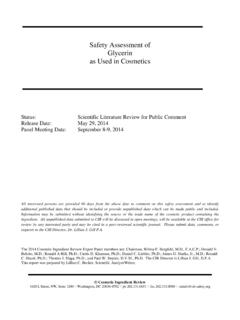
1 I Safety Assessment of Alkoxy Alkyl Silanes as Used in Cosmetics Status: Scientific Literature Review for Public Comment Release Date: January 19, 2016 Panel Meeting Date: March 31- April 1, 2016 All interested persons are provided 60 days from the above date to comment on this Safety Assessment and to identify additional published data that should be included or provide unpublished data which can be made public and included. Information may be submitted without identifying the source or the trade name of the cosmetic product containing the ingredient. All unpublished data submitted to CIR will be discussed in open meetings, will be available at the CIR office for review by any interested party and may be cited in a peer-reviewed scientific journal.
2 Please submit data, comments, or requests to the CIR Director, Dr. Lillian J. Gill. The 2016 Cosmetic Ingredient Review Expert Panel members are: Chair, Wilma F. Bergfeld, , ; Donald V. Belsito, ; Ronald A. Hill, ; Curtis D. Klaassen, ; Daniel C. Liebler, ; James G. Marks, Jr., ; Ronald C. Shank, ; Thomas J. Slaga, ; and Paul W. Snyder, , The CIR Director is Lillian J. Gill, This report was prepared by Lillian C. Becker, Scientific Analyst/Writer. Cosmetic Ingredient Review 1620 L Street, NW, Suite 1200 Washington, DC 20036-4702 ph fax 1 INTRODUCTION This is a review of the available scientific literature and unpublished data relevant to assessing the Safety of the Alkoxy Alkyl Silanes as used in cosmetics. The ingredients in this report are structurally related as Silanes bearing both simple Alkyl and simple alkoxyl groups.
3 The 4 ingredients in this report are: Bis-Stearoxydimethylsilane Stearoxytrimethylsilane Triethoxycaprylylsilane Trimethoxycaprylylsilane According to the Cosmetic Ingredient Dictionary and Handbook (Dictionary), the functions of these polymerized tetramethylcyclotetrasiloxane ingredients include: binder, skin-conditioning agent miscellaneous, skin-conditioning agent emollient, and surface modifier (Table 1).1 The Cosmetic Ingredient Review (CIR) Expert Panel (Panel) reviewed other siloxane polymers, such as methicone and other related methicone-containing ingredients, and concluded that those ingredients were safe as used in cosmetic The Panel also reviewed other cyclicsiloxanes, the cyclomethicones, and concluded that they were safe as used in cosmetic Since trimethoxycaprylylsilane is reported to function as a surface modifier, toxicity studies of particles coated with Alkoxy Alkyl Silanes are included in this Safety Assessment .
4 Some of the data included in this Safety Assessment were found on the European Chemicals Agency (ECHA) Please note that the ECHA website provides summaries of information generated by industry, and it is those summary data that are reported in this Safety Assessment when ECHA is cited. CHEMISTRY Definition and Structure The ingredients in this report are structurally related as Silanes bearing both simple Alkyl and simple alkoxyl groups (Figure 1). These ingredients are liquids, which work well as dispersants for chemical moieties such as titanium dioxide. Figure 1. Alkoxy Alkyl Silanes , wherein m+n=4 and R & R are methyl or Alkyl Physical and Chemical Properties Triethoxycaprylylsilane and trimethoxycaprylylsilane are clear, colorless liquids (Table 2).
5 4,5 Triethoxycaprylylsilane in air is not expected to undergo direct photolysis, but may undergo indirect photolysis through hydroxyl radical Method of Manufacture The Alkoxy Alkyl Silanes can be synthesized via hydrosilation of the appropriate Alkoxy silane and olefin ( , triethoxycaprylylsilane may be synthesized via hydrosilation of 1-octene with triethoxysilane and a platinum catalyst).6 Alternatively, these ingredients may be synthesized via silation of appropriate alcohols with a disilazane ( , stearoxytrimethylsilane may be synthesized via silation of octadecanol with hexamethyldisilazane and an organocatalyst).7 Impurities It was reported that a product mixture containing bis-stearoxydimethylsilane (approximately 75%), stearyl alcohol (approximately 16%), and dimethicone (approximately 9%) may contain octamethylcyclotetrasioxane at < as an manufacturing Analysis of three batches of this mixture showed that Al, As, Ba, Be, Bi, Ca, Cd, Co, Cr, Cu, Fe, Hg, Mn, Mo, Ni, Pb, Sb, Sn, Sr, Tl, V, W, Zn, and Zr were not present (detection level < 2 ppm); cyclotetrasiloxane, cyclopentasiloxane, and cyclohexasiloxane were present at < Triethoxycaprylylsilane is reported to be 95%-100% Impurities are reported to include ethanol ( ), octane (< ), siloxanes (<2%), and branched octyltriethoxysilanes (<2%).
6 USE Cosmetic The Safety of the cosmetic ingredients included in this Safety Assessment is evaluated based on data received from the Food and Drug Administration (FDA) and the cosmetics industry on the expected use of these ingredients in cosmetics. The data received from the FDA are those it collects from manufacturers on the use of individual ingredients in cosmetics by cosmetic product category in its Voluntary Cosmetic Registration Program (VCRP), and those from the cosmetic industry are submitted in response to a survey of the maximum reported use concentrations by category conducted by the Personal Care Products Council (Council). According to 2015 VCRP survey data, triethoxycaprylylsilane is reported to be used in 397 formulations, 378 leave-on formulations and 9 rinse-off formulations (Table 3).
7 9 Stearoxytrimethylsilane and trimethoxycaprylylsilane are reported to be used in 10 and 6 formulations, respectively. Bis-stearoxydimethylsilane had no reported uses in the VCRP. The results of the concentration of use survey conducted by the Council in 2015 indicate that triethoxycaprylylsilane has the highest reported maximum concentration of use; it is used at up to in suntan The other three ingredients are reported to be used at or lower. No uses were reported in the VCRP for bis-stearoxydimethylsilane, but concentration of use data were received from industry; it was reported to be used in a foundation in the Council survey. Therefore, it should be presumed there is at least one use for this ingredient. These ingredients are in products that are used around the eyes ( , triethoxycaprylylsilane in eye shadow up to ), and products that could possibly be ingested and/or have exposure to the mucous membranes ( , triethoxycaprylylsilane in lipstick up to 1%).
8 Additionally, triethoxycaprylylsilane is used in cosmetic sprays and could possibly be inhaled; it is reported to be used at up to in body and hand sprays and up to in perfumes. In practice, 95%-99% of the droplets/particles released from cosmetic sprays have aerodynamic equivalent diameters >10 m, with propellant sprays yielding a greater fraction of droplets/particles <10 m compared with pump ,12 Therefore, most droplets/particles incidentally inhaled from cosmetic sprays would be deposited in the nasopharyngeal and thoracic regions of the respiratory tract and would not be respirable ( , they would not enter the lungs) to any appreciable ,14 Triethoxycaprylylsilane is used in face powders at up to 2%. Conservative estimates of inhalation exposures to respirable particles during the use of loose powder cosmetic products are 400-fold to 1000-fold less than protective regulatory and guidance limits established for talc particles and nuisance dusts in the All of the Alkoxy Alkyl Silanes named in the report are not restricted from use in any way under the rules governing cosmetic products in the European TOXICOKINETICS Absorption, Distribution, Metabolism, and Excretion Dermal/Percutaneous BIS-STEAROXYDIMETHYLSILANE A product mixture (3 mg/mL in ethanol/water) containing bis-stearoxydimethylsilane (approximately 75%)
9 Was placed in the donor chamber containing porcine ,19 Samples were taken at 0, , 1, 2, 4, 6, 8, and 24 h and analyzed by atom absorption spectroscopy. None of the product was detected in the receptor chamber. It was concluded that the test item did not penetrate porcine skin. TRIETHOXYCAPRYLYLSILANE No toxicokinetics data were discovered; however, in humans, rapid hydrolysis of triethoxycaprylylsilane is expected to produce three moles of ethanol for each mole of TOXICOLOGICAL STUDIES Single Dose (Acute) Toxicity Dermal Non-Human TRIETHOXYCAPRYLYLSILANE New Zealand White rabbits (n=5/sex/dose) were dermally exposed to triethoxycaprylylsilane (2000, 4000 or 8000 mg/kg) under occlusion for 24 The study protocol followed the Environmental Protection Agency s (EPA) Toxic Substances Control Act (TSCA) Health Effects Test Guideline.
10 [40 CFR ] The rabbits were observed for 14 days following exposure. One female and three male rabbits died in the 8000 mg/kg group; one male rabbit died in the 4000 mg/kg group. Signs of toxicity were transient, involved the central nervous system, and included limb paresis or paralysis. Other clinical signs included labored breathing, iritis, slight wetness of the perinasal fur, and weight loss (some with emaciation). Necropsy of the rabbits that died revealed hemorrhaged intestines and a small amount of blood in the urine. Gross pathologic examination of all survivors revealed dark or bright red lungs. One rabbit exhibited intestines partially filled with gas, an enlarged spleen, and a raised tan nodule on one kidney. There were no treatment-related microscopic lesions for selected tissues (including spinal cord, sciatic nerve, kidneys and urinary bladder).