Transcription of Kleen-Start Starting Fluid SAFETY DATA SHEET
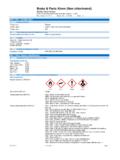
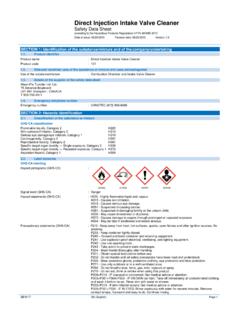
1 Kleen-Start Starting Fluid Page: 1/7 SECTION 1: PRODUCT AND COMPANY IDENTIFICATION Product identifier Trade Name kleen start Starting Fluid Product Code 730 Relevant identified uses of the substance or mixture and uses advised against Identified Use(s) Engine Starting aid Uses Advised Against None Company Identification kleen -Flo Tumbler Ind. Ltd. 75 Advance Blvd. Brampton, ON L6T 4N1 Telephone 905-793-4311 Fax 905-793-4318 Emergency telephone number Emergency Phone No. CANUTEC: 613-996-6666 SECTION 2: HAZARDS IDENTIFICATION Classification of the substance or mixture HPR/WHIMIS 2015/GHS Classification Flam. Aerosol 1; Compressed dissolved gas; Asp. Tox. 1; Carc. 2; Repr. 2; STOT SE 3; Skin Irrit. 2 Label elements Hazard Symbol Signal word(s) DANGER Hazard Statement(s) Extremely flammable aerosol. Contains gas under pressure; may explode if heated. May cause drowsiness or dizziness. Causes skin irritation. Suspected of causing cancer. Suspected of damaging the unborn child.
2 May be fatal if swallowed and enters airways Precautionary Statement(s) Obtain special instructions before use. Do not handle until all SAFETY precautions have been read and understood. Keep away from heat/sparks/open flames/hot surfaces. No smoking. Do not spray on an open flame or other ignition source. Do not pierce or burn, even after use. Protect from sunlight and do not expose to temperatures exceeding 50 C/122 F. Avoid breathing dust/fume/gas/mist/vapours/spray. Wear protective gloves/protective clothing/eye protection/face protection. Wash hands and exposed skin thoroughly after handling. Other hazards: Toxic to aquatic life. Harmful to aquatic life with long lasting effects. Additional Information: None SAFETY DATA SHEET According to Canada s Hazardous Products Regulations (HPR) SOR/2015-17 Kleen-Start Starting Fluid Page: 2/7 SECTION 3: COMPOSITION/INFORMATION ON INGREDIENTS Hazardous Ingredient(s) % wt. * CAS No. Hazard classification Heptane, branched, cyclic and linear 40 - 50 426260-76-6 Flam.
3 Liq. 2, H225 Asp. Tox. 1; H304 Skin Irrit. 2, H315 STOT SE 3, H336 Aquatic Acute 2; H401 Aquatic Chronic 3, H412 Diethyl ether 40 - 50 60-29-7 Flam. Liq. 1; H224 Acute Tox. 4;H302 STOT SE 3; H336 Carbon dioxide 5 - 10 124-38-9 Compressed dissolved gas; H280 Ethanol 1-5 64-17-5 Flam. Liq. 2; H225 Eye Irrit. 2; H319 Chloroethane 75-00-3 Flam. Gas 1; H220 Carc. 2; H351 Toluene 108-88-3 Flam. Liq. 2; H225 Repr. 2; H361 Skin Irrit. 2; H315 Eye Irrit. 2; H319 Asp. Tox. 1; H304 STOT SE 3; H336 STOT RE 2; H373 Aquatic Acute 2; H401 Aquatic Chronic 3; H412 Additional Information - Substances in the product which may present a health or environmental hazard, or which have been assigned occupational exposure limits, are detailed below.: None * The exact percentage withheld as a trade secret in accordance with 29 CFR SECTION 4: FIRST AID MEASURES Description of first aid measures Inhalation Move person to fresh air. If breathing is labored, administer oxygen.
4 If symptoms persist, obtain medical attention. Skin Contact Wash with plenty of water. If skin irritation or rash occurs: Get medical advice/attention. Take off contaminated clothing and wash before reuse. Eye Contact Rinse cautiously with water for several minutes. Remove contact lenses, if present and easy to do. Continue rinsing. If eye irritation persists, get medical advice/attention. Ingestion Do not give anything by mouth to an unconscious person. Seek medical treatment. Do NOT induce vomiting. Most important symptoms and effects, both acute and delayed Aspiration into the lungs may cause chemical pneumonitis, which can be fatal. Indication of any immediate medical attention and special treatment needed IF SWALLOWED: Immediately call a POISON CENTER or doctor/physician. Do NOT induce vomiting. Kleen-Start Starting Fluid Page: 3/7 SECTION 5: FIRE-FIGHTING MEASURES Extinguishing Media -Suitable Extinguishing Media Extinguish with carbon dioxide, dry chemical, foam or water spray.
5 -Unsuitable Extinguishing Media Do not use water jet. Special hazards arising from the substance or mixture Contains gas under pressure; may explode if heated. Advice for fire-fighters A self contained breathing apparatus and suitable protective clothing should be worn in fire conditions. Keep containers cool by spraying with water if exposed to fire. SECTION 6: ACCIDENTAL RELEASE MEASURES Personal precautions, protective equipment and emergency procedures Eliminate sources of ignition. Avoid contact with skin and eyes. Wear protective gloves/protective clothing/eye protection/face protection. Avoid breathing gas / vapours. Environmental precautions Prevent liquid entering sewers, basements and work pits. Avoid release to the environment. Methods and material for containment and cleaning up Cover spills with inert absorbent material. Transfer to a container for disposal or recovery. Reference to other sections None Additional Information None SECTION 7: HANDLING AND STORAGE Precautions for safe handling Wear protective gloves/eye protection.
6 Wash hands and exposed skin thoroughly after handling. Avoid release to the environment. Protect from sunlight and do not expose to temperatures exceeding 50 C/122 F. Conditions for safe storage, including any incompatibilities -Storage temperature Keep in a cool, well ventilated place. Store at temperatures not exceeding 50 C / 122 F. -Incompatible materials This product should be stored away from sources of strong heat or oxidizing chemicals. Specific end use(s) Engine Starting aid SECTION 8: EXPOSURE CONTROLS/PERSONAL PROTECTION Occupational Exposure Limits SUBSTANCE. CAS No. (8hr TWA) (STEL) Note: OEL (Canada) TLV (ACGIH) OEL (Canada) TLV (ACGIH) Heptane, branched, cylic and linear 426260-76-6 400 ppm 400 ppm 500 ppm 500 ppm ---- Carbon dioxide 124-38-9 5,000 ppm 5,000 ppm 30,000 ppm 30,000 ppm # Diethyl ether 60-29-7 400 ppm 400 ppm 500 ppm 500 ppm ---- Chloroethane 75-00-3 100 ppm 100 ppm ----- ----- *A3 #Assure minimum oxygen content of work atmosphere.
7 *A3 = Confirmed Animal Carcinogen with Unknown Relevance to Humans Recommended monitoring method NIOSH 1500 (hydrocarbons, 36 - 126 C); NIOSH 6603 (Carbon dioxide); NIOSH 1610 (Ethyl ether); NIOSH 2519 (Ethyl chloride) Exposure controls Appropriate engineering controls Provide adequate ventilation to ensure that the occupational exposure limit is not exceeded. Personal protection equipment Kleen-Start Starting Fluid Page: 4/7 Eye/face protection Wear protective eyewear (goggles, face shield, or SAFETY glasses). Skin protection (Hand protection/ Other) Wear suitable gloves if prolonged skin contact is likely. Check with protective equipment manufacturer's data. Use gloves only once. Respiratory protection In case of insufficient ventilation, wear suitable respiratory equipment. Check with protective equipment manufacturer's data. Thermal hazards Not normally required. Use gloves with insulation for thermal protection, when needed. Environmental Exposure Controls Avoid release to the environment.
8 SECTION 9: PHYSICAL AND CHEMICAL PROPERTIES Information on basic physical and chemical properties Appearance Liquid Color. Colorless Odor Sweetish, Hydrocarbon-like Odor Threshold (ppm) Not available pH (Value) Not available Melting Point ( C) / Freezing Point ( C) Not available Boiling point/boiling range ( C): 34 - 35 (Diethylether) Flash Point ( C) -45 (Diethylether) Evaporation Rate Not available Flammability (solid, gas) Extremely flammable Explosive Limit Ranges - v/v (Diethylether) Vapor pressure (Pascal) x 104 (Diethylether) Vapor Density (Air=1) Not available Density (g/ml) Not available Solubility (Water) Not available Solubility (Other) Not available Partition Coefficient (n-Octanol/water) Not available Auto Ignition Point ( C) 175 (Diethylether) Decomposition Temperature ( C) Not available Kinematic Viscosity (cSt) <20 @ 40 C Explosive properties Not available Oxidizing properties Not available Other information Not available SECTION 10: STABILITY AND REACTIVITY Reactivity Stable under normal conditions.
9 Chemical stability Stable. Possibility of hazardous reactions None anticipated. Conditions to avoid Avoid contact with heat and ignition sources. Incompatible materials Strong oxidizing agents Hazardous decomposition product(s) Carbon monoxide, Carbon dioxide, Acrid smoke SECTION 11: TOXICOLOGICAL INFORMATION Exposure routes: Inhalation, Skin Contact, Eye Contact Kleen-Start Starting Fluid Page: 5/7 Information on toxicological effects Heptane, branched, cylic and linear (CAS# 426260-76-6) - By analogy with similar materials: Acute toxicity Oral: LD50 >5 g/kg-bw Dermal: LD50 >2 g/kg-bw Inhalation: LC50 = 65 - 103 mg/L (Vapour), 4-hr. rat May cause drowsiness or dizziness. May be fatal if swallowed and enters airways. Irritation/Corrosivity Causes skin irritation. Repeated exposure may cause skin dryness or cracking. May cause eye irritation. Sensitisation It is not a skin sensitiser. Repeated dose toxicity NOAEC: 12350 mg/m3 (2 yr, inhal., rat, Systemic effects) LOAEC: 1650 mg/m3 (2 hr, inhal.)
10 , rat, CNS effects) May cause drowsiness or dizziness. Carcinogenicity No data. It is unlikely to present a carcinogenic hazard to man. NTP IARC ACGIH OSHA NIOSH No. No. No. No. No. Mutagenicity Toxicity for reproduction There is no evidence of mutagenic potential. No information available Diethyl Ether (CAS# 60-29-7): Acute toxicity Oral: LD50 = 1600 mg/kg-bw (rat) Dermal: LD50 >20000 mg/kg-bw (rabbit) May cause drowsiness or dizziness. Irritation/Corrosivity Non-irritant to skin and eye. Sensitisation It is not a skin sensitiser. Repeated dose toxicity Not to be expected. Carcinogenicity Not to be expected. NTP IARC ACGIH OSHA NIOSH No. No. No. No. No. Mutagenicity Not to be expected. Toxicity for reproduction Not to be expected. Toluene (CAS#108-88-3): Acute toxicity Oral LD50 = 5580 mg/kg (rat) Dermal LD50 >5000 mg/kg (rabbit) Inhalation LC50 (4 hour(s)) mg/l (rat) - Vapours may cause drowsiness and dizziness. Irritation / Corrosivity Causes serious eye irritation.