Transcription of ETHYL ETHER 1610
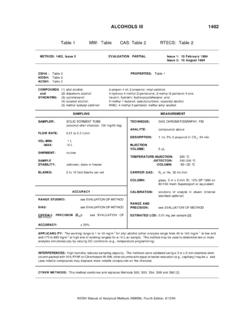
1 NIOSH Manual of Analytical Methods (NMAM), Fourth EditionETHYL ETHER1610(C2H5)2 OMW: : 60-29-7 RTECS: KI5775000 METHOD: 1610, Issue 3 EVALUATION: FULL Issue 1: 15 May 1985 Issue 3: 15 March 2003 OSHA : 400 ppmNIOSH: no RELACGIH: 400 ppm; STEL 500 ppm (1 ppm = mg/m3 @ NTP)PROPERTIES:liquid; d g/mL @ 20 oC; BP oC;MP - 116 oC; VP 59 kPa (440 mm Hg; 58%v/v) @ 20 oC; explosive range to 48% v/vin airSYNONYMS: diethyl ETHER ; 1,1'-oxybisethane; ETHYL oxideSAMPLINGMEASUREMENTSAMPLER:Solid Sorbent Tube(coconut shell charcoal, 100 mg/50 mg)FLOW to L/minVOL- L @ 400 ppm -MAX:3 LSHIPMENT:routineSAMPLESTABILITY:14 days @ 5 oCBLANKS:2 to 10 field blanks per setTECHNIQUE:GAS CHROMOTOGRAPHY, FIDANALYTE: ETHYL mL CS2; 30 min with agitationINJECTIONVOLUME:1 LTEMPERATURE:-INJECTION:250 oC-DETECTOR:300 oC-COLUMN:35 oC (1 min) - 150 oC @ 10 oC/minute,(split 5:1)CARRIER GAS:helium (1-2 mL/min)COLUMN:capillary, fused silica 30 m x.
2 1-:m film 100% dimethylpolysiloxane, Rtx-1 or equivalentCALIBRATION:solutions of ETHYL ETHER in CS2 RANGE:2 to 430 g per sample (capillarycolumn); 1800 to 7100 g per sample(packed column)ESTIMATED g per samplePRECISION ( r) @ 9 to 400 g per sampleACCURACYRANGE STUDIED:606 to 2400 mg/m3(3-L samples)[2] PRECISION ( rT) :+ 20%APPLICABILITY: The working range is 100 to 2700 mg/m3 (33 to 880 ppm) for a 3-L air sample. During sampling, highhumidity may greatly decrease the breakthrough volume. A sampling period of 15 min may be monitored for STEL complianceusing a flow rate of L/min.[3]INTERFERENCES: Any compound, such as pentane, with similar retention METHODS: This revises Method S80 [4] and NMAM 1610 (issue 2) [4].
3 ETHYL ETHER : METHOD 1610, Issue 3, dated 15 March 2003 - Page 2 of 4 NIOSH Manual of Analytical Methods (NMAM), Fourth Disulfide, low benzene grade.* ETHER , reagent grade.* , prepurified and , prepurified and , prepurified and filtered.* See SPECIAL : glass tube, 7 cm long, 6-mm OD, 4-mm ID, flame-sealed ends with plastic caps,containing two sections of activated (600 oC)coconut shell charcoal (front=100 mg; back =50 mg) separated by a 2-mm urethane foamplug. A silylated glass wool plug precedes thefront section and a 3-mm urethane foam plugfollows the back section. Pressure dropacross the tube must be less than kPa at1 L/min airflow.
4 Tubes are sampling pump, to L/min,with flexible connecting chromatograph, FID, integrator andcolumn (see page 1610-1). , glass, 2-mL, PTFE-lined , 10- L, 25- L, 250- , volumetric , volumetric, 1-mL with pipet PRECAUTIONS: ETHYL ETHER is a dangerous fire and explosion hazard (flash point = -45 oC) andtends to form explosive peroxides. Carbon disulfide is toxic and flammable (flash point = -30 oC). Preparesamples and standards in a well-ventilated : each personal sampling pump with a representative sampler in line. the ends of the sampler immediately before sampling. Attach sampler to personal samplingpump with flexible tubing.
5 At an accurately known flow rate between and L/min for a total sample size of to3 L. the samplers. Pack securely for shipment. SAMPLE PREPARATION: the front and back sorbent sections of the sampler tube in separate vials. Include the glasswool plug in the vial with the front sorbent section. mL carbon disulfide to each vial. Attach cap to each vial. to stand 30 min with occasional AND QUALITY CONTROL: daily with at least six working standards from below the LOD to 10 times the LOQ. Ifnecessary, additional standards may be added to extend the calibration curve. known amounts of ETHYL ETHER to carbon disulfide in 10-mL volumetric flasks and dilute to themark.
6 Prepare additional standards as needed by serial together with samples and blanks (steps 11 and 12). calibration graph (peak area vs. g ETHYL ETHER per sample). ETHYL ETHER : METHOD 1610, Issue 3, dated 15 March 2003 - Page 3 of 4 NIOSH Manual of Analytical Methods (NMAM), Fourth Edition desorption efficiency (DE) at least once for each lot of charcoal used for sampling in thecalibration range (step 8). three tubes at each of five levels plus three media and discard the back sorbent section of a blank a known amount (1 to 20 L) of ETHYL ETHER or a standard solution of ETHYL ETHER in carbondisulfide directly onto the front sorbent section with a microliter the tube.
7 Allow to stand (steps 5 through 7) and analyze together with working standards (steps 11 and 12). a graph of DE vs. g ETHYL ETHER three quality control blind spikes and three analyst spikes to ensure that the calibration graphand DE graph are in gas chromatograph according to manufacturer's recommendations and to conditions given onpage 1610-1. Inject sample aliquot manually using solvent flush technique or with autosampler. NOTE:If peak area is above the linear range of the working standards, dilute an aliquot of thedesorbed sample with carbon disulfide, reanalyze, and apply the appropriate dilution factor inthe peak the mass, g (corrected for DE), of ETHYL ETHER found in the sample front (Wf) and back(Wb) sorbent sections, and in the average media blank front (Bf) and back (Bb) sorbent sections.
8 NOTE:If Wb > Wf/10, report breakthrough and possible sample concentration, C, of ETHYL ETHER in the air volume sampled, V (L):EVALUATION OF METHOD:Issues 1 and 2 Method S80 was issued on February 14, 1975 [4], and evaluated over the range 630 to 2500 mg/m3 at 22 Cand 766 mm Hg for 3-L air samples desorbed in mL ETHYL acetate [2]. The concentrations were verifiedby using a total hydrocarbon analyzer. Breakthrough (5% on the backup section) occurred at 33 min whensampling a concentration of 2470 mg/m3 in dry air at a flow rate of L/min., corresponding to a capacityof 15 mg. The average DE was 98% over the range to mg ETHYL ETHER per sample.
9 Sample storagestability was not 3 The sensitivity of this method for ETHYL ETHER was lowered to cover a range from approximately 10 times theLOQ (based upon an improved LOD of g/sample) to 500 times ( REL) the LOQ. The desorptionefficiency was tested at four levels over the range of 8 - 428 :g/sample. The average recovery for ETHYL etherover this range was A 30-day storage stability study for ETHYL ETHER was completed during the methoddevelopment. The storage stability was determined at a level approximately REL. The analyte wasdetermined to be stable for 14 days when stored at 5 C with an average recovery of [1].
10 ETHYL ETHER : METHOD 1610, Issue 3, dated 15 March 2003 - Page 4 of 4 NIOSH Manual of Analytical Methods (NMAM), Fourth EditionREFERENCES:[1]Pendergrass SM, May LR [2000]. NMAM 1610, Issue 3, Backup Data Report. Cincinnati, OH: NationalInstitute for Occupational Safety & Health, DART (unpublished), April. [2]NIOSH [1977]. Documentation of the NIOSH Validation Tests, S80, Department of Health,Education, and Welfare, Publ. (NIOSH) 77-185, available as GPO Stock #017-033-00231-2 fromSuperintendent of Documents, Washington, DC 20402.[3]NIOSH/OSHA [1981]. NIOSH/OSHA Occupational Health Guidelines for Chemical Hazards, of Health and Human Services and Department of Labor, January 1981, Publ.