Transcription of How to tax the provision of a place of residence to …
1 How to tax the provision of a place of residence to the employee rental value , types of accommodation, treatment of rent paid by the employee and whether the employer has exercised proper control Foreword This leaflet explains how the provision of a place of residence to the employee is assessed to Salaries Tax. Under Salaries Tax, there are far too many kinds of benefits connected with housing to be described in one leaflet.
2 If the Assessor accepts that what the employer provides to the employee is a place of residence , only the Rental Value (RV) will be computed and charged to tax. If not so acceptable, the benefit provided by the employer must be assessed as a perquisite at its cash value. Examples of perquisites are rent allowance, refunds of mortgage payments, and subsidies on mortgage interest payments. employee is provided with a place of residence Housing benefits arising from employment are part of the employee s income.
3 If the employee is provided with a place of residence by the employer or an associated corporation of the employer, the RV of that place of residence should be included in his/her Assessable Income. The RV is calculated at 4%, 8% or 10% of his/her total net income from the employer and the associated corporation after deducting outgoings and expenses (excluding expenses of self-education), depending on the type of accommodation provided. See the table below and also Example 3. Type of Accommodation Percentage A residential unit / serviced apartment 10% 2 rooms in a hotel, hostel or boarding house 8% 1 room in a hotel, hostel or boarding house 4% Serviced apartments are popular nowadays.
4 Typically they are fully furnished units or apartments with domestic facilities such as cooking and laundry available and a minimum period of stay is usually required. The Inland Revenue Department ( IRD ) generally does not regard serviced apartments as rooms in hotels, hostels or boarding houses, although individual cases may be examined in detail to determine the nature of the accommodation. Accordingly, where the place of residence is a serviced apartment, the rate of 10% will generally be applied in computing the RV.
5 1 To compute the RV, rent paid by the employee to the employer or the landlord can be deducted to arrive at the RV. Furthermore, if the place of residence is a residential property, the employee may elect to include the Rateable Value of the property instead of the RV, if that can reduce the amount of tax to be paid. See analysis below. Scenario Adjustment No rent paid No adjustment Rent paid Deduct net rent paid from RV If the employee s tax liability can be reduced The employee may elect to include the Rateable Value of the residential unit instead of the RV 2 Example 1 Mr.
6 Chan earned $600,000 in a year. His employer Success Co Ltd provided a flat to him as his place of residence . He claimed deductions for annual subscription to the Hong Kong Institution of Engineers $2,000, contributions to Mandatory Provident Fund (MPF) $18,000 and expenses of self-education $27,500 in that year. Mr. Chan s Assessable Income would be $612,300, computed as follows $ Income 600,000 RV $(600,000 2,000) x 10% 59,800 659,800 Less: Outgoings and expenses (2,000) MPF contributions (18,000) Expenses of self-education (27,500) Assessable Income 612,300 Mr.
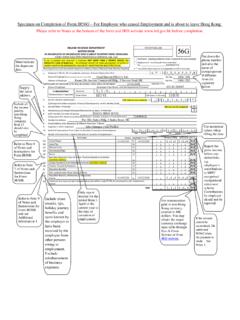
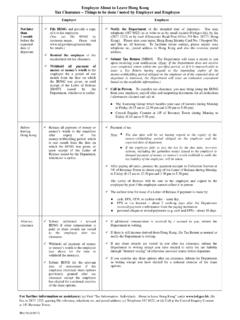
7 Chan s Tax Return Individuals (BIR60) Mr. Chan s Employer s Return of Remuneration and Pensions (IR56B) 3 Example 2 What would be the case if the Mr. Chan in Example 1 was required to pay monthly rent of $3,000 to his employer? Mr. Chan s Assessable Income would be $576,300, computed as follows $ Income 600,000 RV $(600,000 2,000) x 10% ($3,000 x 12) 23,800 623,800 Less: Sum of deductions in Example 1 (47,500) Assessable Income 576,300 Mr. Chan s Tax Return Individuals (BIR60) Mr. Chan s Employer s Return of Remuneration and Pensions (IR56B) 4 Example 3 Mr.
8 Lee came to work in Hong Kong on 1 April 2017. He was remunerated at salaries of $50,000 per month, plus a place of residence . During his first month in Hong Kong, he occupied one room in a hotel and the monthly rent was $8,000. On 1 May 2017, his wife and children arrived and the family moved into a 2-bedroom suite in the hotel and the monthly rent is $16,000. On 1 July 2017, he and his family moved into a flat owned by the employer. The RV should be computed as follows 1 April 2017 30 April 2017 ($50,000 x 1 x 4%) 1 May 2017 30 June 2017 ($50,000 x 2 x 8%) 1 July 2017 31 March 2018 ($50,000 x 9 x 10%) RV $ 2,000 8,000 45,000 55,000 Mr.
9 Lee s Tax Return Individuals (BIR60) Mr. Lee s Employer s Return of Remuneration and Pensions (IR56B) 5 Example 4 Mr. Cheung was a waiter of a restaurant and his annual income is $120,000. He and 5 other colleagues lived in a 3- bedroom flat provided by the employer, Good Taste Restaurant. He and his colleague, Mr. Ng, occupied one of the bedrooms. How should his RV be computed? This form of housing benefit is rather common in Hong Kong. This would be regarded as similar to occupying a room in a boarding house and Mr.
10 Cheung s RV would be computed at 4% of his income 4% x $120,000 = $4,800. Mr. Cheung s Tax Return Individuals (BIR60) Mr. Cheung s Employer s Return of Remuneration and Pensions (IR56B) 6 Example 5 Ms Lam was employed by a foreign company, Success (Overseas) Co Ltd. During the year of assessment 2017/18, her annual income was $600,000 and she stayed in Hong Kong for 250 days. Whilst in Hong Kong she lived in a flat provided by the employer throughout the year.