Transcription of Initiating Intravenous Therapy - mmLearn.org
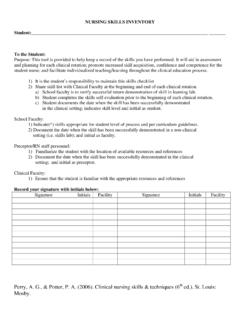
1 COMPETENCY TRAINING: clinical Nursing skills Initiating Intravenous Therapy Created 07/15/2010 1 Reference: Taylor s clinical Nursing skills & Techniques, 7th Edition skills Performance Checklists By Perry & Potter Student: Date: Instructor: Date: PERFORMANCE checklist skills 28-1 Initiating Intravenous Therapy Met Unmet IMPLEMENTATION Comments ____ ____ ____ ____ ____ ____ ____ ____ ____ ____ ____ ____ ____ ____ ____ ____ ____ ____ ____ ____ ____ ____ ____ ____ ____ ____ ____ ____ ____ ____ ____ ____ ____ ____ ____ ____ ____ ____ ____ ____ ____ ____ 1. Explain procedure to resident. 2. Assist resident to a comfortable position.
2 Provide adequate lighting. 3. Correctly verify resident s identity. 4. Perform hand hygiene. Organize equipment at bedside. 5. Use sterile technique to open sterile packages. 6. If needed, prepare IV infusion tubing and solution: a. Verify IV solution correctly prepare and label. Check expiration date. b. Open infusion set. c. Place roller clamp about 2 to 5 cm (1 to 2 inches) below drip chamber in the off position. d. Remove protective sheath over IV tubing port on IV solution bag. e. Insert infusion set spike (sterile) into fluid bag or bottle. f. Prime infusion tubing by compressing drip chamber and filling to 1/3 to 1/2 full.
3 G. Remove protector cap on end of tubing (if necessary), release roller clamp, and allow fluid to fill tubing. h. Remove air bubbles. i. Replace protector cap on end of infusion tubing. 7. Prepare heparin or normal saline lock for infusion. 8. Apply gloves. 9. Identify accessible vein. Apply flat tourniquet over sleeve above proposed insertion site. 10. Select appropriate well-dilated vein for IV insertion. a. Avoid undesirable locations such as infected sites, extremity with compromised circulation ( dialysis graft/fistula, mastectomy or paralysis) site with infiltration or thrombosis, sites distal to a previous site, sclerosed or hardened cordlike veins, veins in the antecubital fossa, veins in the ventral surface of the wrist.
4 B. Use nondominant extremity if able. COMPETENCY TRAINING: clinical Nursing skills Initiating Intravenous Therapy Created 07/15/2010 2 PERFORMANCE checklist skills 28-1 Initiating Intravenous Therapy (Continued) Met Unmet Comments ____ ____ ____ ____ ____ ____ ____ ____ ____ ____ ____ ____ ____ ____ ____ ____ ____ ____ ____ ____ ____ ____ ____ ____ ____ ____ ____ ____ ____ ____ ____ ____ ____ ____ ____ ____ ____ ____ ____ ____ ____ ____ ____ ____ ____ ____ c. Foster venous distention. (1) Place extremity in dependent position. (2) Stroke extremity from distal to proximal below site. (3) Apply warmth to area for several minutes.
5 (4) Avoid tapping or vigorous friction to vein. 11. Temporarily release tourniquet. Apply topical anesthetic as needed. 12. Place connection of infusion set or saline lock nearby on sterile surface. 13. Clean site with appropriate antiseptic and allow to dry. 14. Replace tourniquet 4 to 5 inches above selected insertion site and check resident s distal pulse. 15. Perform venipuncture: a. Anchor vein by placing thumb over vein and stretching skin distal to the selected site. b. Advise resident to remain still. Warn resident of sharp, quick stick. c. Insert over-the-needle catheter (ONC), IV catheter safety device, or winged (butterfly) needle with bevel up at a 10- to 30-degree angle slightly distal to the actual site in the direction of the vein.
6 16. Observe for blood return. Lower needle until almost flush with skin. Advance catheter approximately 1/8 to 1/4 inch. Continue to hold skin taut and advance catheter until hub rested at insertion site. 17. Stabilize catheter / needle with one hand and release tourniquet with the other hand. Remove stylet of ONC; do not recap stylet. Glide protective guard over stylet of IV safety device. 18. Connect end of infusion tubing set of heparin / saline lock adapter to end of catheter. 19. Flush injection cap of saline lock, if needed or slowly slide clamp open to begin infusion. 20. Secure catheter.
7 Follow agency policy. Use recommended dressing to secure the site. 21. Observe site for swelling. 22. Apply sterile dressing over site. 23. Loop tubing alongside arm and secure. 24. Recheck flow rates of IV fluid infusions. 25. Write date and time, VAD gauge and length, and personal initials on dressing. COMPETENCY TRAINING: clinical Nursing skills Initiating Intravenous Therapy Created 07/15/2010 3 PERFORMANCE checklist skills 28-1 Initiating Intravenous Therapy (Continued) Met Unmet Comments ____ ____ ____ ____ ____ ____ ____ ____ ____ ____ ____ ____ ____ ____ 26. Dispose of sharps in appropriate container.
8 Remove gloves and perform hand hygiene. 27. Instruct resident how to move around without dislodging the IV. 28. Observe resident every 1 to 2 hours to determine condition of IV site and status of infusion. Change IV site per policy or as needed. 29. Observe resident s response to IV Therapy . Documentation: 1. Record and report IV insertion and information about infusion and insertion site. 2. Record resident s response to IV infusion and assessment of infusion site. 3. Report unexpected outcomes to the nurse in charge or physician.