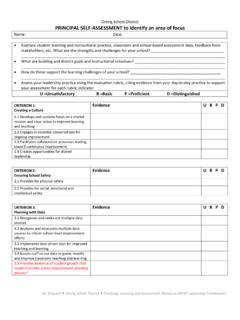
Transcription of T-PESS Principal Orientation Manual
1 T-PESS Principal Orientation Manual Texas Education Agency 8/15/2017 T-PESS Principal Orientation ManualTable of ContentsUser Guide .. 3 Introduction .. 3 Purposes of T-PESS .. 5 Key Priorities .. 5 Evaluation Process .. 6 Timeline and Schedule .. 9T- pess Timeline Sample .. 9 Roles and Expectations .. 10 Principal Expectations .. 10 Appraiser Expectations .. 10 Texas Principal Standards .. 11 Standard 1 Instructional Leadership .. 11 Standard 2 Human Capital .. 12 Standard 3 Executive Leadership .. 13 Standard 4 School Culture .. 14 Standard 5 Strategic Operations .. 15T- pess Rubric Design .. 16 Performance Levels .. 17 Performance Indicators.
2 17 Performance Descriptors .. 18 Research-based Responsibilities and Practices .. 18 Principal Competencies .. 21 Implementing T-PESS .. 24 Appraiser 24 Orientation .. 24 self - assessment and Review of Goal Setting .. 25 Beginning-of-Year Conference and Goal 30 Data Collection and Site Visits .. 30 Mid-Year Conference and Goal Progress Review .. 31T- pess Orientation Manual TEA 8/15/2017 Table of Contents Collection and Summary of Artifacts and Evidence .. 32 End- of-Year Conference and Goal Review .. 32 Summative Annual Appraisal Report .. 32 References .. 36 Glossary .. 37 Guidance on Student Growth in T-PESS .. 41T- pess Look Fors.
3 47 Principal self - assessment and Goal Setting 49 Getting Started Instructions .. 50 Principal self - assessment Form .. 51 Beginning-of-year Goal Setting 733 TEA 8/15/2017 T-PESS User GuideIntroduction Texas recognizes that school leadership is critical to the success of recruiting and retaining top teachers and fostering an environment in which student learning flourishes. To that end, Senate Bill 13831 (82nd Regular Legislative Session) was codified in Section of the Texas Education Code. This statue directed the Texas Education Agency to accomplish the following initiatives: establish and administer a comprehensive appraisal and professional developmentsystem for public school principals; assist in developing the system and make recommendations about the training,appraisal, professional development, and compensation of principals; and est ablish school leadership standards and a set of indicators of successful schoolleadership to align with such training, appraisal, and professional Texas Education Agency (TEA) and the Principal Evaluation Steering Committee completed the new Principal standards in 2013.
4 These new standards are found in Chapter 149 of the Texas Administrative Code3 and are expected to serve as the foundation for the new leadership appraisal and support system. The Texas Principal Standards involve best practices for principals to be effective leaders and improve student performance, primarily by reframing the central role of the Principal as the instructional leader of a campus. The standards are not intended to be performance indicators used for appraisal, but instead embody the practices toward which all principals can strive regardless of their level of experience or the context of their position. In that sense, the standards form the foundation on which the state appraisal system is built.
5 Furthermore, the standards will assist in informing and supporting educator preparation, mentorship, professional development, and career pathway programs and systems that strengthen the educational leadership workforce in the state of Texas. During the 2014-2015 school year TEA planned the development and pilot of the Texas Principal Evaluation and Support System ( T-PESS ) based on the new Principal standards and in accordance with state statute. T-PESS was piloted in approximately 54 districts representing a robust sample of urban, rural, and suburban schools of various sizes and geographic locations. The Principal evaluation system was planned, developed, and implemented thoughtfully with a focus on continuously improving educator performance, student results, and school productivity.
6 1 Senate Bill 1383. Retrieved from outside source, retrieved 11/2014: 2 Section Texas Education Code. Retrieved from outside source 11/2014: # 3 Texas Administrative Code (TAC), Title 19, Part II Chapter : Commissioner s Rules Concerning Educator Standards: Principal Standards. Retrieved from outside source, retrieved 11/2014 (http: 3T- pess Orientation ManualUser Guide TEA 8/15/2017 As an integral part of the development process, TEA convened a steering committee of leaders representative of all levels of the K-12 Texas educational system, representatives from higher education leadership preparation programs, and nationally recognized experts in the field of educator effectiveness and personnel evaluation.)
7 These educational professionals were charged with designing and developing a research-based system for supporting and evaluating Texas principals. The committee convened in early 2014 to begin work on the development of an evaluation instrument and supporting system that reflected the newly developed Texas Principal Standards and met the fundamental tenets of the primary purposes for evaluation and support of school principals. The instrument, supporting process, and materials were drafted and tested in late May 2014 in preparation for the first year of a two-year pilot that began in the fall of the 2014-2015 school year. Results of the pilot test were used to strengthen the evaluation instrument, evaluation process, and implementation of Section of the Texas Education Orientation ManualUser Guide TEA 8/15/2017 Purposes of T-PESS T- pess clarifies what effective principals should know andbe able to do leading to increased consistency and rigor inthe evaluation process.
8 The system is intended to enhancecommunication between a supervisor and a Principal withtransparency, fairness, and constructive feedback. By usingthe results of the evaluation to guide their own professionaldevelopment, all principals will be able to chart a course forprofessional growth from the novice Principal just beginningthe journey of development to the experienced and aneffective school leader seeking to be influential throughoutthe Priorities During the development of T-PESS , the Texas Principal Evaluation Steering Committee agreed on four key priorities as the guiding principles for the process. Systematically revisiting these principles throughout implementation serves to anchor the process and to increase the impact for all stakeholders.
9 Using these priorities as operating principles offers the opportunity for T-PESS to fulfill the purposes of according to the Texas Administrative Code and strengthen leadership performance across the state of Texas. The Steering Committee s key priorities for Principal evaluation are the following: Personify continuous growth and improvement Guide self -reflection Inform professional development Improve leadership qualityFocused attention on Principal support and evaluation provides the unique opportunity to redefine and strengthen the larger system of educator quality and effectiveness. Leadership is a complex task requiring a dynamic combination of knowledge, skills, and dispositions to realize a number of outcomes, most important, the educational needs of all students.
10 Positive outcomes are obtained when systems of evaluation have trustworthy information about effective teaching, leading, and learning and are aligned with other systems across the school district. T-PESS , its purposes, and its key priorities, exemplify TEA s commitment to the process of ensuring that this part of the larger system is meaningful, manageable, and operates in a way that is coherent and supportive of leadership effectiveness, school productivity, and student outcomes. 5T- pess Orientation ManualUser Guide TEA 8/15/2017 Evaluation Process The T-PESS process is comprised of a series of ongoing actions and activities (see Figure 1) intended to embody the essence of a reflective and responsive practitioner.