Transcription of Principal Evaluation Rubrics
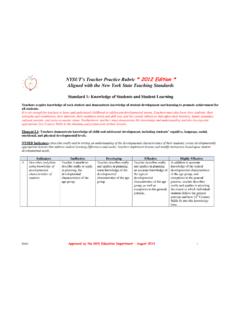
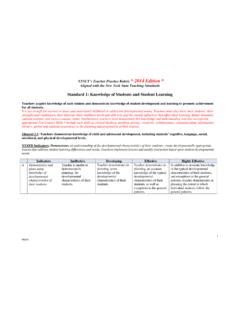
1 Principal Evaluation Rubrics by Kim Marshall Revised August 21, 2011 Rationale and suggestions for implementation 1. These Rubrics are organized around six domains covering all aspects of a Principal s job performance: A. Diagnosis and Planning B. Priority Management and Communication C. Curriculum and Data D. Supervision, Evaluation , and Professional Development E. Discipline and Parent Involvement F. Management and External Relations The Rubrics use a four-level rating scale with the following labels: 4 Highly Effective 3 Effective 2 Improvement Necessary 1 Does Not Meet Standards 2. The Rubrics are designed to give principals and other school-based administrators an end-of-the-year assessment of where they stand in all performance areas and detailed guidance for improvement. These Rubrics are not checklists for school visits. To knowledgeably fill out the Rubrics , a supervisor needs to have been in the school frequently throughout the year; it is irresponsible to fill out the Rubrics based on one visit and without ongoing dialogue.
2 3. The Effective level describes solid, expected professional performance; any administrator should be pleased with scores at this level. The Highly Effective level is reserved for truly outstanding leadership as described by very demanding criteria; there will be relatively few scores at this level. Improvement Necessary indicates that performance has real deficiencies and must improve (although some novice administrators might start here). And performance at the Does Not Meet Standards level is clearly unacceptable and will lead to dismissal if it is not improved immediately. 4. To score, read across the four levels of performance for each criterion, find the level that best describes the Principal s performance, and circle or highlight it. On each page, this will create a clear graphic display of overall performance, areas for commendation, and areas that need work.
3 Write the overall score at the bottom of each page with brief comments, and then record all the scores and overall comments on the summary page. 5. Evaluation conferences are greatly enhanced if the supervisor and administrator fill out the Rubrics in advance and then meet and compare one page at a time. Of course, the supervisor has the final say, but the discussion should aim for consensus based on actual evidence of the most accurate score for each criterion. Supervisors should go into Evaluation process with some humility since they can t possibly know everything about an administrator s complex world. Similarly, administrators should be open to feedback from someone with an outside perspective all revolving around whether the school is producing learning gains for all students. Note that student achievement is not explicitly included in these Rubrics , but clearly it s directly linked to school leadership.
4 How student results factor into Evaluation is for each district or governing board to decide. 6. Some supervisors sugar-coat criticism and give inflated scores to keep the peace and avoid hurting feelings. This does not help an administrator improve. The kindest thing a supervisor can do for an underperforming administrator is give candid, evidence-based feedback and robust follow-up support. Honest scores for all the administrators in a district can be aggregated into a spreadsheet that can give an overview of leadership development needs (see page 9 for a sample). A. Diagnosis and PlanningThe Principal :4 Highly Effective3 Effective2 Improvement Necessary1 Does Not Meet a strong leadership team and develops its skills and commitment to a high and develops a leadership team with a balance of one or two like-minded colleagues to provide advice and solo with little or no support from stakeholders in a comprehensive diagnosis of the school s strengths and assesses the school s strengths and areas for a quick assessment of the school s strengths and unable to gather much information on the school s strong and weak colleagues by presenting the gap between current student data and a vision for college colleagues by comparing students current achievement with rigorous data without a vision or a vision without students low achievement and shows fatalism about bringing about significant staff and student buy-in for a succinct.
5 Inspiring, results-oriented mission a memorable, succinct, results-oriented mission statement that's known by all a boiler-plate mission statement that few colleagues not share a mission strong staff commitment on a bold, ambitious 3-4-year student achievement target. Builds staff support for a 3-4-year student achievement confidence that student achievement will improve each year through hard one year at a time and does not provide an achievement staff ownership for a robust, research-based theory of action for improving and writes a convincing theory of action for improving colleagues' current notions of how student achievement is that hard work improves achievement but shows doubts that progress can be crafts a lean, comprehensive, results-oriented strategic plan with annual input and writes a comprehensive, measurable strategic plan for the current a cumbersome, non-accountable strategic the previous year s cumbersome.
6 Non-accountable strategic a sense of urgency and responsibility among all stakeholders for achieving annual ownership and support among stakeholders for achieving annual the annual plan to stakeholders and asks them to support the necessary signatures for the annual plan, but there is little ownership or wins over resistant staff members who feared change and/or harbored low resistance, low expectations, and fear of on persuading resistant staff members to get on board with the discouraged and immobilized by staff resistance, fear of change, and low tracks progress, gives and takes feedback, and continuously improves measures progress, listens to feedback, and revises the strategic focuses on key data points and prods colleagues to too caught up in daily crises to focus on emerging data. Overall rating:____ Comments: B. Priority Management and CommunicationThe Principal :4 Highly Effective3 Effective2 Improvement Necessary1 Does Not Meet for the year, month, week, and day, relentlessly getting the highest-leverage activities for the year, month, week, and day, keeping the highest-leverage activities front and to work with a list of tasks that need to be accomplished that day but is often distracted from a list in his or her head of tasks to be accomplished each day, but often loses track.
7 Communicates goals to all constituencies by skillfully using a variety of a variety of means ( , face-to-face, newsletters, websites) to communicate goals to a limited communication repertoire and some key stakeholders are not aware of school not an effective communicator, and others are often left guessing about policies and solicits and uses feedback and help from staff, students, parents, and external reaches out to staff, students, parents, and external partners for feedback and asks staff, students, parents, or external partners for or never reaches out to others for feedback or a foolproof system for capturing key information, remembering, prioritizing, and following down important information, remembers, prioritizes, and almost always follows things down but is swamped by events and sometimes doesn t follow his or her memory to retain important information.
8 But often forgets and fails to follow ExpectationsHas total staff buy-in on exactly what is expected for management procedures and sure staff know what is expected for management procedures and reminds teachers of policies on management procedures and constantly reminding staff what they should be doing in management and highly competent people in all key roles and is able to entrust them with maximum appropriate tasks to competent staff members and checks on 't delegate some tasks that should be done by almost everything him- or gets all key teams meeting regularly and taking responsibility for productive that key teams ( , leadership, grade-level, student support) meet to call key team meetings because they are not in people s grade-level, leadership, and other teams only when there is a crisis or an immediate the initiative so that time-wasting activities and crises are almost always prevented or effective at preventing and/or deflecting many time-wasting crises and to prevent them, but crises and time-wasters sometimes eat up lots of time.
9 Finds that large portions of each day are consumed by crises and time-wasting quickly and decisively with the highest-priority e-mail and paperwork, delegating the a system for dealing with e-mail, paperwork, and administrative to stay on top of e-mail, paperwork, and administrative chores but is often way behind on e-mail, paperwork, and administrative chores, to the detriment of the school's sharp and fresh by tending to family, friends, fun, exercise, nutrition, sleep, and healthy and focused by balancing work demands with healthy sometimes unfocused and inattentive because of fatigue and unproductive and irritable because of fatigue and rating:____ Comments: C. Curriculum and DataThe Principal :4 Highly Effective3 Effective2 Improvement Necessary1 Does Not Meet all teachers to buy into clear, manageable, standards-aligned grade-level goals with exemplars of proficient teachers exactly what students should know and be able to do by the end of each grade teachers to district or national scope-and-sequence documents for curriculum teachers without clear direction on student learning outcomes for each grade level.
10 That all teams use summative data from the previous year and fresh diagnostic data to plan teacher teams with previous-year test data and asks them to assess students current teachers to previous-year test data as a baseline for current-year not provide historical test data to each grade-level/subject team invested in reaching measurable, results-oriented year-end with grade-level and subject-area teams to set measurable student goals for the current grade-level/subject teams to set measurable student learning goals for the current teachers to improve student achievement, but without measurable outcome that all teachers have high-quality curriculum materials, technology, and training on how to use teachers effective literacy, math, science, and social studies materials and to procure good curriculum materials in literacy and teachers to fend for themselves with curriculum InterimsEnsures that high-quality, aligned, common interim assessments are given by all teacher teams at least four times each common interim assessments to monitor student learning several times a that teacher teams give common interim assessments to check on student 't insist on common interim assessments, allowing teachers to use their own classroom high-quality data/action team meetings after each round of teacher teams as they analyze interim assessment results and formulate action that teacher teams work together to draw lessons from the tests they not see the value of analyzing tests given during the data meetings engaged in a no-blame.