Transcription of Gabapentin and Postoperative Pain - …
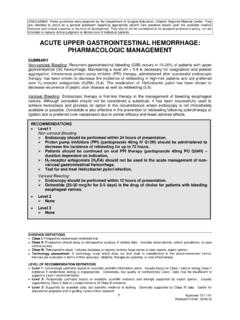
1 DISCLAIMER: These guidelines were prepared by the Department of Surgical Education, Orlando Regional Medical Center. They are intended to serve as a general statement regarding appropriate patient care practices based upon the available medical literature and clinical expertise at the time of development. They should not be considered to be accepted protocol or policy, nor are intended to replace clinical judgment or dictate care of individual patients. EVIDENCE DEFINITIONS Class I: Prospective randomized controlled trial. Class II: Prospective clinical study or retrospective analysis of reliable data. Includes observational, cohort, prevalence, or case control studies. Class III: Retrospective study. Includes database or registry reviews, large series of case reports, expert opinion.
2 Technology assessment: A technology study which does not lend itself to classification in the above-mentioned format. Devices are evaluated in terms of their accuracy, reliability, therapeutic potential, or cost effectiveness. LEVEL OF RECOMMENDATION DEFINITIONS Level 1: Convincingly justifiable based on available scientific information alone. Usually based on Class I data or strong Class II evidence if randomized testing is inappropriate. Conversely, low quality or contradictory Class I data may be insufficient to support a Level I recommendation. Level 2: Reasonably justifiable based on available scientific evidence and strongly supported by expert opinion. Usually supported by Class II data or a preponderance of Class III evidence.
3 Level 3: Supported by available data, but scientific evidence is lacking. Generally supported by Class III data. Useful for educational purposes and in guiding future clinical research. 1 Approved 9/28/2016 Gabapentin FOR ACUTE Postoperative PAIN SUMMARY Gabapentin (Neurontin ) has gained significant interest as part of a multi-modal pain management strategy for the control of acute pain. There has been considerable variation in both the dose and the regimen used in recent clinical trials. Most have relied on pre-operative dosing and have utilized a single dose of 300 to 1200 mg. Higher doses seem to show a decrease in Postoperative pain, a reduction in narcotic requirement, and reduction in narcotic related adverse effects such as nausea, vomiting, and ileus, with a propensity for causing sedation and dizziness.
4 INTRODUCTION Gabapentin and other anticonvulsant medications have been established as an effective treatment for chronic neuropathic pain and are commonly used for such conditions as herpetic neuralgia, diabetic neuropathy, and phantom limb pain following amputation. These medications act by reducing the activity of calcium channels in GABA-ergic neurons thereby activating the noradrenergic spinal pathway which in turn reduce the expression of the spinal cord excitatory amino acids glutamate and aspartate. There has been recent interest in this medication for use as an adjunct for acute pain as part of a multi-modal pain management strategy. LITERATURE REVIEW In 2004, Pandey et al. investigated the use of a single 300 mg dose of Gabapentin preoperatively in patients undergoing single level lumbar discectomy (1).
5 They found that patients receiving Gabapentin preoperatively had a decrease in use of post-operative fentanyl ( g vs. g). In RECOMMENDATIONS Level 1 Pre-operative Gabapentin (600-1200 mg) reduces Postoperative pain scores, decreases narcotic requirement, and decreases narcotic-related side effects such as nausea, and ileus. Level 2 Post-operative Gabapentin (600 mg) may be equally effective as a preoperative dose in improving pain scores and decreasing narcotic requirement and narcotic related side effects. Data does not support repeat dosing of Gabapentin in the Postoperative period. Level 3 Concomitant administration of Gabapentin as part of a multi-modal pain management strategy including narcotics, non-steroidals, and muscle relaxants may improve pain scores in selected patients.
6 2 Approved 9/28/2016 a follow up study in 2005, they evaluated Gabapentin in increasing dosages to evaluate for the optimal pre-operative dose (2). Patients were divided into 5 groups and received placebo, 300 mg, 600 mg, 900 mg, or 1200 mg. They found that pre-operative Gabapentin decreased patient use of fentanyl at all dosages. There was no advantage found in raising the dose from 600 mg to 1200 mg. They concluded 600 mg was the optimal dose for pre-operative Gabapentin administration. In 2006, Ho et al. performed a review of 16 randomized controlled trials (RCTs) evaluating the use of preoperative Gabapentin in controlling Postoperative pain (3). This was a very heterogeneous group that included orthopedic, gynecologic, urologic, breast, and head/neck surgeries.
7 They found that a single preoperative dose of 1200 mg effectively reduced Postoperative pain and opioid consumption. Multiple doses of Gabapentin preoperatively, and continued postoperatively, did not appear to reduce pain scores. Incidence of opioid adverse effects such as vomiting, and pruritus were lower in the Gabapentin group. Although not statistically significant, there was a trend toward a lower incidence of nausea, urinary retention, and constipation in the Gabapentin group. The incidence of sedation was higher in the Gabapentin group and there was a trend towards increased dizziness. In 2007, Peng et al. published a meta-analysis of RCTs in the management of acute Postoperative pain using Gabapentin (4). This analysis included 1181 patients including open gynecologic procedures, orthopedic procedures of the spine and lower extremity, breast surgery, procedures of the head and neck, open nephrectomy, and laparoscopic cholecystectomy.
8 The majority of studies used doses of 600 mg to 1200 mg preoperatively in addition to continued administration in the Postoperative period. A study of laparoscopic cholecystectomy included in the analysis used a dose of 300 mg. They found that Gabapentin resulted in a 35% reduction in total analgesic consumption in the first 24 hours following surgery. Gabapentin also resulted in 27% to 39% reduction in visual analog scale (VAS) pain scores in the first 24 hours postoperatively. It reduced opioid-related nausea, vomiting, and pruritus although there was an increase in dizziness and sedation. They did note that there was significant heterogeneity in the magnitude of the benefit from adding Gabapentin . Subgroup analysis based on surgical procedure, Gabapentin dosing, or study quality could not explain the heterogeneity observed.
9 Solak et al. in 2007 evaluated Gabapentin in patients with chronic post-thoracotomy pain (5). This group compared Gabapentin in stepwise increasing dosages of up to 2400 mg daily with naproxen. The Gabapentin was increased in a stepwise fashion during the period of treatment until the patients were all on 2400 mg daily by the end of the study period. Patients in the naproxen group received 1000 mg daily in divided doses. At the conclusion of the 60 day trial, patients in the Gabapentin group showed improved VAS pain scores and improved Leeds Assessment of Neuropathic Symptoms and Signs (LANSS) scores compared to patients in the naproxen group. In 2006, Sihoe et al. evaluated Gabapentin in the treatment of chronic pain after chest surgery (6). This was a heterogeneous group of patients.
10 Twelve patients were chest trauma victims, 22 with video assisted thoracoscopic surgery (VATS) approach, 8 with open thoracotomies, and 3 with median sternotomies. Patients were started on a dose of Gabapentin 300 mg daily and titrated up to a total dose of 900 mg daily for uncontrolled symptoms. At the conclusion of the study, 73% of patients reported a reduction in their pain score, and 42% reported a reduction of 50% or more. In 2010, the Cochrane Library published a review of four RCTs evaluating single-dose Gabapentin in doses from 250 to 500 mg in treating acute pain (7). Three of these studies used a third molar dental extraction model, and one in major orthopedic surgery. All patients were given Gabapentin in combination with opioids, or NSAIDs.