Transcription of Invasive Hemodynamic Monitoring - …
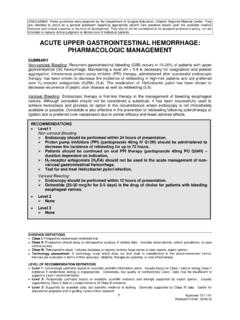
1 DISCLAIMER: These guidelines were prepared by the Department of Surgical Education, Orlando Regional Medical Center. They are intended to serve as a general statement regarding appropriate patient care practices based upon the available medical literature and clinical expertise at the time of development. They should not be considered to be accepted protocol or policy, nor are intended to replace clinical judgment or dictate care of individual patients. EVIDENCE DEFINITIONS Class I: Prospective randomized controlled trial. Class II: Prospective clinical study or retrospective analysis of reliable data. Includes observational, cohort, prevalence, or case control studies. Class III: Retrospective study. Includes database or registry reviews, large series of case reports, expert opinion.
2 Technology assessment: A technology study which does not lend itself to classification in the above-mentioned format. Devices are evaluated in terms of their accuracy, reliability, therapeutic potential, or cost effectiveness. LEVEL OF RECOMMENDATION DEFINITIONS Level 1: Convincingly justifiable based on available scientific information alone. Usually based on Class I data or strong Class II evidence if randomized testing is inappropriate. Conversely, low quality or contradictory Class I data may be insufficient to support a Level I recommendation. Level 2: Reasonably justifiable based on available scientific evidence and strongly supported by expert opinion. Usually supported by Class II data or a preponderance of Class III evidence. Level 3: Supported by available data, but scientific evidence is lacking.
3 Generally supported by Class III data. Useful for educational purposes and in guiding future clinical research. 1 Approved 9/28/2016 NONINVASIVE/MINIMALLY Invasive Hemodynamic Monitoring SUMMARY Noninvasive or minimally Invasive Hemodynamic Monitoring technologies are widely used to guide volume resuscitation. The results of clinical trials investigating the use of such technologies are conflicting. Controversy surrounds the optimal clinical setting in which to effectively utilize these monitors, but there is promising data that postoperative complications may be reduced with a goal-directed approach to fluid management. INTRODUCTION Central to effective shock resuscitation is optimization of oxygen delivery. Cardiac index (CI), a product of stroke volume and heart rate [CI= (stroke volume x heart rate) / body surface area], remains a critical component to focus upon and optimize during patient resuscitation.
4 Instrumentation to monitor CI is helpful to discern what interventions are necessary to improve tissue perfusion. Fluid administration remains the most common intervention to improve oxygen delivery as it improves stroke volume and overall systemic perfusion by increasing preload via the Starling curve (1). Goal-directed fluid therapy during resuscitation, for the purpose of strategic intravascular volume replacement, has evolved significantly. For years, pulmonary artery catheterization (PAC) remained the key modality to guide patients resuscitation. In the past decade, noninvasive or minimally Invasive Hemodynamic monitors have been extensively studied in their ability to provide efficacious goal-directed Hemodynamic therapy to patients with cardiovascular compromise.
5 This guideline focuses on three such strategies: stroke volume variation (SVV), pulse pressure variation (PPV), and plethysmographic variability index (PVI). RECOMMENDATIONS Level 1 None Level 2 Intraoperative stroke volume variation (SVV) Monitoring of low- to moderate-risk surgical patients is associated with earlier return of bowel function. Intraoperative SVV or pulse pressure variation (PPV) Monitoring of high-risk surgical patients lowers complication rates including infection. Changes in plethysmographic variability index (PVI) can predict improvement in cardiac index after volume loading in mechanically ventilated patients. Level 3 PPV may be useful for directed fluid management when positive end-expiratory pressure (PEEP) levels exceed 10 cm H2O Noninvasive or minimally Invasive Hemodynamic monitors do not predict the amount of fluid needed for adequate resuscitation 2 Approved 9/28/2016 LITERATURE REVIEW Stroke volume variation (SVV) A prospective randomized study in 2010 sought to identify possible benefits of intraoperative fluid optimization for 215 high-risk patients undergoing abdominal surgery (2).
6 High-risk status was assigned if at least one criterion from procedure-related and patient-related risk factors was present. Two groups were provided fluids based on routine intraoperative care and SVV. Routine care was defined by the administration of fluid or vasoactive medications based on heart rate, urine output, and central venous pressure (CVP). In the investigation group, intervention with fluid or vasoactive medication was provided when the SVV measurement rose by more than 10% over a period of five minutes. Intraoperatively, the SVV group received more colloid during surgery (1425 ml vs. 1000 ml) and had fewer hypotensive episodes (2 vs. ). SVV patients were observed to have lower lactate levels immediately following surgery ( mmol/L vs.)
7 Mmol/L). Moreover, lactate levels remained significantly higher in the control group up to 8 hours postoperatively. Fewer patients experienced complications in the SVV group (18 patients vs. 35 patients) and the overall number of complications was reduced in the SVV group (34 vs. 77). There was no reported difference in ICU length of stay or overall mortality. Thus the authors concluded that the use of intraoperative goal-directed intervention based on SVV >10% resulted in decreased serum lactate at the conclusion of surgery and improved hemodynamics during surgery. SVV guided therapy also resulted in fewer complications. A smaller study performed across multiple centers was completed in 2013 (3). Again, the study utilized SVV intraoperatively in high-risk surgical patients.
8 This study was intentionally small in order to document the feasibility of carrying out a much larger study with a similar protocol across multiple centers. The objective of the study was to determine the proportion of patients developing postoperative complications in a control group and a group using SVV. Outcomes documented and compared were sequential organ failure assessment (SOFA) score, therapeutic intervention scoring system (TISS) scores, ICU discharge criteria being met, ICU length of stay, and 28 day mortality. In the control group, a standardized approach was utilized but not explicitly defined. In the investigation group, intervention with 200 ml of colloid was administered if SVV rose above 10%. Intraoperatively, the SVV group received more colloid (1589 ml vs. 927 ml).
9 Meanwhile, the control group received more red blood cells (319 ml vs 685 ml). Postoperatively, the SVV group had a significantly reduced rate of infection (0 infections vs. 7 infections). The maximum SOFA score and the cumulative TISS score were lower in the SVV group but not statistically significant. The number of ventilator days was lower in the SVV group ( days vs days) but not statistically significant. In 2012, a similarly designed study observed the outcomes when SVV guided therapy was compared to routine care in low to moderate risk patients undergoing abdominal surgery (4). This study used an SVV of >12% as a threshold for intervention in the investigation group. Intervention in the control group was guided by routine cardiovascular Monitoring based on heart rate, blood pressure, and urine output.
10 Colloid and crystalloid were again used for intervention in both groups. The primary outcome was documentation of return of gastrointestinal function. Both groups had SVV data available, but in the control group the anesthesiologist was blinded to the data. No significant differences were discovered in intraoperative fluid balance, change in hemoglobin concentration, urine output, surgery time, or opioid administration. However, length of stay was shorter ( days vs. days), return of bowel function was faster ( days vs. days), soft diet initiation was sooner ( days vs. days). Based on these results, the authors conclude that the benefit of goal-directed Hemodynamic therapy using SVV may not be limited to only high risk surgical patients.