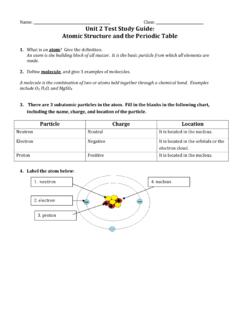
Transcription of Unit 2 Atomic Structure - teachnlearnchem.com
1 1 unit 3: Atomic Structure Name: _____ Basics of the Atom Particle Charge Location in the Atom Mass : unit used to measure mass of atoms Atomic number: -- -- mass number: To find net charge on an atom, consider ____ and ____. ion: anion: a ( ) ion cation: a (+) ion -- -- -- -- Description Net Charge Atomic Number Mass Number Ion Symbol 15 p+ 16 n0 18 e 38 p+ 50 n0 36 e 128 Te2 18 e 1+ 39 2 Historical Development of the Atomic Model Greeks (~400 ) Hints at the Scientific Atom ** Antoine Lavoisier: law of conservation of mass ** Joseph Proust (1799): law of definite proportions: every compound has a fixed proportion , chromium (II) ** John Dalton (1803): law of multiple proportions: When two different compounds have same two elements, equal mass of one element results in integer multiple of mass of other.
2 , hydrogen , chromium (II) chromium (VI) John Dalton s Atomic Theory (1808) 1. Elements are made of indivisible particles called atoms. 2. Atoms of the same element are exactly alike; in particular, they have the same mass. 3. Compounds are formed by the joining of atoms of two or more elements in fixed, whole number ratios. , ** William Crookes (1870s): Rays causing shadow were emitted from cathode. The Thomsons (~1900) Thomson discovered that cathode rays ..deflected by electric and magnetic fields .. Greek model of atom Dalton s model of atom 3 William Thomson ( , Lord Kelvin): Since atom was known to be electrically neutral, he proposed the plum pudding model. -- Equal quantities of (+) and ( ) charge distributed uniformly in atom.
3 -- (+) is ~2000X more massive than ( ) ** James Chadwick discovered neutrons in 1932. -- -- Ernest Rutherford (1909): Gold Leaf Experiment Beam of -particles (+) directed at gold leaf surrounded by phosphorescent (ZnS) screen. Most -particles passed through, some angled slightly, and a tiny fraction bounced back. Conclusions: 1. 2. 3. Recent Atomic Models Max Planck (1900): proposed that amounts of energy are quantized .. -source lead block ZnS screen particle beam gold leaf Thomson s plum pudding model Rutherford s model 4 Niels Bohr (1913): e can possess only certain amounts of energy, and can therefore be only certain distances from nucleus. Schr dinger, Pauli, Heisenberg, Dirac (up to 1940): According to the QMM, we never know for certain where the e are in an atom, but the equations of the QMM tell us the probability that we will find an electron at a certain distance from the nucleus.
4 Light When all e are in lowest possible energy state, an atom is in the _____. , If right amount of energy is absorbed by an e , it can jump to a higher energy level. This is an unstable, momentary condition called the _____. , When e falls back to a lower-energy, more stable orbital (it might be the orbital it started out in, but it might not), atom releases the right amount of energy as light. Any-old-value of energy to be absorbed or released is NOT OK. This explains the lines of color in an emission spectrum. quantum mechanical model electron cloud model charge cloud model 5 Emission Spectrum for a Hydrogen Atom Lyman series: Balmer series: Paschen series: Isotopes different varieties of an element s atoms -- -- Isotope Mass p+ n0 Common Name H 1 H 2 H 3 C 12 atoms C 14 atoms Radioactive Isotopes: Nucleus attempts to attain a lower energy state by releasing extra energy as _____.
5 , half-life: the time needed for of a radioactive sample to decay into stable matter , C 14: half-life is 5,730 years; decays into stable N 14 Years from now g of C 14 present g of N 14 present 0 5,730 11,460 17,190 22,920 1ST 2ND 3RD 4TH 5TH 6TH Say that a 120 g sample of C-14 is found today. 6 Complete Atomic Designation ..gives precise info about an Atomic particle mass # charge (if any) element symbol Atomic # Protons Neutrons Electrons Complete Atomic Designation 92 146 92 11 12 10 34 45 36 59 3+ Co 27 37 1 Cl 17 55 7+ Mn Average Atomic Mass ( Atomic Mass, AAM) This is the weighted average mass of all atoms of an element, measured in For an element with isotopes A, B, etc.
6 : Lithium has two isotopes. Li-6 atoms have mass amu; Li-7 atoms have mass amu. Li-6 makes up of all Li atoms. Find AAM of Li. ** Decimal number on Table refers Isotope Mass % abundance I 53 125 1 7 Electron Configurations e Jogging Rules 1. Max. of two e per jogging track ( , orbital). 2. Easier orbitals fill up first. 3. e must go 100X around. 4. All orbitals of equal difficulty must have one e before any doubling up. 5. e on same orbital must go opposite ways. Si-28 amu Si-29 amu Si-30 s orbital (level) p orbital (rolling hills) d orbital (steep hills) 8 Writing Electron Configurations: Where are the e ? (probably) H He Li N Al Ti As Xe Three Principles about Electrons Aufbau Principle: e will take lowest-energy orbital available Hund s Rule: for equal-energy orbitals, each must have one e before any take a second Pauli Exclusion Principle: two e in same orbital have different spins Orbital Diagrams.
7 Show spins of e and which orbital each is in O 1s 2s 2p 3s 3p P 1s 2s 2p 3s 3p Sections of Periodic Table to Know: Shorthand Electron Configuration ( ) To write for an element: S 1. Put symbol of noble gas that Co precedes element in brackets. In 2. Continue writing e config. from Cl 9 that point. Rb The Importance of Electrons In jogging tracks analogy, the tracks represent orbitals: In a generic e config ( , 1s2 2s2 2p6 3s2 ): coefficient superscript In general, as energy level # increases, e .. kernel electrons: valence electrons: He = 1s2 Ne = [ He ] 2s2 2p6 Ar = [ Ne ] 3s2 3p6 Kr = [ Ar ] 4s2 3d10 4p6 octet rule: Noble gas atoms have full valence shells.
8 They are stable, low-energy, and unreactive. Other atoms want to be like noble gas atoms. fluorine atom, F chlorine atom, Cl 9 p+, 9 e 17 p+, 17 e lithium atom, Li sodium atom, Na 3 p+, 3 e 11 p+, 11 e HAVE MORE ENERGY ARE FARTHER FROM NUCLEUS AND 10 Know charges on these columns of Table: Group 1: Group 2: Group 13: Group 15: Group 16: Group 17: Group 18: Naming Ions Cations use element name and then say ion , Ca2+ Cs1+ Al3+ Anions change ending of element name to ide and then say ion , S2 P3 N3 O2 Cl1