Transcription of SCIENTIFIC APPROACHES TO ASSESS QUALITY AND …
1 SCIENTIFIC APPROACHES TO ASSESS QUALITY AND performance OF TOPICAL PRODUCTS Avraham Yacobi, Ph. D., M. Pharm. DOLE Pharma LLC product QUALITY product performance Tests PQRI Topical Workshop -- March 11, 2013 USP Spalding Auditorium, Rockville, MD USP Standard of QUALITY USP The Standard of QUALITY USP Standards of QUALITY : -Utilized Globally by many countries -Developed and Developing Countries USP Topical/Transdermal performance Test Advisory Panel Kris Derdzinski, Gary Ewing, Gordon Flynn, Howard Maibach, J.
2 Howard Rytting, * Steve Shaw Initial Panel meeting December 17, 2004 *Deceased Kailas Thakker, Avi Yacobi, , Margareth Marques, Vinod Shah, Clarence Ueda, , (Chairperson) USP Topical/Transdermal performance Test Advisory Panel Goals Identify and define essential product characteristics critical to dosage form/drug product performance . Review and evaluate drug release tests used by topical/transdermal drug product manufacturers. Identify and evaluate apparatus for use for in vitro drug release testing .
3 Investigate linking in vitro drug release testing to in vivo drug performance when applicable, or as appropriate. Recommend performance Verification Test (PVT) Methods USP Chapters <3> and <1724> USP Workshop on Topical and Transdermal Drug Products September 2009. USP Chapter <3> product QUALITY Tests and USP Chapter <725> product performance Test Background, Development and Rationale <1724> product performance Test Official in USP 36/NF 31, Supplement 1 (2013) Semisolid Products - QUALITY Drug products topically administered via the skin fall into two general categories, those applied for local action and those for systemic effects.
4 Local actions products include creams, gels, ointments, pastes, suspensions, lotions, foams, sprays aerosols, and solutions. Systemic effect products typically include transdermal products. Semisolid Products- QUALITY and performance Why Test for QUALITY of Semi-solid Products? To provide assurances of batch-to-batch QUALITY , reproducibility, reliability and performance throughout shelf life. product QUALITY tests-assay, identification, content uniformity, pH, microbial limits and minimum fill product performance tests - to ASSESS drug release from the finished dosage form Semisolid Products- QUALITY What is QUALITY of Semi-Solid Products?
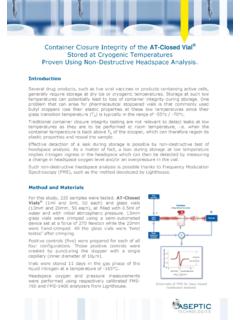
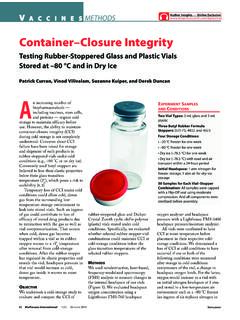
5 product maintains its physical integrity throughout shelf life. product keeps chemical & microbiological stability during shelf life. container closure integrity /compatibility intact throughout shelf life. Semisolid Products- QUALITY Physical integrity Test Parameters Visual separation vs chemical separation Color change pH Crystals Appearance - lumps, air, smell, etc. Viscosity Spreadability Semisolid Products- QUALITY Physical integrity Test Parameters Visual Separation Physical deterioration Visible signs of separation - oil, water, etc.
6 Semisolid Products - QUALITY Chemical Stability Assay/potency Tube/ container uniformity Preservatives- assay/potency Degradation products- Generated during manufacturing processes Shelf life Impurities API Inactive ingredients product Semisolid Products- QUALITY Microbiological Stability Microbial Limit Test Total Aerobic Microbial Count Total Yeast & Mold count Test for specified Microorganisms (S. aureus & P. aeruginosa) Preservative Effectiveness testing testing at 100% and at lower specification limit to ensure product is preserved at in the specification range.
7 testing at the end of shelf life Semisolid Products- QUALITY container closure incompatibilities Peeling: labels, lamination Leakage: vehicles, solvents Migration: actives, inactive materials Penetration: moisture, oxygen etc. Color change: due to instability, degradation, oxidation, etc. Adherence: container closure, tubes, etc. Package deformation: swelling, opening of crimp, bulges in the tube There is now an official acceptance criteria for analytical tube uniformity testing . This is now a requirement as described in chapter <3>.
8 Semisolid Products- QUALITY Tube/ container Uniformity Procedure performance Test product performance Test - Drug dissolution (Solid dosage forms) - In vitro drug release (Semisolid dosage forms) Semisolid Products- performance In-vitro Release testing SUPAC requirements Required to demonstrate product sameness to the approved product : Not needed for filing a new product Change of structural forming ingredient(s) Change of API (particle size for suspension products) Change in the manufacturing process(es) and manufacturing sites Other changes impacting product QUALITY and efficacy.
9 Semisolid Products- performance FDA s New Draft Guidance Acyclovir Cream and Ointment Generic product approval based on: Q1 analysis, qualitative similarity Q2 analysis, quantitative similarity Q3 (micro structure) in vitro test to demonstrate similarity to the approved product Does this development offer an opportunity to reassess the potential use of in vitro release test for the evaluation of individual commercial batches of semisolid products in a similar way the dissolution test is used for oral products?
10 Semisolid Products- performance In-vitro Release testing Good measure to ascertain performance of the product Offers standard for comparing a semi-solid product manufactured across industry. Monitors consistency of product manufactured. May assist in the development of product . Can provide an idea for bioequivalence performance of the product . USP Standards and USP Products To claim a product to be USP, all tests will need to be completed and standards are met. This applies globally. For example, Hydrocortisone Cream USP will need to meet the new requirements of <3>.