Transcription of Introduction to Data Science - Computer Science
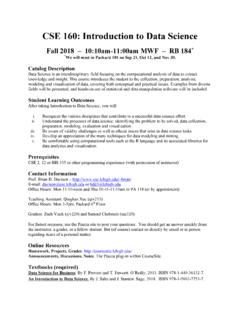
1 Introduction to data Science IFrom Introduction to data ScienceContents1 Course outline for COMPSCI 4414A/9637 (anticipated) Quizzes 5% - 35% Session 5% Proposal 4414: 15% 9637: 10% Draft 5% Report 35% Review 9637 only: 5% and and Support Available at Course Components2 Timeline (Tentative)Course outline for COMPSCI 4414A/9637A/9114 AThe University of Western Ontario London, Ontario, Canada Department of Computer Science Course Outline - Fall (September - December) 2017 From Dan: This is a very high-demand course that interests students in various programs across campus. I thinkthis is great because the diversity of backgrounds assembled in the class makes for a better learning experience forall.
2 (Myself included!) However, space is limited. Because of the volume of requests I receive, I am not able tomanage a wait list. Students will have to monitor the registration website for available spots. However, all arewelcome to sit in the room if there is objective of this course is to introduce students to data Science (DS) techniques, with a focus on application tosubstantive ( "applied") problems. Students will gain experience in identifying which problems can be tackledby DS methods, and learn to identify which specific DS methods are applicable to a problem at hand. During thecourse, students will gain an in-depth understanding of a particular (substantive problem, DS solution) pair, andpresent their findings to their peers in the class.
3 Although this course does not assume prior machine learningor visualization knowledge, it does require students to show substantial initiative in investigating methodsthat are applicable for their project. The lectures give an overview of important methods, but the lecturecontent alone is not sufficient to produce a high quality course course is designed for students who:Like to read - have a desire to understand substantive problemsLike to think - make connections between methods and problemsLike to hack - be willing to munge ( ) data into usabilityLike to speak - teach us about what you foundPrerequisitesAt least one undergraduate programming course ( CS2035) and at least one statistics course ( STAT1024.)
4 This course entails a significant amount of self-directed learning and is directed toward fourth-year undergraduateand graduate : Dan Lizotte dlizotte at uwo dot ca Office MC363 Teaching Assistant: Brent Davis - bdavis56 at uwo dot ca - Runs Q/C Hour (see below)Time: Tuesday from 2:30PM 4:30PM, and on Thursday from 2:30PM 3:30 PMPlace: Middlesex College MC-105B ( )Question and Collaboration Hour: Tuesday from 4:30pm - 5:30pm Location MC 320 Communication: We will be using OWL ( ) for electronic DatesPick Brainstorming Slot by Friday, 6 Oct at 5pmProject Proposal Due Friday, 27 Oct at 5pmProject Draft Due Friday, 17 Nov at 5pmProject Report Due Friday, 8 Dec at 5pmPaper Reviews Due Friday, 15 Dec at 5pmRegister for a wiki account.
5 You will need to use the wiki to let us all know about data sources you find, indicatewhich dataset you are using, and slot yourself in for brainstorming. Also, everyone should free to makeimprovements to any part of the wiki. ( if you find some useful software or other resources.)Slot yourself in for a brainstorming session in the Timeline portion at the bottom of this page before end of Friday,6 Oct at 5pm or Dan will pick a slot for TextsJWHT: James, G., Witten, D., Hastie, T., & Tibshirani, R. (2013). An Introduction to statisticallearning with applications in R. New York: Springer. [Free through Western ( )]HTF: The Elements of Statistical Learning by Hastie, Tibshirani and Friedman.
6 Expanded version ofrequired text. [Free online ( ~tibs/ElemStatLearn/)]LW: Leland Wilkinson's The Grammar of Graphics (2005). [Free from Springer ( )]ggplot2 book by creator Hadley Wickham (2009). [Free through Western ( )]Review if you need to catch up:Larry Wasserman's ( ~larry/all-of-statistics/) All of Statistics. [Free fromSpringer ( )]Devore, J. L., & Berk, K. N. (2007). Modern mathematical statistics with applications. 2nd [Free through Western ( )]linear algebra review ( ~dprecup/courses/ML/ ) - upto and including Section - The InverseOther ResourcesThe data and Software PageCheat Sheetsggplot2 ( ) cheatsheetData Wrangling ( ) cheat sheetTextsPhil Spector.
7 (2008). data Manipulation with R New York: Springer. [ Free through Western ( ) ]probability review ( ~dprecup/courses/ML/ )from Stanford University by way of Doina of resources ( ~dprecup/courses/ ) from COMP-652 at McGill (courtesy Doina Precup)C. M. Bishop, Pattern Recognition and Machine Learning (2006)R. S. Sutton and A. G. Barto, Reinforcement Learning: An Introduction (1998)Ethem Alpaydin, " Introduction to Machine Learning", MIT Press, J. C. MacKay, "Information Theory, Inference and Learning Algorithms", CambridgeUniversity Press, O. Duda, Peter E. Hart & David G. Stork, "Pattern Classification. Second Edition",Wiley & Sons, LinksData Visualization for Human Perception ( ) data Journalism ( )SoftwareThe dplyr package documentation ( ).
8 The"vignettes" are particularly Tensorflow Library (Python, C++) [1] ( )Topics (anticipated) Introduction to data ScienceDefinitionsComponentsRelationship s to Other FieldsData MungingWorking with structured data : selecting, filtering, joining, aggregatingWeb scrapingSimple visualizationsSanity checking(Re)- Introduction to StatisticsData SummariesRandomness, Sample Spaces and Events, ProbabilityRandom Variables, CDF, PMF, PDFE xpectationEstimationSampling Distributions: Law of Large Numbers, Central Limit Theorem, The BootstrapInference: Hypothesis testing, P-values, Confidence IntervalsMultivariate Statistics: conditional probability, correlation, independenceSupervised Machine Learning, Predictive ModelsSupervised LearningRegressionClassificationReinforc ement Learning and Sequential Decision MakingEvaluationVariance: Test set, cross-validation, bootstrapBias: Confounding, causal inferenceUnsupervised Machine Learning, Representations, and Feature ConstructionClusteringDimensionality reductionDomain-specific Feature DevelopmentImagesSoundsTextVisualization Topics to be determinedEvaluationThere will be a midterm test but no final exam.
9 Each student will lead a brainstorming session, produce a proposal,draft, and report for a course project. Graduate students (9637) will additionally submit peer reviews of otherclass projects. For detailed requirements, see Project offences are taken seriously and students are directed to read the appropriate policy, specifically, thedefinition of what constitutes a Scholastic Offence, at this website: [2] ( ).Daily Quizzes 5%Starting on the second lecture, there will be a very short quiz at the beginning of class covering the previous day'smaterials. The final quiz will be on 31 Oct. The lowest quiz mark will be dropped. Quiz marks will only beexcused for medical - 35%Assessing competencies from the fundamentals taught in the first half of the Session 5%Each student will prepare a presentation explaining an applied problem, as well as some potential data sciencemethods that could be applied to the problem.
10 The presentation should be no more than 10 minutes. We will thendiscuss the problem as a class, along with possible approaches for solving the problem using data Science student is expected to be prepared to answer deep questions about the nature of their problem to ensurethat they receive high quality feedback from the brainstorming Proposal 4414: 15% 9637: 10%Document detailing the plan for the project. See Project Guidelines for detailed Draft 5%A draft of the final report will be due approximately midway through the term. The purpose of the draft is to allowthe instructor to provide feedback on the quality of the writing and the direction of the Report 35%Each student will prepare a research paper detailing a substantive problem, the data available, the applicable datascience methods, and empirical results obtained on the Review 9637 only.