Example: biology
Lecture 8 - Computer Science - Western University
Fisher Linear Discriminant We need to normalize by both scatter of class 1 and scatter of class 2 ( ) ( ) 2 2 2 1 2 1 2 ~ ~ ~ ~ s J v +++-= m m Thus Fisher linear discriminant is to project on line in the direction v which maximizes want projected means are far from each other want scatter in class 2 is as small as possible, i.e. samples of ...
Tags:
Information
Domain:
Source:
Link to this page:
Documents from same domain

Introduction to Data Science - Computer Science
www.csd.uwo.caIntroduction to Data Science I From Introduction to Data Science Contents 1Course outline for COMPSCI 4414A/9637A/9114A 1.1Objective 1.2Prerequisites

Genetic Algorithms: A Tutorial - Western University
www.csd.uwo.caWendy Williams 32 Metaheuristic Algorithms Genetic Algorithms: A Tutorial Some GA Application Types Domain Application Types Control gas pipeline, pole balancing, missile evasion, pursuit Design semiconductor layout, aircraft design, keyboard configuration, communication networks

Master Theorem: Practice Problems and Solutions
www.csd.uwo.caMaster Theorem: Practice Problems and Solutions Master Theorem The Master Theorem applies to recurrences of the following form: T(n) = aT(n/b)+f(n) where a ≥ 1 and b > 1 are constants and f(n) is an asymptotically positive function. There are 3 cases: 1. If f(n) = O(nlogb a− ) for some constant > 0, then T(n) = Θ(nlogb a). 2. If f(n) = Θ ...

Introduction to Multicore Programming
www.csd.uwo.caIntroduction to Multicore Programming Marc Moreno Maza University of Western Ontario, London, Ontario (Canada) CS 4435 - CS 9624 (Moreno Maza) Introduction to Multicore Programming CS 433 - CS 9624 1 / 60. Plan 1 Multi-core Architecture ... Network $ $ $ P P P (Moreno Maza) ...

Master Theorem: Practice Problems and Solutions
www.csd.uwo.caMaster Theorem: Practice Problems and Solutions Master Theorem The Master Theorem applies to recurrences of the following form: T(n) = aT(n/b)+f(n) where a ≥ 1 and b > 1 are constants and f(n) is an asymptotically positive function. There are 3 cases: 1.

An Experimental Comparison of Min-Cut/Max-Flow …
www.csd.uwo.cause min-cut/max-flow algorithms on graphs for solving more interesting non-binary problems. [32] was the first to use these algorithms to compute multi-camera stereo. Later, [18, 4] showed 1Greig et al. [15] consider energy (1) in the context of maximum a posteriori estimation of Markov Random Fields (MAP-MRF).

Lecture 8, 9 Propositional Logic
www.csd.uwo.ca–˜∧¬$∧˘is true if p is true (1) , q is false (0) and r is true (1). –Any deviation from this assignment would make this particular mintermfalse. •A disjunction of mintermsis true only if at least one of its constituents mintermsis true. 10
Related documents

Neural Networks and Statistical Models - Cornell University
people.orie.cornell.eduFigure 5: Adaline = Linear Discriminant Function The activation function in a perceptron is analogous to the inverse of the link function in a generalized linear model (GLIM) (McCullagh and Nelder 1989). Activation functions are usually bounded, whereas inverse link functions, such as the identity, reciprocal, and exponential functions, often ...
SPSS Discriminant Function Analysis
kharazmi-statistics.irDiscriminant Function Analysis Discriminant function A latent variable of a linear combination of independent variables One discriminant function for 2-group discriminant analysis For higher order discriminant analysis, the number of discriminant function is equal to g-1 (g is the number of categories of dependent/grouping variable).
Chapter 440 Discriminant Analysis - NCSS
ncss-wpengine.netdna-ssl.comDiscriminant analysis assumes linear relations among the independent variables. You should study scatter plots of each pair of independent variables, using a different color for each group. Look carefully for curvilinear patterns and for outliers. The occurrence of a curvilinear relationship will reduce the power and the discriminating ability
Systems of Linear and Quadratic Equations
8theastviewmath.weebly.comIn Lesson 10-7, you used the discriminant to find the number of solutions of a quadratic equation.With systems of linear and quadratic equations you can also use the discriminant once you eliminate a variable. Using the Discriminant to Count Solutions At how many points do the graphs of y 2 and y x2 4x 7 intersect?

A tutorial for Discriminant Analysis of Principal ...
adegenet.r-forge.r-project.orgCoe cients of the alleles used in the linear combination are called loadings, while the synthetic variables are themselves referred to as discriminant functions. Moreover, being based on the Discriminant Analysis, DAPC also provides membership probabilities of each individual for the di erent groups based on the retained discriminant functions.
Second Order Linear Differential Equations
www.math.utah.eduSecond Order Linear Differential Equations 12.1. Homogeneous Equations A differential equation is a relation involvingvariables x y y y . A solution is a function f x such that the substitution y ... If the discriminant a2 4b 0, then the roots are two complex conjugate
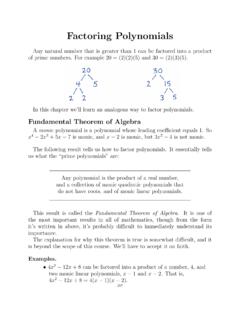
Factoring Polynomials - Math
www.math.utah.eduExample. The discriminant of 4x 22x+2 equals (2) 4(4)(2) = 432 = 228, a negative number. Therefore, 4x 2x +2hasnoroots, anditis completely factored as 4(x2 1 2x+ 1 2). 2Roots.If the quadratic polynomial ax2 + bx + c has 2 roots, we can name them ↵1 and ↵2. Roots give linear factors, so we know that (x ↵1) 159

LIBLINEAR: A Library for Large Linear Classi cation
www.csie.ntu.edu.twLinear classi cation has become one of the most promising learning techniques for large sparse data with a huge number of instances and features. We develop LIBLINEAR as an easy-to-use tool to deal with such data. It supports L2-regularized logistic regression (LR), L2-loss and L1-loss linear support vector machines (SVMs) (Boser et al., 1992). It
Linear Regression and Support Vector Regression
cs.adelaide.edu.auLinear Regression •Given data with n dimensional variables and 1 target-variable (real number) Where •The objective: Find a function f that returns the best fit. •Assume that the relationship between X and y is approximately linear. The model can be represented as (w represents coefficients and b is an intercept) {( x 1, y 1), ( x 2, y