Transcription of AP Chemistry: Chapter 1-3 Note Outline
1 - 1 - AP Chemistry: Chapter 3 notes Outline Objectives: Balance chemical equations Use dimensional analysis to solve stoichiometric problems Use dimensional analysis to do limiting reactant problems Use dimensional analysis to calculate percent yield Calculate percent composition Calculate empirical and molecular formulas Percent Composition Find the percentage composition of a chemical by finding the total molar mass of the compound find the mass percent of each element in a compound: Example: NH4NO3 Percent Error 100%xActualActualObservedError - 2 - Empirical Formula: Rules 1. Percent to Mass 2. Mass to Moles 3. Divide by small 4. Times till whole Example: Determine the empirical formula of a compound with Sn, Fe, 16% C and N.
2 - 3 - Molecular Formulas 1. Molecular Formulas are _____ _____not just the simplest _____ 2. the molar mass of the empirical formula (EF) is always a multiple of the MW. 3. Use the MW to determine by what factor you need to multiply the empirical formula to find the molecular formula. Example Determine the molecular formula for a compound that contains Na, P and O and a molar mass of 306 g/mol - 4 - Example: Complex Molecular and Empirical Formula Problems Combustion Problems Many homes in rural America are heated by propane gas, a compound that contains only carbon and hydrogen. Complete combustion of a sample of propane produced grams of carbon dioxide and grams of water as the only products.
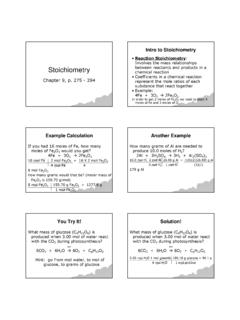
3 Find the empirical formula of propane. - 5 - Galactose (Gal) (also called brain sugar) is a type of sugar found in dairy products, in sugar beets and other gums and mucilages. When grams of galactos is completely burned it produces grams of carbon dioxide and grams of water. The molar mass of galactose is between 172 g/mol and 186 g/mol. What is the empirical and molecular formula of galactose? - 6 - stoichiometry Problems using dimensional Analysis Rules 1. Always start with a balanced equation 2. Write what you know underneath the chemical that is known ( ) 3. Place a question mark (?) underneath what you are looking for. 4. Use dimensional analysis to convert to the chemical you are trying to find information about.
4 Note that you will most likely need to use the mole-mole ratio (also called the stoichiometric ratio) to convert from one chemical to another. Examples How many liters of hydrogen gas is formed when of calcium reacts with sulfuric acid? - 7 - Nitrogen gas reacts with oxygen to form dinitrogen trioxide. How many molecules of oxygen are needed to make L of N2O3 at STP? Calcium Carbonate decomposes into calcium oxide and a common gas. When grams of calcium oxide is formed how many liters of gas is also formed from this reaction. - 8 - Limiting Reactant Problems Rules 1. Convert all reactants to moles 2. Divide by the coefficient in the balanced equation 3. The chemical with the lowest number of moles is the limiting reactant (LR) 4.
5 Use the LR for all further calculations Example: When g of iron and g of chlorine gas reacts, iron(III) chloride is formed. a. Write a balanced equation b. What is the limiting reactant? c. How many grams of Iron (III) chloride is formed d. How much excess reagent is left over at the end of the experiment? - 9 - grams of sulfur dioxide reacts with grams of water to form sulfurous acid. a. Write a balanced equation. b. What is the limiting reactant? c. How many grams of sulfurous acid will be formed? d. How much excess reagent will remain? - 10 - Percent Yield Rules 1. Balanced Equation 2. Write amount given under the reactant that has a value 3. You will be given an amount of product (write this under the product) this is the actual amount produced 4.
6 Convert given reactant amount to same product (and units) that was given 5. 100 PrxllyMadeTheoreticaoducedActualldPercen tYie Examples: Nitrogen gas reacts with hydrogen gas to make ammonia (NH3). of N2 reacts at STP to make 30-L of ammonia. What is the percentage yield?