Transcription of The Drama Triangle: An Attempt to Resurrect a Neglected ...
1 The American Journal of Family Therapy, 37:1 11, 2009 Copyright Taylor & Francis Group, LLCISSN: 0192-6187 print / 1521-0383 onlineDOI: Drama Triangle: An Attempt to Resurrecta Neglected Pathogenic Modelin Family Therapy Theory and PracticeLUCIANO L ABATEG eorgia State University, Atlanta, GeorgiaAmong various models relevant to family theory and practice, twoare relevant to both endeavors. The Attachment Model has beenextremely fruitful in attracting world-wide attention and Drama Triangle, on the other hand, composed by reactive andmanipulative Victim, Persecutor, and Rescuer roles originatingin 1968 by S.
2 B. karpman has not received the attention andinterest it deserves from the family therapy profession. This neglecthas occurred in spite of its pervasive presence in fiction (movies andnovels), religion and politics, and in the justice and legal real life, this triangle is evident where emotional, sexual, andphysical abuse are present. Both models, however, have receivedprominence in relational competence theory (L Abate & Cusinato,2007). Its clinical applications to family therapy practice shouldyield ample dividends by conceptualizing dysfunctional processesin ways that could not be perhaps achieved through other knownrelational models, including attachment.
3 Implications of this trian-gle for family practice are illustrated by the case of a family wherethis triangle was feeble and perhaps futile Attempt to Resurrect one model from Transac-tional Analysis (TA) literature seems ill-advised and unlikely to be of interestto current journal editors and readers. Nonetheless, conviction about itssoundness and relevance to family therapy theory and practice makes thisA bibliography of secondary sources ( , chapters) related conceptually to the 16 modelsof the theory (L Abate & Cusinato, 2007) is available on request from this am indebted to Robert H.
4 Woody for his careful review and thoughtful commentary toan earlier draft of this correspondence to Luciano L Abate, 2079 Deborah Drive, NE, Atlanta, GA30345-3917. E-mail: L Abatechancy endeavor worthwhile and open to the critical opinion and skepticalscrutiny of peers: journal editors, referees, and hopefully, literature of family therapy theory and practice is full of past(Gurman & Kniskern, 1981, 1991) and present theories and models (Sexton,Weeks, & Robbins, 2003). Strangely enough, two relational models have notbeen included in that literature: attachment and karpman s (1968) Drama Tri-angle.
5 While attachment has received a great deal of attention in the researchliterature around the world, but not in family therapy; the second model hasnot received the attention of theorists and therapists that, according to thiswriter s humble opinion, it models are included in a relational competence theory that canbe applied in prevention and family therapy. Attachment has been linkedfrom the outset of relational competence theory as part of the SelfhoodModel11described in detail in past sources. The Drama Triangle occupiesa complete Model14model in its own rights (L Abate & Cusinato, 2007).
6 However, this triangle has not produced relevant conceptual connectionsor empirical evidence in communication, psychological, relationship, andsociological sciences. A bibliography of secondary sources, , chapters tosupport linkages between the models of relational competence theory andexternal sources failed to find any linkages to the Drama Triangle*; hence,the need to evaluate at least the face validity of this triangle before submittingit to therapeutic practice. We should validate models before applying themto dysfunctional relationships (L Abate & Cusinato, 2007).
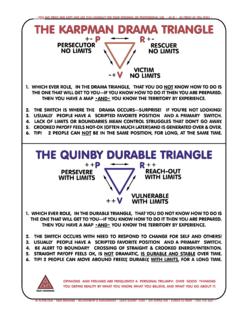
7 The purpose of this paper, therefore, is to update and expand on Karp-man s (1968) original Drama Triangle composed of Victim, Persecutor, andRescuer roles or scripts. karpman drew his examples from the Grimm Broth-ers fables and fairy tales that are replete with examples of this triangle. Inaddition to karpman s original examples, examples from fiction, movies, re-ligion and politics, and the judicial/legal systems illustrate the face validity ofthis triangle. In spite of its pervasiveness and its face validity in real life, thereis not yet empirical and clinical evidence to support its validity to justify itsapplication in family therapy practice.
8 Consequently, one needs to rely onwhatever has been published responsibly about this triangle to support em-pirical validation first and subsequent clinical applications in family pathogenic triangle is constituted by three intrinsically and simul-taneously connected roles found in most, if not all, individuals involved infamily dysfunctions. In such relationships all three roles are enacted by selfand other parties at the same time, without an awareness of or control overtheir damaging consequences. Each participant in an intimate (close, com-mitted, interdependent, and prolonged) role plays the Victim, and can beperceived as a Persecutor or Rescuer at the same time, depending on whodoes or says what.
9 For instance, one partner may perceive herself as theVictim, while being perceived as a Persecutor by the other partner who wasThe Drama Triangle3seen originally as a Persecutor. If one partner perceives oneself as the Victimof one s parents as Persecutors, she or he may perceive originally her partneras the Rescuer. However, when the original perception still remains in thefirst partner s perception without resolution, the triangle may be repeatedfrom one generation to another. The reactive quality of this triangle leads toits repetition from one relationship to , the fluid and seemingly evanescent nature of roles in theDrama Triangle presents serious difficulties for any kind of empirical research(Gottman, Katz, & Hooven, 1997).
10 These difficulties and publications aboutthis triangle in a non-mainstream journal made it impossible to expand itsinfluence outside a limited circle of theorists and more unfortunately, the neglect of this model by the relevant familytherapy literature has rendered it impossible at this time to find empiricalevidence to support its validity even though its pervasive existence is allaround us. To make up for lack of direct empirical evidence, this paperreviews the extant literature and includes examples of this triangle in (1)fiction, movies and novels; (2) religion and politics, and (3) the justice/legalsystems as indirect (face validity) support for the relevance of this triangle infamily are so imbued with this triangle that we cannot conceive of fictionwithout the ever present repetition of these three roles in different customs,sexes, plots, and themes.