Transcription of THE VICTIM TRIANGLE: BASIC CONCEPTS
1 THE VICTIM TRIANGLE: BASIC CONCEPTS The most popular/most practiced relationship pattern in the world.~ or ~How to do relationships that don t work and produce unnecessary stress, frustration, suffering, sadness, anger, violence, general upset, etc. By Michael Zaccardi, LCSW. ( 2009) Please use these pages as worksheets. Write on them. Check off the items you understand. Put a ? next to the things you may disagree with or do not understand. Use a ! for items you really like. Make notes. Change the wording if you like a better way of saying something. Go through this material many times and notice how these ideas translate into more nurturing and graceful relating with yourself, with others, and with the world around you. I encourage everyone to be an ongoing student of relationships.
2 When our relationships with self, with others, and with life (or the world around us) function and function well, that's when we enjoy living. When our relationships do not function well, we experience uncomfortable and painful stress unnecessarily. So notice and observe relationships everyday. Be alert and learning and practicing effective relationship skills for relating well and gracefully. There is a very flawed relating pattern which we all learn normally & naturally as small children (between the ages of 0 5 years old). Because we are so dependent during that early part of life, we employ this primitive pattern to try to manipulate and manage others to meet our needs.
3 When used after early childhood this pattern results in painful relationships that don t work. Furthermore, this pattern can be found/observed in all relationships that don t work and cause distress. As with learning to eat with a spoon or to count using our fingers, we usually do not remember learning this relating pattern. And we continue to use this pattern of relating all through life, as we do with so many automatic BASIC skills learned in early childhood, unless we learn or are taught to relate differently. In this pattern there are roles and rules, and we can come to understand these roles and rules and how they erode and wreck relationships and add needless stress to living a life. When we understand and are able to recognize this pattern we can then choose to break these rules, throw off these roles, and discard the practice of this pattern and replace it with healthy relating .
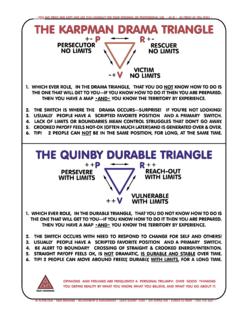
4 The three unhealthy roles with their variety of masks may be summarized as: VICTIM , Rescuer, Meanie. (By contrast, in healthy relating , we relate in a wide variety of healthy roles which provide nurturing to self and others, like family member, student, worker, friend, musician, member of a sports team, etc.) The BASIC rule for participating in this pattern is to talk, think, or act in one or more of the three unhealthy roles. Taking on any one of these roles results, sooner or later, in participating in the pattern's other two roles as well. Thus a participant moves from one role to the other. The speed of changing roles varies from person to person and from one situation to another. This pattern has usually been called the karpman Triangle, the VICTIM triangle, or the drama triangle.
5 I have added a number of additional descriptive names: soap opera (or media) triangle, anger triangle, addiction triangle, co-dependence triangle, control triangle, should triangle, pain triangle, enmeshment (over-involvement) triangle, manipulation triangle, etc., in order to make clear that the range of uninformed relating difficulties are all variations on Triangle pattern relating . Some of the spin-offs or results of doing this pattern are upset, stress, meanness, hurt, pain, sadness, depression, anxiety, worry, frustration, blame, guilt, anger, violence, jealousy, control, chemical use/abuse, addiction, preoccupation, health problems, and negative or painful drama (and so on.). Conversely, the presence of these emotions and experiences signal the presence of triangle relating .
6 When you are unaware that you are relating in this pattern, it continues to be an unrecognized pattern which causes unnecessary stresses and difficulties in your you can recognize that you are using this pattern, you can choose whether or not to continue to relate so stressfully. The VICTIM Triangle relating pattern, thus, can also be thought of as a game. A game has roles and rules, and players play to have fun, amusement, entertainment, win prizes and/or pass time. Games have winners and losers. And, most importantly, people CHOOSE whether to play a game or not. We do not have to play 2009, Michael Zaccardi, LCSW1 a game if we do not want to. In this triangle game the roles are VICTIM , Meanie, and Rescuer. The rules are that you play each role and move from one role to another, quickly or slowly.
7 And while this game is possibly entertaining at times, the prizes or rewards for playing are stress, upset, pain, and so on. Everybody loses in this game. (Whenever we play this game, ultimately we experience being victims of this pattern.) However, we can CHOOSE to engage or not engage in this pattern. Once we become aware of this game and how we may be playing or participating in the pattern, we could decide not to participate and, instead do healthy, truly rewarding relating . Remember this important point: if we are engaged in this pattern, even knowingly, we are not bad people. We may do or say controlling or mean things, which are not OK or even wrong, but we could still be good people caught in a primitive, childish pattern. Consider thinking, feeling, doing and how they each influence each other.
8 We play this VICTIM Triangle game/pattern whenever we think and/or act in the roles of VICTIM , Meanie, or try to control or manipulate others (or self). Crummy feelings result and in turn influence more VICTIM Triangle relating . Know that every position in the triangle is at its core a VICTIM position. A person in the role of Meanie or Bully usually has been or is being victimized in some area of his/her life or feels victimized. A person in the role of Rescuer or Pleaser, similarly, usually has been or is feeling victimized in some way. We can relate on the triangle with two or three or four or ten - any number of people - or a person can do the triangle all by oneself. All that is needed, for the game to be re-enacted, is for the person or persons involved to take on at least one of the roles through talking, thinking, and/or behavior.
9 When doing the triangle solo, a person may be feeling her/his life is so difficult and thinking s/he cannot handle her/his stress or s/he needs to rescue self from this the rescue is usually a form of escaping and/or bullying self or hurting or being mean to one s self because of lack of knowledge of healthy, effective ways to deal with stress by meeting BASIC needs. "Am I automatically on the triangle whenever I help someone?" It is possible to help someone without getting into the pattern as a Rescuer if we practice healthy boundaries and do not move into the Bully or VICTIM role in the process of trying to help. We need to not act or talk in controlling/manipulative ways toward those we are helping. Also, while helping we need to be not victimizing self in order to help others.
10 Due to the seeming capriciousness of life, almost everyone experiences setbacks and misfortunes at times. And since the Triangle is at least a significant default relating pattern, it makes sense that after a trauma or catastrophe we might engage initially in this pattern. However, it is possible to have been or to be a VICTIM of life circumstances and sooner or later not continue to be involved in the VICTIM role or participate on the Triangle. It is possible to say eventually I was a VICTIM of circumstances in the past, but I no longer use the Triangle as my method of relating . Being perceived to be in the role of Meanie does not necessarily mean that I am in that role. This misperception may occur to people in the Triangle pattern if I am not participating in the pattern or if I am in the process of exiting from it.