Transcription of Red Flags of Fraud - Office of Financial Affairs
1 Red Flags of Fraud OVERVIEW Red Flags of Fraud are warning signs that may indicate a higher Fraud risk. They are NOT evidence that Fraud is actually occurring. Many employees demonstrate one or more of the Flags on the list, and the existence of one or two Flags is not likely to cause concern. However, if multiple Flags are identified that span the three categories AND accounting irregularities and/or weak internal controls are identified, the risk that Fraud is occurring or could occur is significantly higher. Common Personality Traits of Fraudsters Wheeler-d ealer attitude Controlling and unwilling to share duties Don t like people reviewing their work Strong desire for personal gain Live beyond their means Often have too good to be true work performance Outwardly.
2 Appear to be very trustworthy Unable to relax Don t take vacation or sick time or only take leave in small amounts Often work excessive overtime Have a Beat the System attitude Common Sources of Pressure Financial problems Medical problems Divorce Legal problems criminal or civil Need to maintain a certain lifestyle pressure to keep up with or out-do others in regards to material possessions Purchase a new home, second home or major home renovation Unreasonable performance goals Gambling Drug/Alcohol addiction Changes in Behavior Buys more material items houses, cars, boats, clothes.
3 Jewelry Brags about purchases Starts to carry unusual amounts of cash Creditors/Collectors show up at work or call frequently Borrows money from co-workers Becomes irritable or moody Becomes unreasonably upset when questioned Becomes territorial over area of responsibility Refuses to take vacation or sick leave Starts coming in early or staying late Redo or Rewrite work to make it neat Mentions family or Financial problems Exhibits signs of addiction absenteeism, become manipulative, looks ill, inconsistent or illogical behavior, loss of sleep, loss of appetite Exhibits signs of dissatisfaction decreased productivity, change in attire, irregular schedules, frequent complaining about work issues YOU Can Prevent Fraud !
4 SDP Session 7 AMay 10, 2011 What can YOU do? Define -What is Fraud ? Analyze Dissect Fraud Elements Manage Risk Internal Control System Prevent Fraud AwarenessWhat is Fraud ?Webster s Dictionary defines as:1a:deceit, trickery; specifically:intentional perversion of truth in order to induce another to part with something of value or to surrender a legal right b:an act of deceiving or misrepresenting :trick2a:a person who is not what he or she pretends to be :impostor; also:one who defrauds :cheatb:one that is not what it seems or is represented to be What is Fraud ?
5 Board of Trustees Policy defines as:.. the intentional, false representation or concealment of a material fact for the purpose of inducing another to act upon it to his or her injury. What is Fraud ?Ultimately all frauds violation of trustFor organizations, no trust violation has the potential to be as harmful as those committed by the very group that is relied upon for employeesWhat is Fraud ?The Association of Certified Fraud Examiners defines Occupational Fraud as The use of one s occupation for personal enrichment through the deliberate misuse or misapplication of the employing organization s resources or assets Occupational Fraud Asset Misappropriation The employee steals or misuses the organization s resources Corruption The employee uses his influence in business transactions in a way that violates his duty to the organization in order to obtain personal gain Financial Statement Fraud Intentional
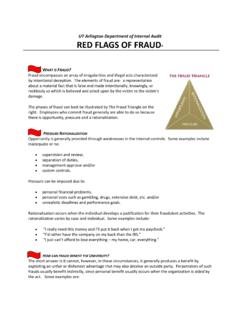
6 Misstatement or omission of material information in the organization s Financial reportOccupational FraudStudy covered 1843 cases of occupational Fraud that occurred in more than 100 countries on 6 in study were anti- Fraud specialists with a median of 12 years of experience in the Fraud examination FraudSummary of Key Findings Median loss caused was $160,000 Median duration before detection was 18 months Initial detection came from tips in of the cases, followed by management review at Small organizations are disproportionately victimized by occupational fraudOccupational FraudSummary of Key Findings 85% of fraudsters in the study had never been previously charged or convicted of a Fraud -related offense Fraudsters often display warning signs or behavioral red Flags that indicate they may be engaged in illicit activity Anti- Fraud controls appear to help reduce the cost and duration of occupational Fraud schemesFraud DissectedFraud TriangleFraud DissectedPressureWhat causes
7 A person to commit Fraud Living beyond means to create a certain lifestyle Medical crisis Addiction Divorce Family crisisFraud DissectedOpportunityThe ability to commit Fraud . Opportunity is created by: Weak or non-functioning internal controls Poor management oversight/supervision Misuse/abuse of one s position and authority Belief they won t get caughtFraud DissectedRationalizationThe reconciliation of the fraudulent behavior with the commonly accepted ideals of decency and trust Stealing justified to save a loved one They will lose everything if they don t steal Belief that no outside help is available to them Labels stealing as borrowing and fully intend to pay back Job dissatisfaction creates belief that the
8 Organization owes them Fraud DissectedFraud TriangleInternal Control SystemInternal control is broadly defined as a process, effected by the organization's board of trustees, management, and other personnel, designed to provide reasonable assurance regarding the achievement of objectives in the following categories: Effectiveness and efficiency of operations Reliability of Financial reporting Compliance with applicable laws and regulations Safeguarding of assets Internal Control SystemInternal Control SystemControl Environment Control consciousness of the organization Atmosphere in which activities are conducted and staff carries out their control responsibilities Intangible Employees understand their responsibilities and limits to their authorityControl Environment Tips.
9 Develop a leadership philosophy and operating style that promotes internal control Properly assign authority and responsibilityto staffInternal Control SystemRisk Assessment Relative to achieving goals and objectives Identifying risks associated with achievement Identify at both unit and activity level Consider external and internal factorsManagement is responsible for: Determining the level of acceptable risk the organization can assume Prioritizing identified risks Consideringqualitative and quantitative costs when developing a management planInternal Control SystemControl ActivitiesActions, supported by policies and procedures.
10 To manage riskPREVENTIVEP roactive controls to prevent loss Segregation of Duties Transaction Approvals Documentation Security of AssetsDETECTIVEP rovide evidence a loss has occurred Audits Reconciliations Physical Inventories Security of AssetsInternal Control SystemInformation and Communication Sharing information up, down and across organizational units From both internal and external sources Presented in a form and time frame that is usefulFormal Systems Information technology Staff meetings Reports HotlineInformal Systems Casual Conversations with faculty, staff or students Vendors and regulators May offer clues when combined with other known factsInternal Control SystemMonitoringPurpose is to determine whether the internal control system is adequately designed.