Transcription of The ARRL Handbook for Radio Communications – The ...
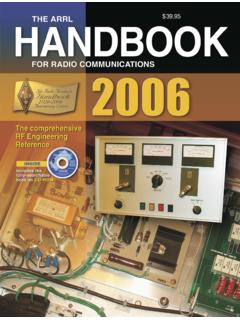
1 72 MONITORING TIMES January 2010 The arrl Handbook for Radio Communications The Comprehensive RF Engineering Reference The 2010 arrl Handbook for Radio Com-munications is the biggest Handbook ever. Since it was first published in 1926, the Handbook has been a mainstay for the Radio electronic ex-perimenter. A core resource for Radio amateurs, hobbyists, engineers and scientists, the arrl Handbook is the single most authoritative refer-ence on practical Communications topics. It is both reference book and tutorial, woven together with practical applications and solutions. The 2010 Handbook , the 87th edition, is both a useful introduction to Radio communica-tion and features the most current mate-rial on electronics and amateur Radio .
2 More than 60 authors and review-ers contributed over 70 percent new or completely revised content, making this the biggest Handbook ever (over 1,250 pag-es). New material includes all-new treatments of digital Communications technology, solid-state RF power amplifiers and switch-mode power supplies. According to the arrl , when editors H. Ward Silver, N0AX, and Mark Wilson, K1RO, dove into preparing this 87th edition, they kept in mind what F. E. Handy, W1 BDI (author of the first edition) wrote in that book: Written first of all for the beginner, such an amount of use-ful and up-to-date information has been added that the Handbook in its present form is equally valuable as a compendium of information for the experienced brass -pounder and the beginner alike.
3 For 2010, The arrl Handbook for Radio Communications has been reorganized into five major sections, making it easier than ever to find exactly what you are searching for: Fundamental Theory, Practical Design and Prin-ciples, Antenna Systems and Radio Propagation, Equipment Construction and Maintenance, and Station Assembly and Management. In this edition of the Handbook there is a new table of contents: Electrical Fundamentals, Analog Basics, Digital Basics, RF Design Tech-niques, Computer-Aided Circuit Design, Power Supplies, Modulation, Oscillators and Synthe-sizers, Mixers, Modulators and Demodulators, RF and AF Filters, Receivers, Transmitters, Transceivers, DSP and Software Radio Design, Digital Modes, RF Power Amplifiers, Repeat-ers, Propagation of Radio Signals, Transmis-sion Lines, Antennas, Component Data and References, Circuit Construction, Station Ac-cessories, Test Equipment and Measurements, Troubleshooting and Repair, Electromagnetic Compatibility and Direction-Finding, Safety, Assembling a Station, Space Communications , Digital Communications .
4 And Image Commu-nications Each chapter has been designed to be either an encyclopedia (providing descriptive overviews of current practices and technology) or practical Handbook (focusing on techniques, designs and projects), Silver explained. In either case, Mark and I tried to ensure that there was enough introductory material to get the newcomer started, as well as plenty of in -depth discussion the experienced amateur will expect. Nearly every chapter has been rewritten or reworked, with many projects making their first appearance in the Handbook . Here are some of the new topics you will find: A full suite of new or revised chapters ad-dress the burgeoning digital modes: Modulation (by Alan Bloom, N1AL); DSP and Software Radio Design (also by N1AL), Digital Modes (by Scott Honaker, N7SS, and Kok Chen, W7AY), and Digital Communications (by Steve Ford, WB8 IMY).
5 There s also a new section on D-STAR digital repeaters by Pete Loveall, AE5PL and Jim McClellan, N5 MIJ. The popular chapter on RF Power Amplifi-ers has been thorough refreshed by experts John Stanley, K4 ERO (vacuum tube technology) and Dick Frey, K4XU (solid -state amplifiers). You ll find new software, expanded design examples, and a new 250 W solid state amplifier project to get you started toward that bigger signal. Power Supplies is a chapter that every ham turns to regularly. It received the attention of world-class authority Rudy Severns, N6LF. As a result, there is a detailed introduction to switch-mode power conversion, arguably the most common power supply technology in the world and whose coverage was long overdue in the Handbook .
6 Some of the other new projects you will find in the Handbook include: variable-voltage bench supply using switch-mode modules; an extended double-Zepp, multi -band horizontal loop; and inexpensive Yagis for VHF/UHF. Station accessory projects include a high -power 160/80 meter matching network for 43 foot verticals, and a 100 W Z-match antenna tuner and transmitting chokes. If you re learning electronics from the Handbook , as many do, the Fundamental Theory section sports reworked and expanded chapters on basic electronics and analog design, includ-ing analog-digital conversion and microproces-sor interfacing. New resources for experimenters include a chapter on Computer-Aided Circuit Design by Dave Newkirk, W9 VES.
7 The Component Data and References chapter received needed updates to the information on component characteristics and surface mount devices by Paul Harden, NA5N. In recognition of the growing range of op-erating modes and activities, you ll find updated and expanded chapters on Space Communica-tions (satellites by Steve Ford, WB8 IMY, and EME by Joe Taylor, K1JT) and Image Com-munications (ATV by Tom O Hara, W6 ORG, and SSTV by Dave Jones, KB4YZ). The book s accompanying CD -ROM inside the back cover once again includes a searchable PDF version of the entire book, including graphics. Construction information and PC board templates for all projects are included, as are the original QST articles, if that was the project s source.
8 Jim Tonne, W4 ENE, has again generously provided his powerful filter design and analysis software, Elsie, as well as other useful applications. Recognizing that the printed Handbook and CD-ROM support a dynamic activity, a webpage has been created to provide links and supplemental information that may change with time. The CD -ROM is fully -searchable book and operates on the following operating systems: Windows XP, Windows Vista or Windows 7, as well as Macintosh systems, using Ado-be Acrobat Reader software. The Acrobat Reader is a free download at PDF files are Linux readable. Available in softcover (hardcover has sold out), the softcover includes book and CD -ROM.
9 arrl Order No. 1448 (ISBN 0-87259-144-1) $ plus shipping. You can order all arrl publications from the arrl , 225 Main Street, Newington, CT 06111-1494. Order Hotline 1-888 -277 -5289 (toll-free US only), Monday through Friday, 8 AM to 8 PM Eastern time. You can also order online at For more than eight decades, hams, hob-byists, engineers and scientists have used The arrl Handbook for Radio Communications for both practical solutions and as a teacher to open doors of understanding. Whether you use it at the Radio , on the workbench or in the library, this is one reference that belongs in your Radio -Lite-Plus Are you tired of having a different soft-ware program for each of your scan-ners?
10 Are you tired of retyping all your data into one soft-ware program to an-other? Then maybe you re ready for Scancat-Lite-Plus. Scancat-Lite- January 2010 MONITORING TIMES 73 Radio Shack Scanners PRO-64/2041 PRO-76 PRO-79/2017 PRO-82/2018 PRO-83/84 PRO-89 PRO-93/2053 PRO-94 (B) PRO-95 PRO-96/2096 PRO-97/2055 PRO-99 PRO-106 /197 PRO-135/136 PRO-137 PRO-160/162 PRO-163/164 PRO-528/433 PRO-2019 PRO-2051 PRO-2052 PRO-2054 PRO-404 PRO-405 Uniden Scanners BC-95 XLT BC-895 BC-245 BC-246T BC-780 BC-250D BC-785D BC-296D BC-796D BCT-8 BCT-15 BCT-15X BC-898T BCD346XT BC-396T BCD396XT BC-996T BCD996XT BR-330 SC-230 It should be noted that the PRO-92 and the PRO-2067 are not supported, and the SC-200 is no longer supported.