Transcription of MMR - WHO
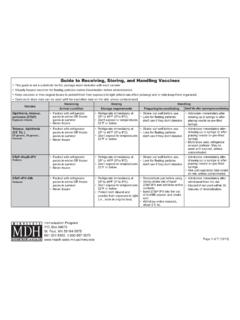
1 MMRV accine Handling The recommended conditions for storing vaccines used in immunization programmes are shown in Appendix 81_1. This diagram also indicates the maximum times and temperatures in each case. At the higher levels of the cold chain, , at national (primary), and regional or province level, OPV must be kept frozen between -15oC and -25oC. Freeze-dried vaccines ( , BCG, measles, MMR and yellow fever) may also be kept frozen at -15oC to -25oC if cold chain space permits, but this is neither essential nor recommended. At other levels of the cold chain (intermediate vaccine stores and health facilities), these vaccines should be stored between +2oC and +8oC. All other vaccines should be stored at between +2oC and +8oC at all levels of the cold chain. Liquid formulations of vaccines containing diphtheria, pertussis, tetanus, hepatitis B, Haemophilus influenzae type b, IPV and their combinations should not be 2006 Temperature sensitivity of vaccinesWHO/ IDYearThere is a serious risk when reconstituted (measles, mumps, and rubella vaccines and their combinations are) stored at any temperature for longer than six hours or above 8 C for any period.
2 This is not only because of the lack of potency, but also because of the possibility of contamination of the product, which could cause serious adverse consequences in those being vaccinated. When used, measles vaccine should be protected from elevated temperature and from light (light may inactivate the virus). Reconstituted vaccines must be discarded at the end of each immunization session and should NEVER be kept for use in subsequent reconstitution, measles and MMR vaccine rapidly lose their potency when kept at temperatures above 2-8 C. Reconstituted measles and MMR vaccines should be kept cold during immunization procedures, must be discarded at the end of each immunization session and must never be kept for use in subsequent 2006 Temperature sensitivity of vaccinesWHO/ IDYearWHO recommended vaccine storage conditions (Appendix 17_3).
3 1:3 Page 2005 WHO-UNICEF effective vaccine store management initiative: Modules 1 - 4 WHO/ IDYear27 June 2008 Page 1 of 7 MMRM easles vaccine (including MR and MMR - page 8):_ It is essential that only the diluent supplied with the vaccine be used. _ After reconstitution measles vaccine should be kept at 2 C-8 C. _ Any remaining reconstituted vaccine must be discarded after six hours or at the end of the immunization session, whichever comes 2004 Immunization in practice: a practical resource guide for Health workers 2004 update_____Module 2: The vaccinesWHO/ IDYearBCG, measles, MR, MMR and rubella vaccines are equally sensitive to light (as well as to heat). Normally, these vaccines are supplied in vials made from dark brown glass, which gives them some protection against light damage, but care must still be taken to keep them covered and protected from strong light at all 2004 Immunization in practice: a practical resource guide for Health workers 2004 update_____Module 3: The cold chainWHO/ IDYearAt the higher levels of the cold chain, at the national (central) and regional or provincial levels, OPV must be kept frozen between -15 C and -25 vaccines, BCG, measles, MMR and yellow fever vaccines, may also be kept in this temperature range (-15 C and -25 C) if there is sufficient space in the cold chain, but this is neither essential nor recommended.
4 At other levels of the cold chain these vaccines should be stored between +2 C and +8 C. All other national immunization service vaccines should be stored between +2 C and +8 C at all levels of the cold 2002 Ensuring the quality of vaccines at country level: Guidelines for health staffWHO/V& IDYearScheduleMumps vaccine should be given in combination with measles and rubella vaccines (MMR).11 Page 2004 Immunization in practice: a practical resource guide for Health workers 2004 update_____Module 1: Target diseasesWHO/ IDYear27 June 2008 Page 2 of 7 MMRR ubella vaccine is usually administered at age 12-15 months, but can also be administered to children as young as 9 months of age. In most countries, the vaccine is given as MR or MMR, and the age of administration is chosen based on the appropriate age for measles vaccination.
5 It may also be administered to older children, adolescents, students, child care personnel, health care workers, military personnel and adult men in contact with women of childbearing 2000 Rubella vaccines (WHO position paper)Weekly Epid. Record (2000, 75: 161-169)66_9 Database IDYearVaccine AdministrationAdministration summary: MR/MMR (see Appendix 2_39.)9 Page 2004 Immunization in practice: a practical resource guide for Health workers 2004 update_____Module 2: The vaccinesWHO/ IDYearPrimary mumps vaccination, especially in the recommended combination with rubella and measles vaccines, is easily adapted to the national vaccination programmes and does not interfere significantly with simultaneously-administered 2001 Mumps virus vaccines (WHO position paper)Weekly Epid. Record (2001, 76: 345-356)60_10 Database IDYearAdverse Event Several carefully conducted studies have been unable to confirm preliminary reports alleging an association between receipt of live attenuated measles vaccine or MMR and the occurrence of autism or chronic bowel 2004 Measles vaccines (WHO position paper)Weekly Epid.
6 Record (2004, 79: 130-142)58_3 Database IDYear27 June 2008 Page 3 of 7 MMRThe attention of the Committee was drawn to the unavailability of a monovalent rubella vaccine in some countries and to the need to provide a rubella-containing combination vaccine to postpartum women seronegative for rubella. GACVS is not aware of any safety issues that would restrict the provision of a rubella-containing combination vaccine in place of single rubella vaccine in those 2004 Global Advisory Committee on vaccine Safety, 3 4 December 2003 Weekly Epid. Record (2004, 79: 16-20)79_6 Database IDYearOutbreak ControlWhile many countries have readily replaced single-antigen measles vaccine with measles mumps rubella (MMR) or measles rubella (MR) vaccines, to prevent a potential gradual increase in rubella susceptibility among women of childbearing age and a paradoxical increase in congenital rubella syndrome (CRS) incidence, efforts are needed to assure that women of childbearing age are also protected against rubella.
7 A strong laboratory-based surveillance mechanism is a must for identification of rubella outbreaks following the introduction of MMR or MR into the NIP. A screening programme should be available for females entering childbearing age because, once the vaccine is introduced into the NIP, the susceptibility of adults getting rubella will be 2005 vaccine introduction guidelines. Adding a vaccine to a national immunization programme: decision and implementationWHO/ IDYearSurveillance of vaccine Preventable Disease While many countries have readily replaced single-antigen measles vaccine with measles mumps rubella (MMR) or measles rubella (MR) vaccines, to prevent a potential gradual increase in rubella susceptibility among women of childbearing age and a paradoxical increase in congenital rubella syndrome (CRS) incidence, efforts are needed to assure that women of childbearing age are also protected against rubella.
8 A strong laboratory-based surveillance mechanism is a must for identification of rubella outbreaks following the introduction of MMR or MR into the NIP. A screening programme should be available for females entering childbearing age because, once the vaccine is introduced into the NIP, the susceptibility of adults getting rubella will be 2005 vaccine introduction guidelines. Adding a vaccine to a national immunization programme: decision and implementationWHO/ IDYear27 June 2008 Page 4 of 7 MMRW here (mumps) vaccine is used and high coverage is achieved the monitoring of vaccine -associated mumps meningitis and its differentiation from meningitis due to other causes can be an important issue. The monitoring of mumps meningitis, whether related to vaccine or natural disease, can be integrated into overall meningitis surveillance activities.
9 The vast majority of mumps vaccine is used in combination with measles and rubella vaccines (MMR), and surveillance strategies for mumps should take surveillance for measles, rubella and congenital rubella syndrome into 2003 WHO recommended standards for surveillance of selected vaccine -preventable diseasesWHO/V& IDYearIntroduction of Vaccines While many countries have readily replaced single-antigen measles vaccine with measles mumps rubella (MMR) or measles rubella (MR) vaccines, to prevent a potential gradual increase in rubella susceptibility among women of childbearing age and a paradoxical increase in congenital rubella syndrome (CRS) incidence, efforts are needed to assure that women of childbearing age are also protected against rubella. A strong laboratory-based surveillance mechanism is a must for identification of rubella outbreaks following the introduction of MMR or MR into the NIP.
10 A screening programme should be available for females entering childbearing age because, once the vaccine is introduced into the NIP, the susceptibility of adults getting rubella will be 2005 vaccine introduction guidelines. Adding a vaccine to a national immunization programme: decision and implementationWHO/ IDYearWhere measles vaccine has been combined with rubella vaccine (MR) or mumps and rubella vaccine (MMR), the protective immune response to the individual components remains unchanged. The use of such combined vaccines is logistically and programmatically sound and is recommended in areas where the disease burden of mumps and rubella disease burden is high, when the vaccine is affordable and, in the case of rubella, where vaccine coverage rates can be sustained at >80%.131 Page 2004 Measles vaccines (WHO position paper)Weekly Epid.