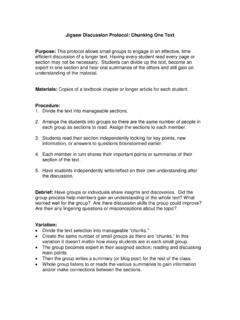
Transcription of Jigsaw Description - School Reform Initiative
1 Protocols are most powerful and effective when used within an ongoing professional learning community and facilitated by a skilled facilitator. To learn more about professional learning communities and seminars for facilitation, please visit the School Reform Initiative website at DescriptionAdapted from the work of Spencer Kagan, Resources for Teachers, San Juan Capistrano, purpose of Jigsaw is shared learning. Members of a group become experts in a particular area of a mutual pursuit and share their learning/ research with the other group members.
2 It is also used when a lot of learning needs to happen in a short time. Chapters of books can be split up, various approaches to the same outcome can be researched, different experiments with the same materials can be conducted, different viewpoints on the same issue can be studied, and the results shared. This is effective for students or adults. There are several ways this can happen:Within Team JigsawEach member of a team/group works independently to master a portion of a topic or skill. When each team member has completed the work as planned, they gather at an agreed upon time to share the new knowledge.
3 Often there is some kind of synthesis of the shared knowledge. Example: There are four protocols for observing in a classroom. Each person in a group of four reads one of the observation protocols and presents that approach to the other team members, with guiding questions to assist the shared learning, such as What kind of feedback is generated by this protocol? What kind of observation is most appropriate for this protocol? What is the value of this protocol in terms of student learning; teacher practice? The group compares and contrasts the four JigsawEach team becomes an expert on one topic or skill.
4 Team members spread out to share their new knowledge with the rest of the teams. Team #1 spreads out and sends a member to each of the other teams to share, then Team #2 does the same. There s a bit of math to do here as there have to be enough experts to share with all the other teams, or teams have to be combined to share experts. Two teams can research the same topic and check with one another for completeness and agreement before they consult with the other teams - this provides some checks and balances. Synthesis can be done as a whole group or in teams.
5 Example: There are four protocols for observing in a classroom. The room is divided into 4 teams of 3 people, (or 6 people). Each team studies one protocol, talking together and planning the best way to present the protocol to the other teams, using the guiding questions. Each team takes turns sending its experts out to the other teams (alone or as a pair) to share the protocol they have studied. A whole group synthesis that compares the four Group JigsawEach member of a team takes on a portion/aspect of a topic or skill.
6 More than one member of the team will take on the same portion/aspect if there are more group members than portions/ aspects. The team splits up and everyone goes to an expert group of all the people from all the teams taking on the same portion/aspect. The expert group masters the topic/skill or does the research necessary. The expert group plans a way to present their learning in the best possible way and practices the presentation if necessary. The experts all return to their teams where they make presentations to their team members.
7 Synthesis is done in the teams. Example: There are four protocols for observing in a classroom. Each team assigns its members one of the four protocols. The team members break up and go with the appropriate expert group to study the protocol, discuss it together for understanding, using the guiding questions. They plan a presentation. The experts return to their team and each protocol is presented in turn. The protocols are compared in the teams.