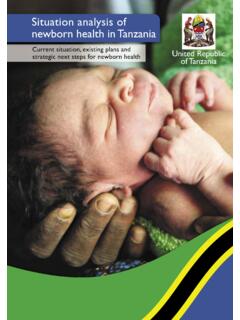
Transcription of Situation Analysis of Children in Tanzania - Tzonline
1 Situation Analysisof Children in TanzaniaiiAcknowledgementsThis report on the Situation of Children in Tanzania is a joint effort between theGovernment of Tanzania and UNICEF Tanzania , with coordination support fromREPOA. Many organisations and individuals contributed throughout the process ofconceptualising, research and writing this report. The report was written by Rakesh Rajani, who led the research and development of theanalysis. Maggie Bangser, Ulrik Lund-Sorensen and Valerie Leach all contributedextensive parts of some chapters. Earlier drafts were produced by REPOA (Mainland)and William Ackroyd (Zanzibar). Marjorie Mbilinyi, Walter Bgoya and Faraja Kottawrote the essays in the report, giving their own reflections on some of the issues Miyazawa and Ulrik Lund-Sorensen researched and produced the data andgraphs. Comments and suggestions during the various stages of the draft were received from theMinistry of Community Development, Women s Affairs and Children ; the President sOffice for Planning and Privatisation from the Government of Tanzania and from theMinistry of Youth Employment Women and Children Development; the Ministry ofEducation, Culture and Sports and the Ministry of Water, Construction, Energy andLands from the Government of Zanzibar.
2 ILO-IPEC, UNESCO and WHO alsocontributed, as did many staff at UNICEF Dar es Salaam and UNICEF Zanzibar. Editing, reference checks and finalisation of the document was done by Valerie Leach,Engelbert Nyang ali, Ulrik Lund-Sorensen and Esther Obdam. The lay-out of the booklet was designed by Total Design Ltd., Box 21746, Dar esSalaam, The illustrations were made by MasoudKipanya The cover illustration was prepared by EmanuelMathias, age 15, who is a gifted artist and student affiliated with the Dogodogo streetchildren project since 1997. iiiForewordTanzania s Children have been the subject of several important reports during thispast year: the Report to the United Nations Committee on the Rights of the Child; theNational Report on the Follow-up to the World Summit for Children ; and this SituationAnalysis, which attempts to synthesise information about the condition of Children in amanner which will be widely accessible for planners and activists at many levels.
3 You willsee from these reports that the Situation of Tanzania s Children is largely not a good one,and in some respects it has been trend must be turned around, if we are to achieve the sustainable humandevelopment that we are aiming for in our Development Vision 2025. There is,however, an increasing realisation that this is not just the responsibility of theGovernment, or NGOs or international organisations, but the responsibility of each andevery one of us. Everybody has a role to play, including Children can no longer exclude Children - 50 per cent of the population-from thedevelopment process. Not only because Children have the right to be included, to havetheir opinions heard, but because their input is beneficial to the process. Listen tochildren and you will be surprised by their understanding of the issues, and the practicalways they suggest to deal with to the National Report on the Follow-up to the World Summit forChildren ( , 2000) the Situation of Children in Tanzania indicated a declinedue to the inability of attaining the required goals.
4 However, developments at themacro-level are encouraging, and this gives us reason for optimism. The huge challengeis to bring these positive developments to the micro-level where they can impactpositively on the Situation of are, in Tanzania , determined to provide an environment conducive for childrento grow up healthy, educated and in dignity. All stakeholders must remember to have thebest interest of Children at the centre of all development policies. And, we need to do thisnot just forthe Children of Tanzania , but withthe Children of count on your commitment to play your William MkapaDar es SalaamPRESIDENT OF THE UNITED8 January 2002 REPUBLIC OF TANZANIAivContentsAcknowledgements iiForeword iiiContents ivTables and Figures viAcronyms viiiMap of Tanzania xIntroduction 1 Human rights and development 2 The Situation of Children in Tanzania 3 Equity and governance 5 Chapter 1: The Development Context 7 Essay: Making budgets people-oriented 13 Chapter 2: The Early Childhood Years Maternal and Child Health 16.
5 Healthy women and mothers 16. Healthy infants and Children 20. Childhood illnesses 22. Nutrition 26. HIV/AIDS The Quality of Services 32. Water and sanitation 32. Health services Financing Health The Policy Environment 36 What is gender and why is it important? Conclusion 39 Chapter 3: The Schooling Years Access to Schooling 42. Children with special needs 48. Late enrolment 49. School dropout 50. Attendance rates 51. Reasons for low enrolment and high dropout 51. Non-Formal Education The Quality of Education 54. State of infrastructure 55. Books and learning materials 56. Teacher qualifications and conditions 56. The learning environment 59. Examination performance Financing Education The Policy Environment Conclusion 69 Essay: Why Children s participation matters 73 Situation Analysis of Children in Tanzania vChapter 4: The Adolescent Years Secondary Education Sexual and Reproductive Health HIV/AIDS Adolescents at Risk 90.
6 Child labour 91. Child domestic workers 93. Street Children and adolescents 95. Children and adolescents in commercial sex work 95. Orphaned and foster Children and adolescents 96. Children and adolescents with disabilities 98. Adolescents in prisons Conclusion 99 Acute vulnerability amongst the vulnerable 102 Chapter 5: Children and Adolescents in Zanzibar The Development Context 104. The political Situation 104. The economic Situation The Early Childhood Years 105. Infant and under-five mortality 105. Maternal mortality 106. Immunisation 107. Childhood illnesses 107. Nutrition The Schooling Years 110. Pre-school development 110. Primary school enrolment 111. Dropout, repetition and transition rates 112. The quality of primary education The Adolescent Years 115. Secondary education 115. Sexuality and HIV/AIDS 115. Abuse Conclusion 116 Essay: The Great Lakes conflict and Children in Tanzania 118 Refugees in Tanzania 119 Conclusion 121 References and materials consulted 125 ContentsviTablesTable Care Visits and Delivery Attendance by Income Quintile, 1996 Table Mortality Rate (IMR) and Under-five Mortality Rate (U5MR) byIncome Quintile, 1996 Table Coverage by Income Quintile, 1996 Table of Diarrhoea, 1999 Table per Health Facility and Number of Health Facilities per10,000 Population per RegionTable with Disabilities Enrolled in Primary Education, 1999 Table School Buildings and Furniture in Tanzania , Required vs.
7 Actual,1999 Table in Public Teacher Training Colleges, 1996-2000 Table Budget as a Percentage of GDP in Selected CountriesTable , Teacher Recruitment and Classroom ConstructionProjections in PEDP, 2002-2006 Table of Benefits of Public Spending on Education by Quintile,1998 Table VII Leavers Selected to Form I in Public Secondary Schools, 2001 Table Age at First Birth, by Background Characteristics, 1999 Table of Children Working by Schooling, 2000 Table of Children by Status in Employment, 2000 Table and Under-five Mortality, 1985-1999 Table Coverage through the Nineties, Mainland and ZanzibarTable and Treatment of ARI and Diarrhoea, 1999 Table School Net Enrolment Rates by District, 1990-1997 Table Education Repetition and Dropout Rates, 1996/97 Table of Reading Mastery for Std. VI Pupils, 1995 by RegionsTable of Students Enrolled in Secondary Schools( O Level), 1990-1998 Table in Tanzania and the Great Lakes, 1960s to 1990sTable of Health and Nutrition Profiles of Refugee and Host Com-munities in Tanzania , Latest Years AvailableFigures Figure Rate of Inflation, 1994-2000 Figure Debt Service Payments, 1994/95-1999/00 Figure Health Care in the NinetiesFigure Health Care.
8 The Rural-Urban Disparity, 1999 Figure Attended by Skilled Personnel by Mother s Education, 1999 Figure of Under-five Mortality in Relation to the 2015 TargetFigure and Under-five Mortality, 1960-2000 Figure and Under-five Mortality. The Rural-Urban Disparity, 1999 Figure and Under-five Mortality by Age of Mother at BirthFigure in the NinetiesFigure Coverage. The Rural-Urban Disparity, 1999 Figure Malaria Prevention and Treatment, 1999 Figure Acute Respiratory Infection Cases through the NinetiesFigure Child Malnutrition in the NinetiesFigure Child Malnutrition. The Rural-Urban Disparity, 1999 Figure Child Malnutrition. The Male-Female Disparity, 1999 Figure Supplementation of Breastmilk for Children Aged 0-3 Months, 1999 Figure Supplementation of Breastmilk with Liquids and Foods, 1999 Figure Orphaned Children in Tanzania in the NinetiesSituation Analysis of Children in Tanzania viiFigure Use of Safe Drinking Water and Sanitation, 1999 Figure Health OC Disbursement per Population July 2000-May 2001 Figure Water OC Disbursement per Population July 2000-May 2001 Figure Net Enrolment Rate, 1981-2000 Figure Gross Enrolment Rate 1981-2000 Figure Gross and Net Enrolment, Comparison of 6 Countries, 1999 Figure Education Net Enrolment Rate in Relation to 2015 TargetFigure Enrolment Ratio, 1995-2000.
9 The Rural-Urban DisparityFigure Enrolment Ratio Urban and Rural by Sex, 1995-2000 Figure in Net Enrolment Rates between Selected DistrictsFigure Primary School Enrolment, Tanzania -District Level Data, 2000 Figure Primary School Enrolment, Masasi-Ward Level Data, 1998 Figure in Net Enrolment Rates between Wards in Temeke District,1999 Figure Differences in Net Enrolment Rates between Wards in Morogoro RuralDistrict, 1999 Figure Differences in Net Enrolment Rates between Wards in Iringa Rural District, 2000 Figure Standard I Enrolment by Age Distribution, 2000 Figure Primary School Dropout, 1980/86 to 1993/99 Figure Percentage of Children Aged 7-13 Attending Primary School, by Age andResidence, 1999 Figure Percentage of Toilet Shortage in Primary Schools by Region, 1999 Figure Proportion of Certified Teachers, 1999. The Rural-Urban DisparityFigure Primary School Pupil:Teacher Ratios in Selected Districts, 2000 Figure National PSLE Grades.
10 The Male-Female Disparity, 2000 Figure PSLE Pass Rates. The Urban-Rural Disparity, 2000 Figure PSLE Pass Rates in Selected Districts, 2000 Figure Real Public Expenditure per Primary Pupil, 199/93 to 1999/00 (1997/98 prices)Figure Education OC Disbursements per School Age Child, July 2000-May 2001 Figure Education OC Disbursements per School Age Child, July 2000-May 2001 Figure Schooling in Selected Countries, by SexFigure in Public and Private Secondary Schools, 1996-2000 Figure in Secondary Schools, by Sex, 1996-2000 Figure of Secondary School Students, 1999 Figure Secondary School Examination Results, 2000 Figure and Use of Contraception by Women in the NinetiesFigure of Contraception (Modern/Traditional), 1999-the Educational DivideFigure of Contraception (Modern/Traditional), 1999-by Residence and SexFigure Prevalence Among Male and Female Blood Donors by Age Groups,2000 Figure HIV Prevalence Among Male and Female Blood Donors by Region, 2000 Figure Prevention of HIV/AIDS, Knowledge and Use of Condoms, 1999 Figure Use of Condom for Family Planning or to Avoid STIs,1999-the Educational DivideFigure Tested for HIV/AIDS, 1999-The Educational DivideFigure Domestic Product, 1985-2000 in 1985 Prices Figure Health Care in the NinetiesFigure Child Malnutrition in the NinetiesFigure Child Malnutrition in the NinetiesFigure of Children Enrolled in Pre-schools in the NinetiesFigure School Gross and Net Enrolment Rates, 1990-1999 Figure Rates for Form II ExaminationsFigure of Great Lakes Region Refugees in Tanzania , 1961 to 1999 Figure of Refugees in Tanzania .