Transcription of Electrical Circuits - Clinton Utilities
1 LESSON PLAN: LESSON Electrical Circuits Page 1 of 5 ENERGY USE AND DELIVERY LESSON PLAN Electrical Circuits This lesson is designed for 3rd 5th grade students in a variety of school settings (public, private, STEM schools, and home schools) in the seven states served by local power companies and the Tennessee Valley Authority. Community groups (Scouts, 4-H, after school programs, and others) are encouraged to use it as well. This is one lesson from a three-part series designed to give students an age-appropriate, informed view of energy. As their understanding of energy grows, it will enable them to make informed decisions as good citizens or civic leaders.
2 This lesson plan is suitable for all types of educational settings. Each lesson can be adapted to meet a variety of class sizes, student skill levels, and time requirements. Setting Lesson Plan Selections Recommended for Use Smaller class size, higher student ability, and /or longer class length The Modeling Section contains teaching content. While in class, students can do Guided Practice, complete the Recommended Item(s) and any additional guided practice items the teacher might select from Other Resources. NOTE: Some lesson plans do and some do not contain Other Resources.
3 At home or on their own in class, students can do Independent Practice, complete the Recommended Item(s) and any additional independent practice items the teacher selects from Other Resources (if provided in the plan). Average class size, student ability, and class length The Modeling Section contains teaching content. While in class, students complete Recommended Item(s) from Guided Practice section. At home or on their own in class, students complete Recommended Item(s) from Independent Practice section. Larger class size, lower student ability, and/or shorter class length The Modeling Section contains teaching content.
4 At home or on their own in class, students complete Recommended Item(s) from Independent Practice section. Electrical Safety Reminder: Teachers should remind students that electricity is dangerous and that an adult should be present when any recommended activities or worksheets are being completed at home. Always obey instructions on warning labels and ensure one has dry hands when touching electronics or appliances. Performance Objectives By the end of this lesson, students will be able to: Describe how electricity is measured in homes (kWhs). Use and understand math prefix kilo.
5 Convert watts to kW and kW to watts. Find kWh, using base-ten multiplication. Solve real-world word problems using watts, kWs, and kWhs. Read a home electric meter, using place value of thousands, hundreds, tens, and ones. Explain how electricity in a closed circuit can produce heat, light, sound, and magnetic fields. Public School System Teaching Standards Covered State Science Standards AL 4th KY-SC-P -ET-U -5 3rd KY-SC-P -ET-U -3 5th MS GLE 10b 5th NC 4th TN 4th TN 4th Common Core Mathematics AL 3rd AL 3rd AL 3rd AL 4th AL 4th AL 4th AL 5th AL 5th AL 5th AL 5th GA 3rd GA 4th GA 4th GA 5th GA 5th GA 5th GA 5th GA 5th KY 3rd KY 3rd KY 3rd KY 4th KY 4th
6 KY 4th KY 5th KY 5th KY 5th KY 5th TN 3rd TN 3rd TN 3rd TN 4th TN 4th TN 4th TN 5th TN 5th TN 5th TN 5th LESSON PLAN: LESSON Electrical Circuits Page 2 of 5 I. Anticipatory Set (Attention Grabber) Essential Question How is electricity measured? II. Modeling (Concepts to Teach) A circuit is a way of routing electricity along a path. Electricity derives from electrons, the negatively-charged particles in an atom, moving from one place to another, occurring almost instantly.
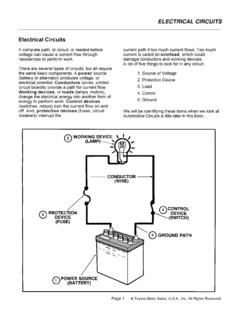
7 So, when someone flips on a switch, he/she is completing a pathway or an electric circuit , allowing a current, or flow of electrons, to travel through the wires. In order to make a circuit , the following is needed: 1. Conductive material (Metal wire. The wire is surrounded by rubber or plastic because those materials make good insulators. Insulators are materials through which electrons have a difficult time flowing. They protect people from dangerous flows of electricity going through the metal.) 2. Voltage source (battery). Voltage is the force that drives current through the circuit .
8 3. Light bulb, fan, heater, buzzer, etc. 4. Switch (to be able to turn it on and off). An electric circuit is, in many ways, similar to a circulatory system. Blood vessels, arteries, veins and capillaries are like the wires in a circuit . The blood vessels carry the flow of blood through a body. The wires in a circuit carry the electric current to various parts of an Electrical or electronic system. The heart is the pump that drives the blood circulation throughout the body. It provides the force or pressure for blood to circulate. The blood circulating through the body supplies various organs, like your muscles, brain and digestive system.
9 A battery or generator produces voltage the force that drives current through the circuit . REMEMBER What do the terms watts, kW, and kWh stand for and what do they measure? (Class discussion) UNDERSTAND Explain what a kWh is. Work example math problems to find using values of 10 and/or 100 using multiplication and division. (ex: 40w x 100 hours = 4000 watt-hours which is = 4 kilowatt hours) (Class discussion) ANALYZE Why would a house or apartment use more kWs at certain times of the day than others? (Ex: Cooking dinner when everyone is home versus around 1:00 when everyone is at school or work.)
10 (Class discussion) EVALUATE How could we decrease kWs at these high-energy times? (Class discussion) LESSON PLAN: LESSON Electrical Circuits Page 3 of 5 To teach to the Math and Reading/Language Arts Common Core Standards: Together, read the sections Watts are like miles-per-hour and Watts measure power kilowatts-per-hour measure energy from the website: Review (or teach) mathematical prefixes centi-, deci-, and kilo- using website: Teach: Kilowatt is 1000 watts For more math practice with math prefixes, go to Read and model the math problems from the section Measuring Energy at.