Transcription of ELECTRICAL CIRCUITS AND METERS - Study Guide with …
1 _____ ELECTRICAL CIRCUITS and METERS Study Guide 2004 Melior, Inc. _____ Course Objectives Upon completion of this course, technicians should understand and be able to apply their knowledge of: ELECTRICAL properties: atomic structure, voltage, current, resistance, AC and DC Digital Volt-Ohm METERS : setup, usage, and procedures Making measurements on CIRCUITS ELECTRICAL principles and variables, Ohm s Law Power, magnetism Series, parallel, and series-parallel circuitry: characteristics, measurement methods, and applications Reading and interpreting schematics Components and applications: fuses, relays, solenoids, fixed and variable resistors, capacitors, and others Using the Job Sheets As you proceed through the online modules, on some pages you will find links that will open a window with a printable procedure or job sheet containing hands-on lab activities based on the NATEF standards related to the content you are studying.
2 When you come upon a procedure or job sheet link, click on it and print the job sheet for completion in the shop. See your instructor for guidance in completing the job sheets. Some jobs sheets will require supplemental materials such as a vehicle service manual, equipment manual, or other references Module 1 Overview In order to properly diagnose and repair automotive ELECTRICAL systems, the technician must first have an understanding of the basics underlying how those systems operate. In this section, we will look at ELECTRICAL fundamentals and how they determine the construction and application of all automotive CIRCUITS . Let's begin first with a "What is Electricity"? Electricity may be defined as: "The movement of electrons through a conductor having the ability to do work". "Where does Electricity come from?" An easy answer might be: batteries, generators, a wall outlet, etc. But, let's take a closer look at the origin of Atoms The atom (figure 1-1) is composed of a nucleus including Protons (positive charge) and Neutrons (no charge) with revolving Electrons (negative charge).
3 Each atom has a different number of electrons around its perimeter (figure 1-2). The movement of these electrons makes up electricity. 2004 Melior, Inc. ELECTRICAL CIRCUITS and METERS Study Guide _____ _____ - 2 - Figure 1-1 The Atom Figure 1-2 Atomic Structure Let's look at one specific example of an atom that we're familiar The copper atom (figure 1-3) has 29 electrons around its nucleus located in different layers or shells around the nucleus, two in the first shell, eight in the second and 18 in the third shell for a total of 28. That leaves just one electron in the outer shell or "Valence shell", and this single electron is the one that does all of the ELECTRICAL work.
4 Atoms that have one or two electrons in the valence shell are called conductors. They include copper, gold, silver, aluminum, nickel, zinc, and others. That is why they are used to make wire. Figure 1-3 Free Electron from Copper Atom Atoms with a large number of electrons in the outer shell are called insulators and include rubber, plastics, etc. Those atoms that have around four electrons in the valence shell are called semiconductors. Semiconductors are used to make electronic components such as transistors, which will be discussed later. ELECTRICAL Energy When a sufficient ELECTRICAL force (Voltage) is applied to a wire, the one "free" electron (figure 1-3) in the outer shell can no longer hold on to the atom. It then begins to carry its negative charge down the wire much like feeding Ping-Pong balls into a paper towel roll. The higher the applied voltage, the more electrons are moved. Those moving electrons operate the lights, horns, computers, and every other ELECTRICAL device on your car or truck.
5 If a substance has a large number of outer shell electrons, such as rubber, they don't let go as easily, and as such we use them as insulators. 2004 Melior, Inc. ELECTRICAL CIRCUITS and METERS Study Guide _____ _____ - 3 - Magnetism Another ELECTRICAL characteristic is Magnetism. Magnetism, or Electromagnetism, is also caused by the movement of electrons in a wire and is the property that makes generators, starters, blower motors, EGR valves, and many other "actuators" work. Electrostatic Forces Free electrons also create electrostatic forces, but the forces are caused by a "collection" of charges in one place, rather than by a movement of electrons.
6 Recall that opposite charges (Protons +, and Electrons -) attract each other, and like charges (Proton-Proton or Electron-Electron) repel each other. These attractive and repulsive forces are called Electrostatics, and can be seen in figures 1-4 and 1-5. Figure 1-4 Electrostatic Fields Figure 1-5 Electrostatic Forces From this, we can now see how the basic structure of atoms is used to produce electricity and is applied to operating automotive systems. ELECTRICAL Properties In our Study of Electricity, we will apply, measure, and calculate four different units: Voltage, Current, Resistance, and Power. Most students have no doubt used these terms and probably measured for them, but often they are used interchangeably even though they are in fact all different. To ensure that we are all talking about the same thing, a brief description of each is in order. Voltage Voltage can be described as ELECTRICAL pressure. A comparison to a household water hose will be useful in discussing voltage.
7 If you have a water hose with a closed nozzle on the end and the spigot has been opened, there is water pressure in the hose even though no water is able to escape through the nozzle. 2004 Melior, Inc. ELECTRICAL CIRCUITS and METERS Study Guide _____ _____ - 4 - What actually causes voltage can be understood by recalling the earlier discussion about "free electrons." When there are more free electrons in one place as compared to another (such as between the positive and negative plates of a car battery), there is said to be a "Difference of Potential" or Voltage. The greater the difference between the number of electrons on one battery plate and the number on the other plate, the higher the voltage.
8 A dead battery has the same number of electrons on the positive plates as on the negative plates. As we deal with electricity, we will see that this " ELECTRICAL pressure" has a number of different names that all mean the same. They are: Voltage or "V" ELECTRICAL Potential Potential Difference Electromotive Force or "EMF" or "E" For the purposes of this course, we will use the term Voltage and either the V or the E designation. Also, remember that voltage is merely a "pushing" force and does not perform the real work in an ELECTRICAL circuit . Current Current is the movement of electrons in a circuit . Like our voltage and water pressure analogy from before, current would be compared to the actual water moving through the hose. It is current, rather than voltage or power, which causes the lights to shine, the motors to turn, and the fuses to blow. Unlike voltage, which is the presence of electrons, current is the movement of electrons through some sort of conductor.
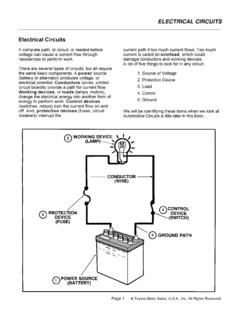
9 The greater the number of electrons past a certain point, the greater the current or Amperage. Automotive systems vary from very high to very low current. For instance, the starter system typically is high current, being in excess of 100 Amps, whereas spark plug current is very low (many confuse high voltage with high current in ignition coils) at much less than one amp. Current is generally referred to in one of two terms: Amperes, Amperage, Amps, or "A" Intensity or "I" For our purposes, "A" and "I" will be used interchangeably. Conventional Current Flow vs. Electron Current Flow There are two different ways to look at current flow in a complete circuit ; one is called "Electron Flow" and the other is "Conventional Flow". An understanding of the difference will help the technician in the use of ELECTRICAL diagrams. The Electron flow theory says that since electrons do the work in a circuit and since electrons have a negative charge, then current must flow from the negative (-) battery terminal through the circuit and into the positive (+) terminal.
10 This is used mostly by ELECTRICAL engineers. Conventional flow theory says that since positive is greater than negative, then current must travel from + to -. Conventional flow is used by the automotive industry and as such, all of our ELECTRICAL diagrams will be written in that format. DC and AC The current in any circuit will be one of two types: Direct Current (DC) or Alternating Current (AC). 2004 Melior, Inc. ELECTRICAL CIRCUITS and METERS Study Guide _____ _____ - 5 - Direct current always flows in the same direction in a circuit , whereas Alternating current flows in one direction then reverses itself and moves in the opposite direction.