Transcription of “Clearing the Sill of the World”: Jane Eyre and the Power ...
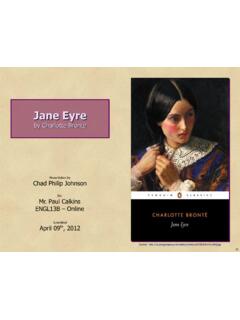
1 Forum on Public Policy 1 Clearing the Sill of the World : jane Eyre and the Power of education in the nineteenth - century Novel Nancy L. Davis, Associate Professor of English, William Rainey Harper College Abstract The idea of education in nineteenth - century women s writing revolves around social class, social mores, and the subtleties of the writer s imagination. Nowhere can this be seen more vividly and thoroughly than in Charlotte Bronte s novel, jane Eyre. The book s opening scene, striking in its symbolic detail, highlights and foreshadows the aforementioned criteria for women s education of the era. Although doors to education were opening wider both in the United States and England due to the Suffragist Movement and other influences, specifically, America s Civil War and the West s Industrial Revolution, the majority of women were as constricted in their educational goals as the claustrophobic space in which the young jane sequesters herself inside the breakfast-room of the Reed home at the opening chapter of Bronte s novel.
2 Four images made clearly apparent in this first chapter become critical motifs in the book, notably the window out of which jane gazes; the books surrounding her in the library; birds, as highlighted in Bewick s History of British Birds, which she is studying; and the red curtains behind which she takes sanctuary from the Reed family. jane s own imagination is far more advanced and exercised than the Brocklehursts of Lowood or even Mr. Rochester himself as he is first introduced at Thorndale. And so, it is jane s subtleties of the imagination that instantaneously endear her to Rochester, subtleties learned from Helen Burns and Miss Temple, jane s female mentors.
3 It is these same subtleties that imbue her with moral fortitude when Bertha s existence is revealed; protect her on the moor when, destitute, she is found--unbeknownst to either party by her long lost cousins; and, finally, fill her with the courage to reject the narrow path of St. John and listen to her own educated and by now experienced heart. Given the cultural, social, and economic upheavals of the late nineteenth century , given women s compelling desire to pull down the walls of denial in educational traditions, and given the strength of woman s keen intellect and imagination, it was only a matter of time before the jane Eyres of the middle to late- nineteenth century opened their windows, grabbed their books, and took off in flight draped in the crimson folds of passion, indeed eventually clearing the sill of the world.
4 1 Introduction The idea of education in nineteenth - century women s writing revolves around social class, social mores, and the subtleties of the writer s imagination. Nowhere can this be seen more vividly than in Charlotte Bronte s novel, jane Eyre. The opening scene in the book, striking in its symbolic detail, highlights and foreshadows the aforementioned criteria for women s education of the era. Although doors to education were opening wider both in the United States and England due to the Suffragist Movement, America s 1 Richard Wilbur, The Writer, in New and Collected Poems (New York: Harcourt, 1988). Forum on Public Policy 2 Civil War, and the Industrial Revolution, the majority of women were as constricted in their educational goals as the claustrophobic space in which the young jane sequesters herself inside the breakfast-room of the Reed home at the outset of Bronte s novel.
5 Four images made clearly apparent in this first chapter become critical motifs in the book, notably the window out of which jane gazes; the books surrounding her in the Reed s breakfast-room; birds, as first referenced in the text that jane is reading, Bewick s History of British Birds; and the red curtains behind which she takes sanctuary from the Reed family. But Master John Reed will not allow jane sanctuary for long; to do so would mean risking usurpation of Power , and in his own household: What were you doing behind the curtain? he asked. I was reading. Show the book. I returned to the window and fetched it thence. You have no business to take our books; you are a dependent, mama says; you have no money; your father left you none; you ought to , I ll teach you to rummage my book-shelves: for they are mine; all the house belongs to and stand by the door, out of the way of the mirror and the window.
6 2 John hurls the book at jane , striking and injuring her a symbolic and violent action that sums up her lonely station in the world as a powerless and faceless female without opportunity. But jane experiences a revelation, and rather than cower before the Master, she sees the tyrant in him and asserts herself in the face of it. For jane already has read a good deal of history. I had read Goldsmith s History of Rome, and had formed my opinion of Nero, Caligula, etc. 3 She also understands that something significant has changed about her response to such assaults when she asserts, I resisted all the way: a new thing for fact is, I was a trifle beside myself; or rather out of myself, as the French would say and continues by referring to herself as a rebel slave.
7 4 Knowledge of French culture and language, the Roman Empire? At an early age, we see that jane is quite well self-educated. Of course, jane is punished, sent to the red-room. Complicit in this banishment are all the women in the household, gentry and servants alike a common phenomenon of these times. Four hands were imminently laid upon me, she Not coincidentally, the red-room is 2 Charlotte Bronte, Chapter 1, in jane Eyre (New York: Penguin, 1984), 13. 3 Ibid., 1:13. 4 Ibid., 2:14. 5 Ibid., 1:13. Forum on Public Policy 3 where John Reed s father died the only Reed family member to have nurtured and loved his niece. jane experiences an unwelcome rite of passage in this room, eventually leading to the decision to send her away to school.
8 The school, of course, is the infamous Lowood, and it reflects perfectly the education orphans and those of lower socioeconomic means receive: dubiously relevant scraps of information coupled with physical and spiritual starvation of its inmates. What, then, do windows, doors, birds, and red curtains have to do with jane s educational experiences at Lowood and elsewhere in the novel? As often is the case in women s literature, windows are important symbols of wider horizons, as yet unimagined opportunities, escape routes. Books speak volumes: women who were taught to read often became avid readers, plying pages of novels and nonfiction texts for intellectual and creative sustenance a refuge of sorts, like the Reed s book collection was for jane .
9 Indeed, as Elaine Showalter has argued, reading offered them [women] vicarious participation, emotional expression, and the feeling of community that arises from a recognition of shared dreams. 6 Birds, of course, denote flight, and jane takes off any number of times in her quest for freedom and independence, love and self-actualization. And the red curtains provide protection and elegance literally, the fabric of something substantive. Finally the color red symbolizes rebellion, passion, ardent devotion to principles, and love. Although jane will become gainfully employed, becoming unemployed for a member of her socioeconomic class can spell immediate destitution. When she begins employment with Rochester at Thorndale, jane can at least make the claim that she has secured a better than prototypical education for a nineteenth - century lower middle-class female, though such learning has come at great expense: humility for the crumbs of education distributed; the knowledge that a person of her gender and social station is entirely disposable and replaceable; the basics of arithmetic, Latin, grammar, history, the reading of select classics, French, piano, and drawing.
10 Those dissociated snippets of information to be found in the despairing refuge of the under-prepared governess and 7 And so, the continuum of women s education in the nineteenth - century is routinely assured. 6 Kate Flint, The Woman Reader (Oxford: Oxford University Press, 1993), 34. 7 Ibid., 30. Forum on Public Policy 4 However, as we will see, not only has jane been better educated than the average governess of her time, jane s imagination is far more advanced and exercised than, certainly, the Brocklehursts of Lowood or even Mr. Rochester himself as he is first introduced at Thorndale. For we know that Edward Rochester has much to learn, learning that later will be attributed to his young governess.