Transcription of Surfactant Replacement Therapy in Extremely Low ...
1 INDIAN PEDIATRICS227 VOLUME 52__MARCH 15, 2015 Surfactant Replacement Therapy in Extremely Low Gestational AgeNewbornsM EIBISBERGER, E RESCH AND B RESCHFrom Research Unit for Neonatal Infectious Diseases and Epidemiology, Division of Neonatology, Department of Paediatrics,Medical University of Graz, to: Prof. Dr. Bernhard Resch, Division of Neonatology, Department of Paediatrics, Medical University of Graz,Auenbruggerplatz 34/2, 8036 Graz, Austria. trials have been carried out to establishthe relative efficacy of various surfactantproducts in improving clinical outcome inpreterm infants with respiratory distresssyndrome (RDS). Meta-analyses of trials comparingnatural and synthetic surfactants showed a clear reductionin air leaks and suggested improved survival with naturalsurfactants [1]. In 2000, Ainsworth, et al. [2] reported ahigher mortality rate in infants receiving a syntheticsurfactant compared with the natural Surfactant .
2 ACochrane review of eleven trials demonstrated asignificant reduction in the risk of pneumothorax andmortality rate by use of natural Surfactant [3]. Both naturalsurfactant extracts and synthetic Surfactant extracts wereeffective in the treatment and prevention of RDS butnatural Surfactant treatment was associated with greaterearly improvement in the requirement for Surfactant administration to infantsjudged to be at risk of developing RDS (intubated infantsless than 30-32 weeks gestation) demonstrated adecreased incidence of pneumothorax, pulmonaryinterstitial emphysema and mortality [4]. Resultssuggested that there would be two less cases ofpneumothorax and five less deaths per 100 infants treatedwith prophylactic Surfactant compared to rescuetreatment when Surfactant was given within 15 minutes ofbirth. This regimen was shown to be as effective astreatment before the first breath [5].
3 UUUUUPPPPPDDDDDAAAAATTTTTEEEEEIn contrast, no difference between early and latesurfactant Therapy was observed in a controlled clinicalstudy having a high rate of antenatal steroid treatmentin the study population [6]. In most of the earlier trials, therate of antenatal steroid use was low. The latest Cochranereview of trials comparing early selective treatment ofRDS (within the first two hours of life) to late selectivetreatment found evidence of the benefit of early Therapy [7].RECENT TRIALSSome recent trials focussed on continuous positive airwaypressure (CPAP) treatment and optimal Surfactant timingin Extremely low gestational age newborns [8-11]. TheContinuous Positive Airway Pressure or Intubation atBirth (COIN) trial assigned 610 infants who were born at25-28 weeks of gestational age to CPAP or intubation andventilation at 5 minutes after birth [8]. At 28 days, therewas a lower risk of death or need for oxygen Therapy in theCPAP group than in the intubation group (OR ; 95%CI to ; P= ).
4 At 36 weeks of gestational age, of 307 infants who were assigned to receive CPAPhad died or had bronchopulmonary dysplasia (BPD), ascompared with of 303 infants who were assignedto receive intubation (OR favoring CPAP ; 95% CI, to ; P= ). There was little difference inoverall mortality. In the CPAP group, 46% of infants wereintubated during the first 5 days, and the use of surfactantwas halved. The incidence of pneumothorax wassignificantly increased with 9% in the CPAP as comparedThere is a growing body of evidence over the last years suggesting continuous positive airway pressure (CPAP) ventilation being the firstchoice of ventilatory support in newborns with Extremely low gestational age, and early rescue Surfactant treatment being as effective asprophylactic Therapy . The Intubation Surfactant Extubation procedure is discussed as an alternative procedure that may have thepotential to combine the positive effects of Surfactant and early CPAP.
5 A further mode of Surfactant administration , administration via a thinendotracheal catheter during spontaneous breathing with CPAP, has recently come into clinical use. This less invasive surfactantadministration technique shows some short-term benefits but still cannot be recommended for general use in this vulnerable follow-up studies are needed to allow new recommendations on Surfactant Therapy in this high-risk : Low birth weight, Prematurity, Respiratory distress PEDIATRICS228 VOLUME 52__MARCH 15, 2015 EIBISBERGER, et Replacement Therapy with 3% in the intubation group (P< ), but there wereno other serious adverse events. The CPAP group hadfewer days of ventilation. Results showed that primaryCPAP treatment with Surfactant administration , only ifventilation is required, was comparable to intubation andimmediate Surfactant Replacement Surfactant Positive Pressure and Pulse OximetryRandomized Trial (SUPPORT) by the NICHD NeonatalResearch Network included infants between 24 and 27week of gestational age, who were assigned to intubationand Surfactant treatment within 1 hour after birth or toCPAP treatment, including the possibility of surfactantadministration if intubation criteria were met [9].
6 Overall,death or BPD was not significantly different between thestudy groups. A significantly lower mortality rate wasfound in infants who were born between 24 and 25 weeksand treated with CPAP compared to the same age grouptreated with intubation and Surfactant Therapy (deathduring hospitalization: vs. , P= ; death at36 weeks: vs. , P=.01). This studydemonstrated that CPAP with subsequent surfactanttherapy (if needed) is an equivalent alternative tointubation and primary Surfactant treatment. TheBreathing Outcomes Study, a prospective secondarystudy to the SUPPORT trial, assessed respiratorymorbidity at 6-month intervals from hospital discharge to18-22 months corrected age [10]. Treatment with earlyCPAP rather than intubation/ Surfactant was associatedwith less respiratory morbidity defined as wheezing morethan twice per week during the worst 2-week period orcough longer than 3 days without a multicentre randomized trial by the VermontOxford Network DRM study group [11] compared threeapproaches to the initial respiratory management ofpreterm neonates born at 26 to 29 weeks of gestationalage: prophylactic Surfactant followed by a period ofmechanical ventilation (prophylactic Surfactant );prophylactic Surfactant with rapid extubation to bubblenasal CPAP (intubate- Surfactant -extubate) or initialmanagement with bubble CPAP and selective surfactanttreatment (nCPAP).
7 The primary composite outcome ofdeath or BPD at corrected 36 weeks of gestational age in648 infants enrolled at 27 centres did not differ betweenthe groups. In the nCPAP group, 48% were managedwithout intubation and ventilation, and 54% withoutsurfactant treatment. The authors concluded that initialCPAP was a possible and less invasive and probably evenless expensive alternative to Surfactant Surfactant followed by nCPAP, andnCPAP with early selective Surfactant Therapy werecompared in the CURPAP trial [12]. Of 208 inborn infantsborn at 25 to 28 weeks of gestational age, who were notintubated at birth, 105 were randomly assigned toprophylactic Surfactant or nCPAP within 30 minutes ofbirth. Thirty-three ( ) infants in the prophylacticsurfactant group (n=103), needed mechanical ventilationin the first 5 days of life compared with 34 ( ) in thenCPAP group (RR , 95% ; P= ).Death and type of survival at 28 days of life and atcorrected 36 weeks of gestational age, and incidence ofmain morbidities of prematurity (secondary outcomes)were similar between groups.
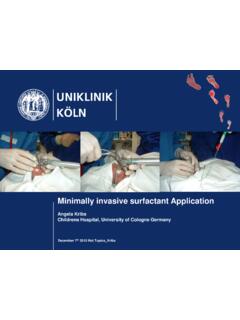
8 A total of of infantsin the prophylactic Surfactant group and in thenCPAP group survived in room air at corrected 36 weeksof gestational age [12]. In summary, prophylacticsurfactant was not superior to nCPAP and early selectivesurfactant in decreasing the need for mechanicalventilation and the other morbidities of prematurity inspontaneously breathing very preterm infants on these results together, primary nCPAP treatment and early Surfactant Therapy after establishmentof respiratory distress syndrome signs seem to beappropriate for clinical practice in Extremely lowgestational age Intubation Surfactant Extubation (INSURE)procedure is discussed as an alternative procedure thatmay have the potential to combine the positive effects ofsurfactant and early CPAP [13]. Another mode ofsurfactant administration , via a thin endotracheal catheterduring spontaneous breathing with CPAP, has recentlycome into clinical use [14-16].
9 Results of a multicentreGerman study showed that the application of Surfactant tospontaneously breathing preterm infants was feasible, andit reduced the need for subsequent mechanical ventilation[17]. This effect was even more pronounced in thesubgroup of infants who were stabilized with CPAP afterbirth. The intervention group had significantly fewermedian days on mechanical ventilation, and a lower needfor oxygen Therapy at 28 days compared with the standardtreatment group. The authors recorded no differences inmortality or serious adverse events between the main limitations of the new method were the need forexpertise, and a risk of trauma [18]. This minimallyinvasive Surfactant Therapy (MIST) was also successfullyevaluated in eleven preterm infants (25 to 28 weeks ofgestational age) in Australia [19]. The subsequentinitiated Collaborative Paired Trials InvestigatingMinimally- invasive Surfactant Therapy (OPTIMIST)trial is planned to enroll a total of 606 infants from morethan 30 centres worldwide, and is expected to becompleted by end-2017 [20].
10 Klebermass, et al. [21] used this less invasivesurfactant administration (LISA) technique in aINDIAN PEDIATRICS229 VOLUME 52__MARCH 15, 2015 EIBISBERGER, et Replacement Therapy prospective cohort of 224 preterm infants (23 to 27 weeksof gestational age), and compared the results with ahistorical control group [21]. LISA was well tolerated by94% of all infants, and 68% of infants stayed on CPAP onday 3. The rate of mechanical ventilation was 35% withinthe first week and 59% during the entire hospital to historical controls, significantly highersurvival rates and significantly less intraventricularhemorrhage and cystic periventricular leukomalacia, buthigher rates of patent ductus arteriosus and retinopathy ofprematurity were documented. Experience with the MIST technique used in 44 preterm infants was recentlycompared to the INSURE procedure of a historicalcontrol group of 31 infants.