Transcription of SALES TAX EXEMPTION FOR BUILDING MATERIALS USED IN …
1 Office of Legislative Research Research Report September 2, 2016 2016-R-0149 Phone (860) 240-8400 Connecticut General Assembly Office of Legislative Research Stephanie A. D'Ambrose, Director Room 5300 Legislative Office BUILDING Hartford, CT 06106-1591 SALES TAX EXEMPTION FOR BUILDING MATERIALS USED IN STATE CONSTRUCTION PROJECTS By: Rute Pinho, Principal Analyst John Rappa, Chief Analyst ISSUE Explain the state SALES and use tax EXEMPTION for BUILDING MATERIALS that contractors purchase for use in state construction projects. How does the Department of Revenue Services (DRS) enforce this EXEMPTION ? Do other states provide a comparable one? SUMMARY State law allows contractors to purchase BUILDING MATERIALS for use in construction contracts with state agencies and other exempt entities ( , municipalities and nonprofit organizations) without paying SALES and use tax on them.
2 The EXEMPTION applies to MATERIALS permanently installed or placed in a construction project, such as the bricks and mortar used to construct an office BUILDING . It does not apply to the equipment, tools, and supplies the contractor uses to fulfill the contract ( , scaffolding, tractors, pipe cutters, trowels, wrenches) (Conn. Agencies Regs. 12-426-18). To receive the EXEMPTION , contractors must present to sellers a DRS certificate attesting that the MATERIALS will be used for an exempt entity s project. The contractor must sign the certificate and declare under penalty of false statement that the exempted items will be permanently installed or placed in the exempt entity s project. Sellers do not have to prove that a sale is exempt from the SALES and use tax if the applicable certificate was properly completed and taken in good faith.
3 According to Susan Sherman, DRS s legislative program manager, DRS uses its audit process to verify that purchases for which contractors have claimed the EXEMPTION were eligible. September 2, 2016 Page 2 of 11 2016-R-0156 We identified 15 other states with comparable SALES and use tax exemptions for BUILDING MATERIALS used in state construction projects. Like Connecticut, these states distinguish between MATERIALS that become part of the project and MATERIALS used or consumed to complete it. In 10 of the states, the EXEMPTION applies only to BUILDING MATERIALS that are physically incorporated into the construction project ( , lumber, windows, doors, and plumbing and electrical MATERIALS ). In the remaining five states (Massachusetts, Missouri, New Jersey, Texas, and Vermont), it also applies to tools and supplies that are consumed in the construction but are not incorporated into the structure ( , nonreusable concrete forms, sandpaper, and garbage bags).
4 In all of the states, the EXEMPTION also applies to construction contracts for other designated governmental entities; in most, it applies to charitable nonprofits as well. SALES AND USE TAX EXEMPTION FOR AGENCY CONTRACTORS Scope Connecticut law exempts contractors (including subcontractors) from paying SALES and use taxes on BUILDING MATERIALS they purchase for projects being performed under contract with state agencies and other exempt entities, including the government, municipalities, nonprofit hospitals, and other nonprofit organizations (Conn. Agencies Regs. 12-426-18). The contractor EXEMPTION applies only to MATERIALS and supplies permanently installed or placed in a project, such as the bricks and mortar used to construct an office BUILDING .
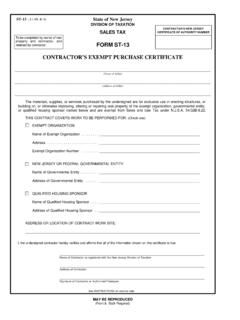
5 It does not apply to the equipment, tools, and supplies the contractor uses or consumes in fulfilling a contract. Contractors are also exempt from paying SALES and use taxes on services resold to state agencies or exempt entities under a construction contract. The EXEMPTION applies only to services that will become an integral and inseparable component of the BUILDING contract ( , plumbing and electrical services). It does not apply to services consumed by the contractor , such as those of a secretary hired to process and file project-related documents (CGS 12-410(5)). Obtaining the EXEMPTION and Verifying Eligibility To receive the EXEMPTION , contractors must present DRS s CERT-141, contractor s Exempt Purchase Certificate (see Figure 1) when purchasing BUILDING MATERIALS from a seller (DRS, BUILDING Contractors Guide to SALES and Use Taxes, 2007).
6 September 2, 2016 Page 3 of 11 2016-R-0156 The certificate is designed to ensure that contractors, and the goods they purchase, qualify for the SALES and use tax EXEMPTION . CERT-141 requires contractors to identify the project, the contracting agency or entity, and the amount of MATERIALS and supplies purchased for the project. If a contractor cannot identify the exact amount of MATERIALS that will be installed or placed in the project, it must provide an estimate, but it is liable for taxes on any MATERIALS or supplies that are not ultimately installed or placed in the project. The contractor must sign the certificate and declare under penalty of false statement that the exempted items will be permanently installed or placed in the project.
7 The penalty is a maximum $5,000 fine, up to five years in jail, or both. The contractor must also acknowledge that it is liable for taxes and penalties if this condition is unmet. Lastly, it must keep, for at least six years, the certificate and any records supporting its use, including those showing where and how the exempted MATERIALS and supplies were used. Sellers do not have to prove that a sale is exempt from the SALES and use tax if the applicable certificate was properly completed and taken in good faith. But a seller s good faith will be questioned if he or she knew, or should have known, facts suggesting that the sale did not qualify for the EXEMPTION ( , the seller knows the contractor intends to use the MATERIALS for a private construction project).
8 COMPARABLE EXEMPTIONS IN OTHER STATES We identified 16 states, including Connecticut, that exempt the sale of BUILDING MATERIALS incorporated or used in state construction projects. Table 1 lists the states providing the EXEMPTION and briefly describes the applicable property and the exempt entities. As it shows, all of the states extend the EXEMPTION to other designated governmental entities; most extend it to charitable nonprofit organizations as well ( , those organized for charitable, religious, educational, Figure 1: DRS CERT-141 September 2, 2016 Page 4 of 11 2016-R-0156 scientific, literary, or other specified purposes). In Missouri, the EXEMPTION applies only to specified state agencies.
9 In 11 states, including Connecticut, the EXEMPTION applies only to BUILDING MATERIALS that are physically incorporated into the construction project. In the remaining five states (Massachusetts, Missouri, New Jersey, Texas, and Vermont), it also applies to supplies that are consumed in the construction but are not incorporated into the structure. September 2, 2016 Page 5 of 11 2016-R-0156 Table 1: State SALES Tax Exemptions for BUILDING MATERIALS Used in State Construction Projects State and Citation Applicable Property Exempt Entities State Agencies and Entities Other Entities Alabama Ala. Admin. Code (3) Ala. Admin. Code Tangible personal property to be incorporated into real property pursuant to a contract with a governmental entity All Counties Incorporated municipalities Educational institutions (state, county, or municipal) Industrial or economic development boards or authorities exempt from state SALES and use tax Other governmental agencies exempt from state SALES and use tax Colorado Colo.
10 Rev. Stat. Ann. 39-26-708 1 Colo. Code Regs. 201-5:SR-10 BUILDING MATERIALS purchased by contractors for construction work on property owned by an exempt entity; includes only items that become a part of the structure All government Political subdivisions1 Schools (public and nonprofit) Charitable nonprofits 1 Political subdivisions are governmental units, such as counties, municipalities, and school districts Table 1 (continued) September 2, 2016 Page 6 of 11 2016-R-0156 State and Citation Applicable Property Exempt Entities State Agencies and Entities Other Entities Connecticut Conn. Agencies Regs. 12-426-18 MATERIALS and supplies to be installed or placed in projects being performed under contracts with exempt entities and will remain in the projects after their completion All government Political subdivisions Acute care, for-profit hospital operating as a sole community hospital ( , Sharon Hospital) Charitable nonprofits (and cemetery companies) Connecticut Technology Park MATERIALS Innovation and Recycling Authority Tourism districts Solid waste-to-energy facilities Municipal or regional resource recovery authorities Metropolitan Transportation Authority or subsidiary in connection with New Haven commuter rail service Table 1 (continued)