Transcription of Brown Bear, Brown Bear, What do You See? - PALS
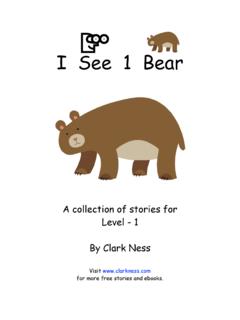
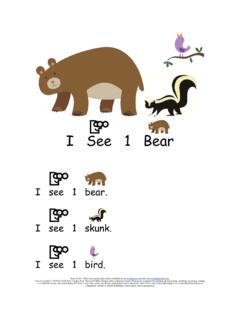
1 MaterialsProcedureVirginia q Pre-K q Kindergarten q Grades 1 3 Brown bear , Brown bear , what do You See?Literacy Skills / WritingA great picture book can be used in a variety of ways. Below are some suggestedactivities for Eric Carle s Brown bear , Brown bear , what do You See?.1. Photocopy bear onto Brown cover paper, fold in half, and make a little book with white paper inside. The book can be cut out to make the bear shape. Ask children to re-write the story of Brown bear . They can change the animals, the colors, and what the animals Make a color chart using the animals in the Create a class book for which each child writes and illustrates his/her own page. In response to Children, children, what do you see?, students can draw self-portraits and complete the sentence, I see a _____ looking at me. Encourage students to be silly and creative. You may also emphasize shapes and/or adjectives, by asking students to include a shape in their response, such as, I see a round, red beetle looking at me.
2 Source: Literacy Activities for the Early Years, Jane Welsh. 1. Photocopy bear from cover2. Color chart using animals from the book3. Brown bear , Brown bear , what do You See?MaterialsProcedureVirginia Pre-K q Kindergarten q Grades 1 3 Chalk One Up!Literacy Skills / Writing1. Black paper2. Sidewalk Chalk3. Glue4. Rough-grit sandpaper5. Scissors6. Cardstock1. Read Arthur series book, Binky Rules. In the book, Binky s name mysteriously appears in chalk all over the school. Students will make chalk name rubs similar to those in the Cut out sandpaper letters and glue them to Children take turns selecting the letters of their names from the sandpaper alphabet (younger children can select just their initials).5. Children place black paper over the sandpaper letters and rub with sidewalk chalk. As children rub, their names mysteriously appear on the black : , WGBH Play and Learn with Arthur Vol 2 MaterialsProcedureq Pre-K q Kindergarten q Grades 1 3 Virginia , , , , , StartLiteracy Skills / Writing1.
3 Newspaper headlines1. Students select a headline of interest from the day s newspaper. 2. Students choose only one word from the headline. 3. Direct students to write a sentence that starts with that word. For example, using the headline, Culture is National Treasure, from which the student chooses the word treasure, the student might write, Treasure is something you cherish. 4. Then direct students to use the last word of the first sentence to write a second sentence. Using our example of, Treasure is something you cherish, the student s second sentence would start with cherish. Therefore, s/he might write, Cherish means you really love something. 5. Up to this point, you are leading students step by step through this writing exercise. After two sentences are composed and students have an understanding, explain to students that they will now write a whole page using this pattern. The writing may not make sense in its flow of sentences.
4 Only the individual sentences must make sense. The purpose of this exercise is to get students writing and having fun! Extended example using the word treasure: Treasure is something you cherish. Cherish means you really love something. Something you might cherish is your skateboard. Skateboard is a word for a fun toy that can sometimes be dangerous. Dangerous situations scare me. Me has two letters. Letters are fun to write, because in them I can say things in my own words. Words sometimes escape me, but not today! Today I m writing. Writing is a blast! Source: (2003). The Virginia Press Association s Newspaper in Education CommitteeMaterialsProcedureLiteracy Skills / Writing1. To introduce or review the use of adjectives, read aloud The Important Book. This story describes everyday items and experiences, highlighting the objects many uses or appearances. The most important thing about the object is Students select an important thing to describe.
5 what is important to them?3. VARIATION: You may use the book for the first week of school, describing the most important qualities of your grade level. Then, ask students to compose an important book passage about themselves to include with your grade level analysis. This is a great class generated book for your classroom library at beginning of the year!1. The Important Book by Margaret Wise Brown Source: (2008). Teichman, , , , , q Pre-K q Kindergarten q Grades 1 3 The Important ThingMaterialsProcedureq Pre-K q Kindergarten q Grades 1 3 Virginia , , King Change-a-LotLiteracy Skills / Writing1. King Change-a-Lot2. Wish slips3. A large chamber pot1. Read, King Change-A-Lot by Babette Ask children to fill an old chamber pot with written Bring closure to the activity by asking students open ended prompts, such as, what else could King Change-a-Lot have wished for? How would you change the Kingdom? what sort of King/Queen would you be and why?
6 Source: Literacy Activities for the Early Years: Pre-K q Kindergarten q Grades 1 3 Virginia CloudLiteracy Skills / Writing1. Little Cloud 2. Blue construction paper3. White paint4. Crayons5. Writing paper and pencil1. Read Little Cloud to the Take children outside, lie down and watch the Talk about what the clouds look In the classroom, ask the children to draw and write about what they saw in the clouds. Use blue construction paper for their drawing and writing paper for their Students paint their cloud drawings and write while the clouds Once dry, students may need to add details to the clouds with : Literacy Activities for the Early Years, MaterialsProcedureq Pre-K q Kindergarten q Grades 1 3 Virginia BagsLiteracy Skills / Writing1. Large Ziploc bags2. Various colors of finger paint3. Clear packing tape 1. Place a dollop of paint into each Seal each bag and reinforce the four sides with clear packing Spread out the paint inside each Encourage children to use their fingertips to practice writing.
7 To erase, the child can simply rub his hand over the bag and start : (1996). The Mailbox: Learning Center, 38. MaterialsProcedureLiteracy Skills / Writing1. Samples of different types of poems - try to find poems written by children at your grade level or compose poems about your favorite thing2. Drawing paper1. Writing should relate to students lives. We should encourage them to write about what they know. Often, what they know is a memorable moment, experience, or favorite thing. During April, National Poetry Month, students can compose a series of poems about their favorite thing. Select standard poem structures (concrete, list, acrostic, quatrain, etc.) and conventions (repetitive verse, sound words, rhyme, sensory images, etc.) appropriate to your grade An easy way to begin is by students illustrating a cover for their collection of poems. The cover should be a large picture of their favorite thing. Writing a list poem is a good scaffold to more difficult poem styles!
8 3. Students may perform a selected poem at an open mic or poetry cafe event for your , , , q Pre-K q Kindergarten q Grades 1 3My Favorite ThingMaterialsProcedureLiteracy Skills / Writing1. Select a picture book and cover it in construction paper. On the construction paper cover, draw multiple question marks and include the author and illustrator s Using picture books familiar to the students, briefly reflect on the story and do a picture walk. Then ask, Does the title match the story? Demonstrate that the title of a book reflects the story and gives the reader an idea as to the topic and type of Read the mystery title book aloud. While you read, prompt students to be thinking of a good title for the Once finished, take recommended title options from the class. Then give students four pre-prepared options from which to choose. Two of the titles may be appropriate, but one will be a clear best fit (and the actual title). The other two choices may be silly to emphasize more clearly that a title must match the Students vote on which title they believe is the real title of the book.
9 Remove the construction paper cover and reveal the title!Source: (2008). Teichman, A new read aloud covered in construction paper2. Select picture books previously read aloud to class q Pre-K q Kindergarten q Grades 1 3 Virginia , TitleMaterialsProcedureVirginia Name BagsLiteracy Skills / Writing1. Plastic bags2. Any type of manipulative letters such as letter cards, magnetic letters, letter tiles, Place the letters of a child s name in a bag. Make a bag for each The children write their names on an answer card and include it in the bag. The child uses the letters to spell his/her name. 3. The children can switch bags to spell a friend s names, Pre-K q Kindergarten q Grades 1 3 MaterialsProcedureq Pre-K q Kindergarten q Grades 1 3 Virginia Day FunLiteracy Skills / Writing1. Picture books about rain2. Writing paper3. Crayons1. Make a classroom book to read on rainy days. Start by reading various titles about rainy days. Some good books are Rainy, Rainy Saturday, The Napping House, and Mushroom in the Rain.
10 Consider rhymes and songs as well, such as Rain, Rain Go Away and It s Raining, It s Pouring. 2. Help children research rain and discuss what they like to do on rainy Students write about the rain and illustrate their work. 4. Compile student work in a classroom book to enjoy on rainy : , WGBH Play and Learn with Arthur Vol 1. MaterialsProcedureq Pre-K q Kindergarten q Grades 1 3 Virginia , , , 1. Paper2. PencilLiteracy Skills / Writing1. Fold a sheet of paper into 3 equal sections labeled 1, 2, and 3. 2. Write a sentence on the board and have students copy it in the first section of their papers. 3. Student illustrate the meaning of the sentence in the space underneath. 4. Next, ask students to expand or elaborate on the sentence in the third space. Sentence ElaborationSource: 2002). Southwest Educational Development Laboratory: SEDL Letter, XIV, Skills / WritingVirginia , , , , 1. Squiggle and write helps students when experiencing writers block.