Transcription of SEDATION AND AGITATION MANAGEMENT
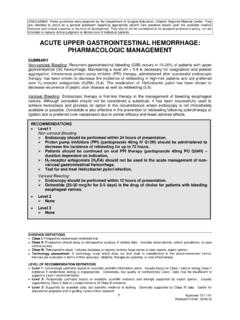
1 DISCLAIMER: These guidelines were prepared by the Department of Surgical Education, Orlando Regional Medical Center. They are intended to serve as a general statement regarding appropriate patient care practices based upon the available medical literature and clinical expertise at the time of development. They should not be considered to be accepted protocol or policy, nor are intended to replace clinical judgment or dictate care of individual patients. SEDATION AND AGITATION MANAGEMENT . SUMMARY. SEDATION is an essential component of care for critically ill patients necessitating appropriate selection and monitoring of drug therapy.
2 Each sedative agent possesses specific risks, benefits, and economic cost, which must all be considered in choosing an appropriate therapy. It is important to recognize that while sedative agents may provide anxiolytic, amnestic, sedative-hypnotic, anticonvulsant, and muscle relaxant effect, they do not have an analgesic effect. Midazolam and propofol are appropriate where short-term SEDATION is necessary, while lorazepam and diazepam are appropriate for long-term SEDATION . Due to its cost and risk profile, propofol should be reserved for patients in whom conventional SEDATION has failed, rapid assessment of neurologic function is necessary, or intracranial hypertension is present.
3 RECOMMENDATIONS. Level 1. None Level 2. Sedatives should be titrated to a Riker SEDATION - AGITATION Scale (SAS) score of 3 to 4. Midazolam is the drug of choice for short-term anxiolysis (</= 72 hours) in ventilated patients. Intermittent administration is preferred. Lorazepam is the anxiolytic of choice for patients anticipated to be ventilated for 24. hours to 5 days. Propofol should be reserved for the following patient populations: Failure of conventional SEDATION Need for rapid neurologic assessment Presence of intracranial hypertension Level 3.
4 Oral diazepam can be used for long-term anxiolysis (anticipated time on ventilator greater than 5 days). Dexmedetomidine may have a role in the ICU SEDATION , however, it should be evaluated on a case by case basis. INTRODUCTION. SEDATION is an essential component of care for the critically ill patient. The goal for SEDATION in the ICU is to provide comfort and anxiolysis, and facilitate mechanical ventilation or procedures. An ideal regimen should control anxiety and AGITATION , and provide amnesia while minimizing adverse effects. Practices of ICU SEDATION vary widely.
5 Monitoring tools frequently include subjective assessments by caregivers or SEDATION scales that are not validated. Inappropriate therapy may result in adverse drug reactions, prolonged mechanical ventilation, extended ICU stays, and increased costs. EVIDENCE DEFINITIONS. Class I: Prospective randomized controlled trial. Class II: Prospective clinical study or retrospective analysis of reliable data. Includes observational, cohort, prevalence, or case control studies. Class III: Retrospective study. Includes database or registry reviews, large series of case reports, expert opinion.
6 Technology assessment: A technology study which does not lend itself to classification in the above-mentioned format. Devices are evaluated in terms of their accuracy, reliability, therapeutic potential, or cost effectiveness. LEVEL OF RECOMMENDATION DEFINITIONS. Level 1: Convincingly justifiable based on available scientific information alone. Usually based on Class I data or strong Class II. evidence if randomized testing is inappropriate. Conversely, low quality or contradictory Class I data may be insufficient to support a Level I recommendation.
7 Level 2: Reasonably justifiable based on available scientific evidence and strongly supported by expert opinion. Usually supported by Class II data or a preponderance of Class III evidence. Level 3: Supported by available data, but scientific evidence is lacking. Generally supported by Class III data. Useful for educational purposes and in guiding future clinical research. 1 Approved 4/03/2001. Revised 3/29/2005, 10/24/2009. Selection of drug therapy is based on identification and differentiation of pain, anxiety, AGITATION , and delirium. Anxiety is a psychophysiologic response to real or imagined danger, while AGITATION refers to excitement accompanied by motor restlessness.
8 Benzodiazepines and propofol have been extensively studied in critically ill patients. Benzodiazepines are considered first-line agents for the MANAGEMENT of anxiety and AGITATION (Table). Midazolam has a short half-life and undergoes hepatic metabolism to an active metabolite. Substantial accumulation may occur with high doses or prolonged infusions. Lorazepam has an intermediate half-life and is glucuronidated in the liver, but has no actives metabolites to accumulate. Diazepam has a long half-life and is hepatically metabolized to several active metabolites.
9 Propofol is classified as a short acting sedative-hypnotic agent and is useful in the MANAGEMENT of refractory intracranial hypertension; however, its ability to reduce ICP is dose dependent (>50. mcg/kg/min). Its use has been associated with hypotension, metabolic acidosis, rhabdomyolysis, methemoglobinemia, and potentially life-threatening bradyarrhythmias (see Propofol guideline). LITERATURE REVIEW. SEDATION Assessment Despite the widespread use of sedatives, there are few well-designed trials addressing optimal drug therapy. Most existing studies did not use a validated SEDATION scale.
10 Many were not blinded and confounding variables (analgesic use and neuromuscular blockade) were not controlled. Endpoints were variable and the ideal level of SEDATION was not consistent among studies. Riker and colleagues performed a study to test the Riker SEDATION - AGITATION Scale (SAS) for reliability and validity in adult ICU patients (1). The SAS includes seven levels of AGITATION , ranging from dangerous AGITATION to unarousable. Paired evaluators (experienced ICU nurses) simultaneously and independently scored patients using the SAS, Ramsey, and Harris scales.