Transcription of PointNet: Deep Learning on Point Sets ... - CVF Open Access
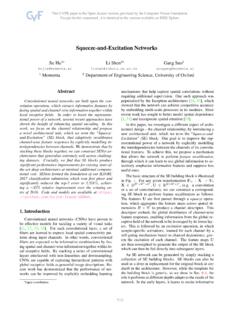
1 pointnet : deep Learning on Point sets for 3D Classification and Segmentation Input Point Cloud ( Point set representation). Charles R. Qi* Hao Su* Kaichun Mo Leonidas J. Guibas Stanford University Abstract pointnet Point cloud is an important type of geometric data mug? structure. Due to its irregular format, most researchers transform such data to regular 3D voxel grids or collections table? of images. This, however, renders data unnecessarily voluminous and causes issues. In this paper, we design a car? novel type of neural network that directly consumes Point Classification Semantic Segmentation Part Segmentation clouds, which well respects the permutation invariance of Figure 1.
2 Applications of pointnet . We propose a novel deep net points in the input. Our network, named pointnet , pro- architecture that consumes raw Point cloud (set of points ) without vides a unified architecture for applications ranging from voxelization or rendering. It is a unified architecture that learns object classification, part segmentation, to scene semantic both global and local Point features, providing a simple, efficient parsing. Though simple, pointnet is highly efficient and and effective approach for a number of 3D recognition tasks. effective. Empirically, it shows strong performance on par or even better than state of the art.
3 Theoretically, we provide analysis towards understanding of what the still has to respect the fact that a Point cloud is just a network has learnt and why the network is robust with set of points and therefore invariant to permutations of its respect to input perturbation and corruption. members, necessitating certain symmetrizations in the net computation. Further invariances to rigid motions also need to be considered. 1. Introduction Our pointnet is a unified architecture that directly takes Point clouds as input and outputs either class labels for the entire input or per Point segment/part labels for In this paper we explore deep Learning architectures each Point of the input.
4 The basic architecture of our capable of reasoning about 3D geometric data such as network is surprisingly simple as in the initial stages each Point clouds or meshes. Typical convolutional architectures Point is processed identically and independently. In the require highly regular input data formats, like those of basic setting each Point is represented by just its three image grids or 3D voxels, in order to perform weight coordinates (x, y, z). Additional dimensions may be added sharing and other kernel optimizations. Since Point clouds by computing normals and other local or global features.
5 Or meshes are not in a regular format, most researchers Key to our approach is the use of a single symmetric typically transform such data to regular 3D voxel grids or function, max pooling. Effectively the network learns a collections of images ( , views) before feeding them to set of optimization functions/criteria that select interesting a deep net architecture. This data representation transfor- or informative points of the Point cloud and encode the mation, however, renders the resulting data unnecessarily reason for their selection. The final fully connected layers voluminous while also introducing quantization artifacts of the network aggregate these learnt optimal values into the that can obscure natural invariances of the data.
6 Global descriptor for the entire shape as mentioned above For this reason we focus on a different input rep- (shape classification) or are used to predict per Point labels resentation for 3D geometry using simply Point clouds (shape segmentation). and name our resulting deep nets PointNets. Point Our input format is easy to apply rigid or affine transfor- clouds are simple and unified structures that avoid the mations to, as each Point transforms independently. Thus combinatorial irregularities and complexities of meshes, we can add a data-dependent spatial transformer network and thus are easier to learn from.
7 The pointnet , however, that attempts to canonicalize the data before the pointnet * indicates equal contributions. processes them, so as to further improve the results. 1652. We provide both a theoretical analysis and an ex- their operations are still on sparse volumes, it's challenging perimental evaluation of our approach. We show that for them to process very large Point clouds. Multiview our network can approximate any set function that is CNNs: [20, 16] have tried to render 3D Point cloud or continuous. More interestingly, it turns out that our network shapes into 2D images and then apply 2D conv nets to learns to summarize an input Point cloud by a sparse set of classify them.
8 With well engineered image CNNs, this key points , which roughly corresponds to the skeleton of line of methods have achieved dominating performance on objects according to visualization. The theoretical analysis shape classification and retrieval tasks [19]. However, it's provides an understanding why our pointnet is highly nontrivial to extend them to scene understanding or other robust to small perturbation of input points as well as 3D tasks such as Point classification and shape completion. to corruption through Point insertion (outliers) or deletion Spectral CNNs: Some latest works [4, 14] use spectral (missing data).
9 CNNs on meshes. However, these methods are currently On a number of benchmark datasets ranging from shape constrained on manifold meshes such as organic objects classification, part segmentation to scene segmentation, and it's not obvious how to extend them to non-isometric we experimentally compare our pointnet with state-of- shapes such as furniture. Feature-based DNNs: [6, 8]. the-art approaches based upon multi-view and volumetric firstly convert the 3D data into a vector, by extracting representations. Under a unified architecture, not only is traditional shape features and then use a fully connected net our pointnet much faster in speed, but it also exhibits strong to classify the shape.
10 We think they are constrained by the performance on par or even better than state of the art. representation power of the features extracted. The key contributions of our work are as follows: We design a novel deep net architecture suitable for consuming unordered Point sets in 3D;. deep Learning on Unordered sets From a data structure We show how such a net can be trained to perform Point of view, a Point cloud is an unordered set of vectors. 3D shape classification, shape part segmentation and While most works in deep Learning focus on regular input scene semantic parsing tasks; representations like sequences (in speech and language We provide thorough empirical and theoretical analy- processing), images and volumes (video or 3D data), not sis on the stability and efficiency of our method; much work has been done in deep Learning on Point sets .