Transcription of Standards: A 21st Century Skills Implementation Guide
1 Standards: A 21st Century SkillsImplementation GuideProduced byPartnership for 21st Century Skills 1 7 7 N . C hu rc h Ave nu e , S u i t e 3 0 5 Tu c s o n , A Z 8 5 7 0 1 ( 5 2 0 ) 6 2 3 - 2 4 6 6To succeed in college, career and lifein the21st Century , students must be supported in mastering both content and Implementation Guide presents state leaders, policymakers and/or districtand school leaders with assessment tactics and examples to assist in statewide21st Century Skills initiatives. The Partnership for 21st Century Skills has issuedfive brief, user-friendly guides, one for each of the P21 support systems:1. Standards2. Assessment3. Professional Development4. Curriculum & Instruction5. Learning EnvironmentsIt is worth noting that these support systems are not merely ends, but means to a greater goal to help childrendevelop the cognitive, academic, emotional and physical competencies they need to succeed in 21st Century Partnership recognizes that taking an aligned, comprehensive approach across all five support systems is asignificant challenge for all educators.
2 The Implementation Guides have been developed to help support thisdifficult work. While not every recommendation and example will apply to every state, we hope the resourceswill help jumpstart efforts to produce more capable, successful 21st Century students and 21st Century Skills initiatives must focus on:1:CoreAcademic Subject MasteryIt is important to note that no 21st Century Skills Implementation can be successful without developingcore academic subject knowledge and understanding among all students. Students who can thinkcritically and communicate effectivelymust build on a base of core academic subject knowledge. Forthis reason, core academic subjects are a bedrock component of the P21 Framework for 21st CenturyLearning. All 21st Century Skills can and should be taught in the context of core academic : 21st Century Skills OutcomesIn addition to core subject mastery, the Partnership asks every state, district and school the followingquestion: are schools helping students Critical thinkers?
3 Problem solvers? Good communicators? Good collaborators? Information and technology literate? Flexible and adaptable? Innovative and creative? Globally competent? Financially literate?To learn more about the Partnership s state initiatives, the Framework or the Implementation Guides,please for 21st Century Skills 1 7 7 N . C hu rc h Ave nu e , S u i t e 3 0 5 Tu c s o n , A Z 8 5 7 0 1 ( 5 2 0 ) 6 2 3 - 2 4 6 6 RationaleStandards drive the critical elements of the American educational system the curricula that schools follow, thetextbooks students read, and the tests they take. Similarly, standards establish the levels of performance thatstudents, teachers, and schools are expected to meet. Over the past two decades, state agencies and educationalgroups have paid considerable attention to describing what students need to know but without adequatelyaddressing the more complex thinking and technical Skills that will govern 21st Century must measure what we value in order to achieve it.
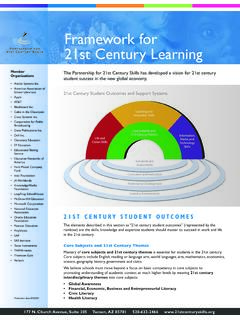
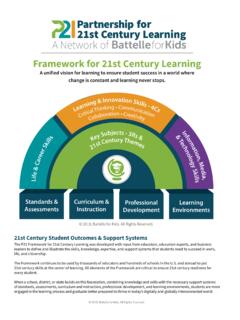
4 And so we call on states to look hard at currentstandards and ask,do these standards really represent what our future citizens should know and be able to do?While standards typically define essential academic content knowledge, they should also define the Skills thatcontribute to success in modern life, such as life Skills , learning and innovation Skills , and information, media andtechnology succeed in the 21st Century , all students require a solid foundation in core academic subject mastery. Inaddition, all students must gain the cognitive and social Skills that enable them to deal with the complexproblems of our age. The Partnership for 21st Century Skills Framework emphasizes learning and innovationskills, information, media and technology Skills and life and career Skills . as well as core subjects and 21stcentury succeed in the 21stcentury, all students willneed to 1) master coreacademic subjects, 2)perform to high standards,and 3) gain the cognitiveand social Skills thatenable them to deal withthe complex problems ofour for 21st Century Skills 1 7 7 N.
5 C hu rc h Ave nu e , S u i t e 3 0 5 Tu c s o n , A Z 8 5 7 0 1 ( 5 2 0 ) 6 2 3 - 2 4 6 6 Guiding Recommendations,Promising DirectionsThe following action steps can be taken to move states, districts and schools towards ensuring that our nation sstudents will be prepared for success in the 21st RecommendationsPromising Directions#1:Integrate 21st Century Skills into coreacademic subject subject areashould be treated differently, with an eye forthoughtful and authentic ways to incorporateskills like critical thinking, problem solving,communication, information literacy andtechnology literacy into the Partner Stateshave developed, or are in the process of developing, 21st Century Skills standards in core academic subjects. These statesinclude West Virginia, North Carolina, Wisconsin and New Jersey.#2:Integrate 21st Century themes into coresubject area standards,where awareness, financial literacy, health literacyand civic literacy are all requirements in the 21stcentury and should be intentionally integratedinto state standards wherever possible.
6 Iowahas integrated 21st Century Skills such as financial literacy,technology literacy, civic literacy and more into state standards and thecore curriculum. Wisconsin s Financial Literacy Standardsset forth the knowledge, Skills , and attitudes students need to understand and make informeddecisions for themselves and their families, laying the foundation forfinancially literate and responsible ASCD s Healthy School Communitieseffort serves as a community-building resource for schools and communities that work together tocreate healthy environments that support learning and teaching. It alsoprovides a space for networking and sharing of resources, ideas, andpractices that encourage the ongoing promotion of a coordinatedapproach to school health programming and policy within schoolcommunities. National Health Education Standards (NHES)published by theAmerican Cancer Society emphasizes skill acquisition as one of thefoundations for its work.
7 These standards focus on ensuring thatstudents understand concepts such as health promotion and diseaseprevention, and factors that influence health behaviors.#3:Make standards inch-wide and than presenting a long list of facts,standards should communicate the essentialunderstandings, or habits of mind, within eachsubject area. Typical state standards attempt tocover a content area so comprehensively, theessential concepts that produce deep mastery canbecome lost. The Common Core State Standards Initiativehas identified the needfor core academic standards to be fewer, clearer, and higher, to bestdrive effective policy and practice. AASL s Standardsfor the 21st Century Learner has put forth standardsthat help educators understand and integrate key 21st Century skillsacross the curriculum, requiring students to 1) inquire, think criticallyand gain knowledge; 2) draw conclusions, make informed decisions,apply knowledge to new situations and create new knowledge; 3) shareknowledge and participate ethically and productively as members ofsociety; and 4) pursue personal and aesthetic RecommendationsPromising Directions#4:Incorporate 21st Century technologyliteracy and tools where appropriate increasingly plays asignificant role in mastering subject area contentknowledge.
8 In the 21st Century , a student s abilityto conduct relevant science inquiry, mathematicalprocesses and multi-disciplinary projects relies ontechnology literacy. P21 Partner Stateshave integrated (or are in the process ofintegrating) technology literacy Skills into their standards; these includeWest Virginia, North Carolina, Massachusetts, New Jersey, Iowa andWisconsin. ISTE National EducationTechnology Standardsfor students,teachers and administrators are strongly aligned with 21st centuryskills. #5:Make standards observable be effective, standards thatintegrate 21st Century Skills must allow discretemeasurement of these Skills ; assessment systemsmust be aligned with any revised state standardsthat incorporate 21st Century Skills . P21 Partner States:Partner states that have been revising standards inways to ensure observable, measureable outcomes include West Virginia,North Carolina, Massachusetts, New Jersey, Iowa and Wisconsin.
9 American Diploma Project (Achieve):Achieve has long been a leaderin the push to ensure state standards are observable and #6:Make standards useful and the 21st Century standards are to be effective,they should reflect realistic practices of today sworld. To that end: Civic, corporate and other communityconstituencies should be involved indeveloping a framework for standards. States should create curriculum andinstruction guides and professionaldevelopment strategies fully aligned withthe standards. Attention should be given to the format anddelivery of the standard document itself. Suchdocuments should be readable, highlight thepresence and relevance of 21st Century Skills ,and ultimately, be presented via interactive,web-based formats. WestVirginia sTeach 21 Web site:Teach 21 is a comprehensive Webresource designed by teachers working collaboratively with the WestVirginia Department of Education.
10 The site assists colleagues inplanning and delivering effective 21st Century instruction in WestVirginia classrooms. The site links West Virginia Content Standards andObjectives for every grade and subject to sample lesson plans,formative assessments and a variety of teacher 21st Century Skills Maps:While they are not standards documents,the Partnership for 21st Century Skills has worked with the nationalcontent groups to create a series of awareness-raising tools thatillustrate the intersection between the core academic subjects and 21stcentury Skills . To date, maps have been published in social studies,English language arts, science and #7:Ensure standards are an integratedcomponent of curriculum,assessment andprofessional be successful, anyefforts around standards must flow through theentire education continuum and become fullyintegrated to every part of the teaching andlearning cycle.