Example: confidence
A Guide to Building Energy Rating for Homeowners
A Building Energy Rating or BER is an energy label with accompanying advisory report for homes. The rating is a simple A to G scale. A-rated homes are the most energy efficient and will tend to have the lowest energy bills. BER Cert Advisory Report A BER makes the energy performance of a home visible to prospective buyers
Tags:
Information
Domain:
Source:
Link to this page:
Documents from same domain

Domestic Energy Assessment Procedure (DEAP)
www.seai.iefor generating Building Energy Rating (BER) labels and BER Advisory Reports. This provision applies to new dwellings and dwellings for sale or rent. S.I.243 of 2012 details the Irish legislative requirements for BER, including scenarios where a Building Energy rating is required and scenarios where buildings are exempted.

Energy Audit Handbook - Home - Sustainable Energy ...
www.seai.ieAn energy audit is an inspection, survey and analysis of energy flows for identification 1. Undertaking an Energy Audit of energy savings opportunities in a building, process or system to reduce the amount of energy input into the system, without negatively affecting the output(s). SEAI: Energy Audit Handbook 6
Renewable Energy in Ireland - Sustainable Energy Authority ...
www.seai.ieRENEWABLE ENERGY IN IRELAND 2020 Report 3 2018 Highlights Progress towards targets • Overall renewable energy supply was 11% of gross final consumption. Ireland has a binding EU target of 16% by 2020. • Ireland is not on track to meet 2020 renewable

Dwelling Energy Assessment Procedure (DEAP)
www.seai.ieDEAP Manual Version 3.2.1 . Scope of the Dwelling Energy Assessment Procedure (DEAP) The procedure is applicable to self-contained dwellings. For dwellings in the form of flats, apartments,
Code of Practice Solar PV Grant - SEAI
www.seai.ie- Building Regulations TGD D – Materials and Workmanship. - SR 50-2 “Code of Practice for Building Services Part 2: Thermal Solar Systems” and Agrément Certificates for Solar Thermal and Solar PV systems . - Site specific design wind and snow loads – derived from Eurocode-1 (and Irish National Annex).
Progress, Ambition & Impacts - SEAI
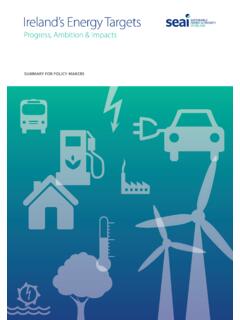
www.seai.ieSummary for Policy-makerS Irelands ’ Energy Targets Progress, Ambition & Impacts
Best Practice Guide Photovoltaics (PV)
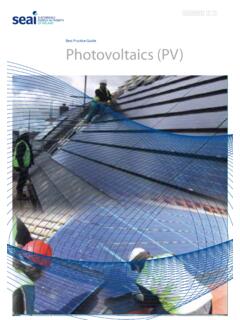
www.seai.iePV systems convert solar radiation into electricity. They are not to be confused with solar thermal panels which use the sun’s energy to heat water (or air) for water and space heating. This chapter looks at PVs and examines a number of issues of interest to designers including: • PV module size and shape. • Colour.

Energy in Ireland 2016 - SEAI
www.seai.ie1 Energy in Ireland 1990 – 2015 2016 Report Report prepared by Martin Howley and Mary Holland Energy Policy Statistical Support Unit November 2016
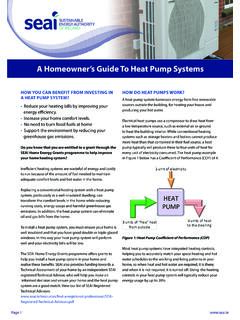
A Homeowner’s Guide To Heat Pump Systems - seai.ie
www.seai.iePage 2 www.seai.ie TYPES OF HEAT PUMP SYSTEMS Different types of heat pump systems draw heat from different sources: air, water or the ground.

A Homeowner’s Guide To Wall Insulation
www.seai.iefixing insulation to the inner surfaces of your external walls. This usually involves attaching an insulation board to the walls and covering it with a vapour barrier layer and plasterboard. While this is often a more affordable option of insulation, it should be noted that you will lose room space and will have to
Related documents

FLORIDA BUILDING CODE, ENERGY CONSERVATION …
www.floridabuilding.orgFORMS R-56 FLORIDA BUILDING CODE — ENERGY CONSERVATION, 6th EDITION (2017) TABLE R402A NR = No requirement. (1) Each component present in the As Proposed home must meet or exceed each of the applicable performance criteria in order to comply with this code using

High-Performance Building Envelopes: Design Methods for ...
www.brikbase.orgHigh-performance sustainable facades can be defined as exterior enclosures that use the least possible amount of energy to maintain a comfortable interior environment, which promotes the health and productivity of the building’s occupants (Aksamija, 2013). This means that

Energy Efficiency - Building Performance
www.building.govt.nz6 1 January 2017 MINISTRY OF BUSINESS, INNOVATION AND EMPLOYMENT ENERGY EFFICIENCY Clause H1 Provisions H1.3.2EBuildings must be constructed to ensure that their building performance index does not exceed 1.55. H1.3.3 Account must be taken of physical conditions likely to affect energy performance of

Vermont Residential Building Standards (RBES) Energy Code ...
publicservice.vermont.govThe Vermont Residential Building Energy Standards (“RBES”, the “Residential Energy Code” or simply the “Energy Code”) initially was passed by the Vermont legislature in May 1997. It is a minimum standard of energy efficiency that has applied to virtually all new residential
A Guide to Building Commissioning
www.pnnl.govprovide tremendous benefits such as reducing energy use, improving building opera-tion and occupant comfort, and increasing equipment life. These benefits can be achieved in several ways: • The process can return the building’s equipment to its original and intended operation. The need for this can be the result of years of accumulated deferred
Why Measure Carbon Dioxide Inside Buildings?
www.energy.wsu.eduBy Rich Prill, Washington State University Extension Energy Program Indoor air quality Workers and students spend about half their waking hours at work or school. Therefore, maintaining adequate indoor air quality (IAQ) in schools and the workplace is becoming a top priority for facility managers and building operating engineers. An essential