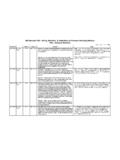
Transcription of API Std 53 - Blowout Prevention Equipment Systems …
1 StandardEditionSectionInquiry #QuestionReply534th Edition, Nov. 1: In reference to API Standard 53 requirement , are pressure-energized ring gaskets required for Surface BOP Choke Manifolds?Question 2: Is API 6A, 16A and 16C considering change to the design requirements based on the exclusion of non-pressure energized ring gaskets in API Standard 53 1: has been noted that there are requirements within the standard ( & ) that are not requirements within the Equipment design 2: This question falls outside the scope of S53 and does not meet the requirements for submitting a technical inquiry. You may consider submitting your question directly to each of the task groups for the documents you reference in the Edition, Nov. to Section , can a surface BOP stack arrangement with one annular, one blind shear ram, and two pipe rams, with the fifth device being optional, be considered a Class 5 stack arrangement?
2 No; a Class 5 surface BOP stack arrangement must contain five devices at a minimum. The stack must contain one annular, one blind shear ram, two pipe rams, and the fifth device can be an annular or pipe Edition, Nov. regards to API STD 53, I am seeking further clarification as to whether a by-pass line is required on a surface BOP choke and kill manifold. Section which refers to the general scope of a choke and kill does not mention a by-pass line. The sizing is mentioned in considerations and the by-pass lines are also indicated on the I interpret examples and considerations as not mandatory. Is this correct?Yes, the bleed line (line that by-passes the chokes) is Edition, Nov. this bleed line (that bypasses the chokes) a mandatory line to have on a surface choke and kill manifold???No, the bleed line (line that by-passes the chokes) is Edition, Nov.
3 You please advise if a by-pass line is require on surface choke and kill , the bleed line (line that by-passes the chokes) is Edition, Nov. nominal inside diameter (ID) for lines downstream of the chokes shall be equal to or greater than the nominal connection size of the choke inlet and outlet. Question 1: The way this is written; it is conceivable that you could have a 4-1/16 line entering the choke & kill manifold; reducing to 3-1/16 at choke bore inlet and then maintain 3-1/16 downstream of you concur? Question 2: Why is it API concern if an operator wants to have a 2-1/16 outlet after the buffer tank to go to strip tank, etc?Reply 1: YesReply 2: Unfortunately, the question you have asked is not in a format that is acceptable for developing a response. Specifically, API only addresses questions phrased in the form such that the answer is yes or no.
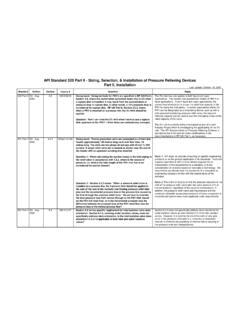
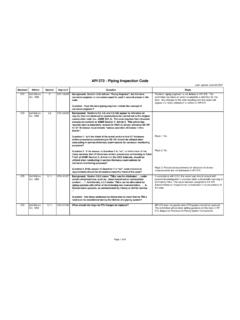
4 Please review the guidance for submitting questions to API at: Edition, Nov. para This paragraph states Minimum nominal inside diameter (ID) for lines downstream of the chokes shall be equal to or greater than the nominal connection size of the choke inlet and outlet. This paragraph does not state how far downstream the piping needs to comply with this. The lines downstream of the chokes utilized to flow well fluids during well control operations shall maintain the minimum nominal ID until it enters the next system (mud gas separator, overboard line, etc.).API Std 53 - Blowout Prevention Equipment Systems for Drilling WellsLast update: August 12, 2015 Last update: August 12, 2015 Last update: August 12, 2015 Last update: August 12, 2015 534th Edition, Nov. : A drilling contractor has a well control system with BOPs, choke and kill manifolds rated at 10,000 psi.
5 The Equipment is being used on a 5000 psi well head. The choke manifold has one remote operated drilling choke. Question 1: Referencing and , is it correct that the Equipment is technically de rated to 5000 psi for the wellhead? Question 2: Is only one remote operated choke is required? Reply 1: API 53 does not address de-rating. For the specific well mentioned in this question, the Equipment can only be tested to 5000 psi (see ).Reply 2: Yes534th Edition, Nov. to Section , can you please clarify further the meaning of the size range shown and your interpretation of nominal diameter?The intent is that the pipe ID be as close as practical to the ID of the Edition, Nov. : When a piece of Equipment is built to an API Equipment specification it complies with the specification at the time it was built. If it is repaired or remanufactured, it may be brought up to the latest edition of the Equipment specification if possible.
6 Therefore, in service Equipment on a rig may not comply with all of the requirements of the latest edition of the relevant Equipment 53, Section 2 (Normative References), states For undated references (no date included in the listing), the latest edition of the referenced document applies . Sections , , and state Control Systems for subsea BOP stacks shall be designed, manufactured, and installed in accordance with API 16D . API 53 also states in various sections that you shall meet API 16D, Method A, B, or C for precharge calculations, which is calling out a specific requirement of API : Do Sections , , and require in-service control Systems to always be 100% in compliance with the latest API 16D, or are these sections referring only to specific requirements of 16D like the precharge?The intent is that compliance with the normative references applies at the time the rig is built and/or the BOP system or components are installed.
7 This can also be affected by a contractual agreement or regulatory Edition, Nov. a) advises what the minimum nominal for choke lines by pressure rating only. For pressure rated Systems 10K and above, is a 3 in. nominal choke line required for 4-inch. and 7-inch. through-bore BOP Equipment ?No; 4-inch up to, but not including 7 1/16-inch. bore Equipment , is not addressed in API 53 or API Edition, Nov. states "The bleed line (if installed, the line that bypasses the chokes) shall " Section states "The bleed line (the line that bypasses the chokes) shall ". It does not contain the "if installed" language, but it is sub-headed under Other Considerations for Choke Lines. Is a bleed line to bypass the choke lines REQUIRED on choke manifold assemblies on surface BOP installations? No, the bleed line (line that by-passes the chokes) is optional (reference previous interpretations 53-05-15, 53-06-15 and 53-07-15).
8 This intepretation has been rendered invalid as a result of publication of API S53, 4th Edition, Addendum 1 in July 2016. Therefore this interpretation has been withdrawn as a result of these updated requirements. 534th Edition, Nov. API 53, Sections and saying that the pumps need to be checked on the initial test and the subsequent tests, only on the initial test, or only when the Equipment owner s PM program requires it?Yes; the intent of and is to conduct the test at pre-deployment, initial latch-up, and not-to-exceed six months. Any other testing is at the discretion of the Equipment owner or other applicable requirements that fall outside of API Edition, Nov. , there are some cases where we can't have a straight exit lines after buffer chamber at choke manifold because of the position or space to flare pits on the rig's location. Following the recommendations that we have for choke and kill bends, can we use that for the choke manifold exit lines before buffer chamber?
9 See for vent line Edition, Nov. drilling contractor has a new rig with a subsea MUX stack and subsea conventional stack (for weight on older wellheads). They have stated that the drape hose are below the moonpool and that the shielding is more for wave motion than fire rating. The moon pool conduit lines are hard , , , and are ambiguous with respect to the requirement of fire retardant hoses. It is our understanding that the requirement in takes precedence and hence the hoses should not be fire note in Std 53 indicates that the API requirement assumes that a fire in the moonpool would burn out the conduit hoses and hence trigger the deadman system if the electrical signals are also lost. For our deepwater semis however, it is not likely that the hoses are affected by a fire in the moonpool as the hoses are hanging below bottom box of the rig.
10 There is no requirement in the API of how short time the hose should sustain a fire, and hence the design will not be a proper form of weak link you clarify if a fire retarded hose for the conduit line and hot line will fulfil the requirements in Std 53?Keep in mind that API 16D is the specification for control Systems ; do not confuse the requirements of API 16D with those of API 16C (choke and kill Systems ). Additionally, Section applies only to surface BOP intent in API 53 is to provide a weak link between the control system and the BOP because the fire retardant properties would be counter to the intended purpose of the emergency system . Since there are many vessel designs in operation it is not practical to have a different option for each. Sections and require floating rigs to have an autoshear and deadman respectively, therefore should be interpreted as: Rigid conduit and hot line supply hoses between the control system and the BOP shall NOT be fire retardant.