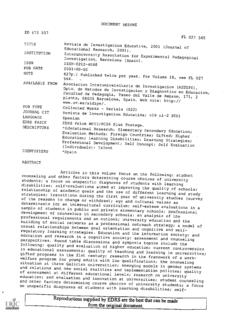
Transcription of The Effects of Social Networking Sites on Students ...
1 The Effects of Social Networking Sites on Students Studying and habits Tolga Gok Dokuz Eylul University, To cite this article: Gok, T. (2016). The Effects of Social Networking Sites on Students studying and habits . International Journal of Research in Education and Science (IJRES), 2(1), 85- 93. This article may be used for research, teaching, and private study purposes. Any substantial or systematic reproduction, redistribution, reselling, loan, sub-licensing, systematic supply, or distribution in any form to anyone is expressly forbidden. Authors alone are responsible for the contents of their articles.
2 The journal owns the copyright of the articles. The publisher shall not be liable for any loss, actions, claims, proceedings, demand, or costs or damages whatsoever or howsoever caused arising directly or indirectly in connection with or arising out of the use of the research material. International Journal of Research in Education and Science Volume 2, Issue 1, Winter 2016 ISSN: 2148-9955 The Effects of Social Networking Sites on Students Studying and habits Tolga Gok* Dokuz Eylul University Abstract Social media is important to communicate with people, share/ask information, and follow/evaluate/interpret the events, etc.
3 For everyone at the present time. The positive and negative Effects of Social Networking Sites on Students studying and habits were examined in this research. The study was conducted on 220 Students in vocational school of higher education. The data were collected with the help of a questionnaire designed for gathering the Students opinions about the digital technologies and Social media . The results revealed that the digital technologies and Social Networking Sites have negative impact on Students studying and habits . Some suggestions related to the findings were presented in the study.
4 Key words: Digital technologies; Higher education; Internet; Smartphone; Social Networking Sites Introduction Social Networking Sites (SNS) have become popular with the help of digital technologies (tablet, smartphone, notebook, etc.) and internet recently (Boyd &Ellison, 2007). Social media is a virtual platform. This platform helps people to make new connections, to improve friendly relations with other humans, and to exchange information (Coyle & Vaughn, 2008; Wang, Chen, & Liang, 2011). Many Social Networking Sites (Blogs, Facebook, Instagram, LinkedIn, Twitter, Youtube, etc.)
5 Are using at the present time. One of the most popular Sites is Facebook. The statistical data showed that there are more than 500 million people with Facebook membership and the majority of them are members of other Social Networking Sites besides approximately 250 million of these memberships visit Facebook site in each day at least one time (Boyd & Ellison, 2007). Social media has really become an integral part of people in daily lives (Boyd & Ellison, 2007; Hakoyama & Hakoyama, 2011). Raacke & Raacke-Bonds (2008), Williams & Merten (2009) and Raffterty (2009) indicated that people have a Social Networking Sites account based on difference reasons (making new friends, following famous people, sharing personal information, commenting the events, etc.)
6 These people addicted to SNS are called as heavy users . Many studies (Barnes & Laird, 2012; Carroll & Kirkpatrick, 2011; Gok, 2015; Nehls & Smith, 2014; O Keeffe & Pearson, 2011) were conducted to determine the positive and negative Effects of Social Networking Sites . Schill (2011) reported that Social media is the negative impacts (anxiety, behavioral changes, mental health problems, psychological effect , severe loss of personal productivity, stress, a sense of guilt and crisis, etc.) on adolescents. Bryant et al., (2006) indicated that many adolescents preferred technological communication in order to express their feelings and thoughts instead of using face to face communication.
7 Wang, et al. (2011) showed that children spent plenty of time on SNS instead of doing homework, studying the courses, and preparing examination. Many studies (Duncan, Hoekstra, & Wilcox, 2012; Kalpidou, Costin, & Morris, 2011; Ophir, Nass, & Wagner, 2009; Wang et al., 2011) reported that Students grades negatively affected using of SNS. Salas & Alexander (2008) revealed that SNS provided Students to discuss about class materials and to share academic issues. Other studies (Giles & Price, 2008; Junco, Merson, & Salter, 2010; Subrahmanyam & Lin, 2007; Valkenburg & Peter, 2009; Wei & Lo, 2006) reported that the usage of Social media and internet was changed to gender.
8 They demonstrated that male spent more time than female on computer games and female spent more time than male on chatting. The purpose of the research was to examine the positive and negative Effects of Social Networking Sites on female and male Students studying and habits . The research questions investigated were: a) Are there any differences between female and male Students Social Networking Sites usage? b) Are there any differences between female and male Students studying and habits ? * Corresponding Author: Tolga Gok, 86 Gok Method The present study was used survey methodology.
9 A questionnaire was designed for the research. The questionnaire consists of 14 questions (see Appendix A) and covers demographic information, digital technologies, Social Networking Sites , and habits of the female and male Students . The reliability and validity of the questionnaire were not analyzed in this research but the research instrument s reliability and validity will be conducted with the help of more data in the future study. The Students were given approximately five minutes to fill out the questionnaire. The research was performed on four departments (Industrial Glass and Ceramics, Geotechnic, Drilling Technology, Natural Building Stone Technology) in Torbali Technical Vocational school of Higher Education at Dokuz Eylul University, Turkey.
10 The study sample consisted of 220 volunteer Students (33% female and 67% male). The Students were between 18 and 20 years of age. The collected data were analyzed by IBM-SPSS Statistics 22. The frequency distributions, means and standard deviations of female and male Students values were calculated and independent-samples t-test was conducted to determine the statistical difference of means between male and female Students according to the statements. The difference between genders was considered significant with p values less than Results and Discussion The results obtained from the questionnaire were given as follows.