Transcription of An Analysis of Learning Styles and Learning Strategies ...
1 111 Journal of English Teaching, Volume 6 (2), June 2020 DOI: An Analysis of Learning Styles and Learning Strategies Used by a Successful Language Learner Urai Salam English Education Study Program of Teacher Training and Education Faculty Tanjungpura University, Pontianak Email: Sukarti American Corner of Tanjungpura University Zainal Arifin Teacher Training and Education Faculty, Tanjungpura University, Pontianak Abstract This study aimed to describe major Learning Styles and Learning Strategies used by a research subject from four years of a college student of English Education Study Program. It was a qualitative study and conducted through a case study design. The subject was a successful four years college student. The data was collected through questionnaires, interviews, and documents. Two questionnaires were administered, Perceptual Learning Style Preferences Questionnaire (PLSPQ) to determine the student Learning style preferences, whereas, Strategy Inventory for Language Learning (SILL) to determine the student Learning Strategies .
2 A semi-structured interview was applied to gain the primary data, while, the document was provided to support it. The results revealed that the successful language learner performed two major Learning Styles proposed by Reid (1984), visual, in which the subject learns best by reading and taking notes; and the individual, in which the subject learns better individually. Subsequently, the subject uses two major Learning Strategies proposed by Oxford (1990). The first Learning strategy is the cognitive strategy includes practicing along with receiving and sending messages. The second strategy is the compensation strategy includes guessing intelligently in listening and reading and overcoming limitations in speaking and writing. Keywords: Learning Styles , Learning Strategies , successful language learner. INTRODUCTION Listening, speaking, reading, and writing are the four main skills of English as an international language and they are integrated.
3 These skills must be studied by language learners because English is used as a lingua franca to convey information and knowledge e-ISSN: 2622-4224 | p-ISSN: 2087-9628 112 Journal of English Teaching, Volume 6 (2), June 2020 DOI: Salam, Sukarti, and Arifin DOI: in both written and spoken during the teaching and the Learning process by English lecturers in the English Education Study Program. Therefore, to carry out studies properly, language learners must master all English skills. The chosen Learning style is very important for language learners to master all English skills mentioned above. Brown (2000) cited in Gilakjani (2012, p. 105) defines Learning Styles as the manner in which individuals perceive and process information in Learning situations. He argues that Learning style preference is one aspect of Learning Styles , refers to the choice of one Learning situation or condition over another.
4 Students learn in different ways from each other. They often choose to use what has become known as a preferred Learning style. Therefore, every language learner should be aware of their Learning style preferences to create a good atmosphere in Learning English. Awareness of preferred Learning Styles is very important because it has impacts on language learners' achievement in acquiring English. Honey and Mumford in Pritchard (2009, p. 42) says that an inability or reluctance to adopt any particular style has the potential to hamper language learners' ability to learn effectively. For that reason, language learners must be familiar with the existence of Learning Styles within themselves that encourage them to learn effectively. In addition to Learning Styles , Learning Strategies are also important to be investigated by language learners. Learning Strategies are steps taken by learners to improve their Learning process.
5 According to Oxford in Shi (2017), Learning Strategies as the often steps of behaviors used by language learners to enhance the acquisition, storage, retention, recall, and use of new information (p. 24). As also mentioned by Oxford (1990), Strategies can make it easier, faster, more enjoyable, more self-directed, more effective, and more transferable to a new situation (p. 8). Because of that, being aware of Learning Strategies will help language learners to learn English better. The writers have built up information from four years of college students of English Education Study Program in the academic year of 2018/2019 and found that most of them were not conscious of their Learning style preferences as well as the best Learning Strategies used to learn English. They found English difficult, hence, they were yet satisfied with their English ability. This condition, in contrast, did not happen to a certain student who became the participant of this research.
6 This student was seen very skillful in English by most of her peers in the class. She actively gave some input when her peers faced difficulties in absorbing the knowledge from the lectures. Her outstanding idea during the class discussion was well delivered both spoken and written. She also answered all tasks given by the lecture effortlessly. For those reasons, this student was not surprised to have exceptional English language achievements, for example, she got for the average grade (GPA); 660 for the Test of English as a Foreign Language (TOEFL) and she won an academic competition in the English Language as a Foreign Language Test (TOEFL) in Pontianak, became one of the finalists of the 365 Network Telling Story in Jakarta, and became the winner of the 2018 Spelling Bee Competition in Pontianak. Therefore, this research aimed to investigate and find out the most frequently Learning Styles and the Learning Strategies used by a successful language learner in the language Learning process.
7 METHODS This study focused on analyzing a student's Learning style preferences and students' Learning Strategies in English. This study used a case study as the research design because this method helped the writers to dig deeper information about certain phenomena. This 113 Journal of English Teaching, Volume 6 (2), June 2020 DOI: Salam, Sukarti, and Arifin DOI: concept was approved by Yin in Woodside (2010, p. 1) "case study is an empirical inquiry that investigates a contemporary phenomenon within its real-life context, especially when the boundaries between phenomenon and context are not clearly evident". Moreover, a broader definition proposed by Woodside who defines "case study research is an inquiry that focuses on describing, understanding, predicting, and/or controlling the individual ( , process, animal, person, household, organization, group, industry, culture, or nationality).
8 " Meanwhile, Creswell (2012, p. 465) claims that "a case study is an in-depth exploration of a bounded system ( , activity, event, process, or individuals) based on extensive data collection." In short, a case study is an empirical study in deep exploration. Research Participant The participant is the basis of a case. It can be an individual or group of people. Therefore, purposive sampling was used to determine the participant. There were three requirements, first, grade point average (GPA) and/or above; second, Test of English as a Foreign Language (TOEFL) 600 and/or above; third, good English achievements. The population was 100 students, consisting of 27 male students and 73 female students taken from four years of English Education Study Program. Finally, the participant was a successful language learner whose well competence in English from four years college student in academic year 2018/2019 of English Education Study Program, Teacher Training and Education Faculty of Tanjungpura University.
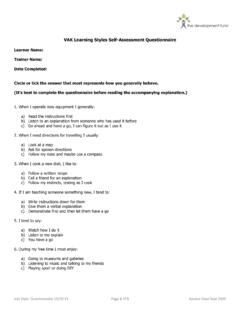
9 Data Collection A questionnaire, interview, and document were utilized as the instruments of data collection. First, the writers administered Perceptual Learning Style Preference Questionnaire (LSPQ), a questionnaire developed by Reid in 1984 particularly for foreign language learners to the successful language learner to gain fundamental data especially her Learning style preference. This questionnaire consists of thirty items that represent six Learning style preferences, namely Visual, Auditory, Kinesthetic, Tactile, Group, and Individual. Five items for each Learning style category were arranged randomly. Items 6,10,12,24,29 are Visual, items 1,7,9,17,20 are Auditory, items 2,8,15,19,26 are Kinesthetic, items 11,14,16,22,25 are Tactile, items 3,4,5,21,23 are Group, and items 13,18,27,28,30 are individual. Second, the writers handed the Strategy Inventory for Language Learning (SILL), developed by Oxford (1989), a questionnaire designed to find out language learner's Learning Strategies .
10 Strategy Inventory for Language Learning consists of fifty items and represents two categories of Learning Strategies both Direct and Indirect Strategies . Direct Strategies include Memory Strategies , Cognitive Strategies , and Compensation Strategies , otherwise, indirect Strategies include Metacognitive Strategies , Affective Strategies , and Social Strategies . Every Learning strategy has a different number of items. Memory Strategies represented by items 1-9, Cognitive Strategies represented by items 10-23, Compensation Strategies represented by items 24-29, Metacognitive Strategies represented by items 30-38, Affective Strategies represented by items 39-44, and Social Strategies represented by items 45-50. Finally, the writers interviewed to enrich the data and to cover major areas of interest that were not covered yet by the questionnaires, such as biographical data, general opinion about language Learning , as well as Strategies used to learn reading, writing, listening and speaking.