Transcription of 10.1 Integer Programming and LP relaxation
1 CS787: Advanced AlgorithmsLecture 10: lp relaxation and RoundingIn this lecture we will design approximation algorithms using linear Programming . The key insightbehind this approach is that the closely related Integer Programming problem is NP-hard (a proofis left to the reader). We can therefore reduce any NP-complete optimization problem to an integerprogram, relax it to a linear program by removing the integrality constraints, solve the linearprogram, and then round the LP solution to a solution to the original problem. We first describethe Integer Programming problem in more Integer Programming and LP relaxationDefinition Integer program is a linear program in which all variables must be in a linear program, the constraints in an Integer program form a polytope.
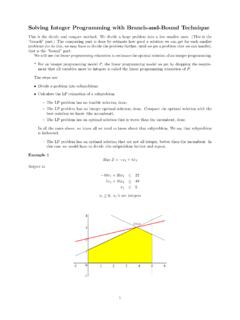
2 However, thefeasible set is given by the set of all Integer -valued points within the polytope, and not the entirepolytope. Therefore, the feasible region is not a convex set. Moreover, the optimal solution maynot be achieved at an extreme point of the polytope; it is found at an extreme point of the convexhull of all feasible integral points. (See Figure )Figure : The feasible region of an Integer linear , in designing LP-based approximation algorithms we follow the following approach:1. Reduce the problem to an Integer Relax the integrality constraint, that is, allow variables to take on non-integral Solve the resulting linear program to obtain a fractional optimal Round the fractional solution to obtain an integral feasible that the optimal solution to the LP is not necessarily integral.
3 However, since the feasibleregion of the LP is larger than the feasible region of the IP, the optimal value of the former is noworse than the optimal value of the latter. This implies that the optimal value to the LP is a lowerbound on OPT, the optimal value for the problem we started out with. While the rounded solutionis not necessarily optimal for the original problem, since we start out with the optimal LP solution,we aim to show that the rounded solution is not too far from relationships between the different values are illustrated in Figure below.
4 The gapbetween the optimal LP value and the optimal integral solution is called the integrality gap of thelinear : The relationship between the optimal LP and ILP values for minimization now apply the linear Programming approach to two problems: vertex cover and facility Vertex Cover revisitedWe have already seen a factor of 2 approximation using maximum matchings for the lower we will see another factor of 2 approximation based on Linear Programming . This time weconsider a weighted version of the problem. Recall that we are given a graphG= (V,E) withweightsw:V <+, and our goal is to find the minimum weight subset of vertices such that everyedge is incident on some vertex in that first reduce this problem to an Integer program.
5 We have one{0,1}variable for each vertexdenoting whether or not this vertex is picked in the vertex cover. Call this variablexvfor vertexv. Then we get the following Integer program. The first constraint essentially states that for each2edge we must pick at least one of its v Vwvxvsubject toxu+xv 1 (u,v) Exv {0,1} v VTo obtain a linear program, we relax the last constraint to the following:xv [0,1] v VNext we use a standard LP solver to find the optimal solution to this LP. Letx vdenote this optimalfractional solution. By our previous argument, the following holds:Proposition (x ) OPT, where OPT is the value of the optimal solution to the vertexcover example below illustrates that the optimal solution to the LP is not necessarily : An example where the vertex cover LP has an integrality gap of 4/3.
6 The optimalfractional solution setsxv= 1/2 for all vertices, with a total cost of 3/2, while the optimal integralsolution has cost remains to round the fractional solution. For vertex cover, the obvious rounding works: for eachx v 1/2, setxv= 1 and includevin the vertex cover. For eachx v<1/2, setxv= 0 and don tincludevin the vertex is easy to see that this is a feasible solution and forms a vertex cover. Consider any edge(u,v) E. Then, by construction,x u+x v 1. Therefore, at least one ofx uandx vis at least 1/2,and is picked in the vertex cover.
7 It remains to prove that the solution we obtain has small v Vxvwv 2 v Vx vwvProof:Recall that we setxvto be 1 if and only ifx v 1/2, and 0 otherwise. The lemma thenfollows by noting thatxv 2x vfor , the weight of our vertex cover is exactly v Vxvwvbecause by definitionxv= 1 if andonly ifvis included in our vertex cover, and 0 otherwise. We therefore have the following above algorithm is a2-approximation to weighted vertex Facility locationThe story behind the facility location problem is that a company wants to locate a number ofwarehouses such that the cost of opening these warehouses plus the cost of shipping its product toits retail stores is minimized.
8 Formally, the facility location problem gives a collection of facilitiesand a collection of customers, and asks which facilities we should open to minimize the total accept a facility cost offiif we decide to open facilityi, and we accept a routing cost ofc(i,j)if we decide to route customerjto facilityi. Furthermore, the routing costs form a metric, thatis, they are distance functions satisfying the triangle , we reduce this problem to an Integer program. We let the variablexidenote whether facilityiis open, and letyijdenote whether customerjis assigned to facilityi.
9 The following programthen expresses the problem. The first constraint says that each customer should be assigned to atleast one facility. The second says that is a customer is assigned to a facility, then that facilitymust be ifixi+ i,jc(i,j)yijsubject to iyij 1 jxi yij i,jxi,yij {0,1} i,jTo obtain a linear program, we relax the last constraint toxi,yij [0,1].For convenience, letCf(x) denote the total factory cost induced byx, , ifixi. Similarly, letCr(y) denote the total routing cost induced byy, i,jc(i,j) ,y be the optimal solution to this linear program.
10 Since every feasible solution to the originalILP lies in the feasible region of this LP, the costC(x ,y ) is less than or equal to the optimalsolution to the ILP. Sincex andy are almost certainly non-integral, we need a way to round thissolution to a feasible, integral solution without increasing the cost function that theyijvariables for a singlejform a probability distribution over the facilities. TheLP pays the expected routing cost over these facilities. If we could pick the closest facility over allthose thatjis connected to, our routing cost would be no more than in the LP solution.










![[SAVOR the RECIPE of RELAXATION ]](/cache/preview/2/4/2/d/3/5/7/8/thumb-242d35787d17da00c6f3be15bf78c263.jpg)